

TL;DR
- Web3 internships in the US typically pay $18 to $38 per hour, while engineering interns at top exchanges report $50 to $70 per hour
- Technical interns at established companies can earn $5,000 to $8,000 per month
- Apply between October and January for summer programs
- No degree required at most crypto startups. A portfolio beats a resume
- Conversion to full time is common at top companies
Landing a web3 internship comes down to four things: pick a track (technical or non-technical), build one or two public projects that prove you can ship, apply early to structured programs at exchanges and protocols and stay active in the communities where teams actually hire. Most roles are remote, most are paid and unpaid ones are a red flag in a venture-funded industry.
This guide breaks down what these roles pay, which skills matter for each track and where to find openings that are actually hiring. You can browse web3 jobs on CoinTerminal right now to see what companies are asking for, then use this article to close the gap.
One thing worth saying upfront: web3 hiring is less credential-driven than traditional tech. Companies care whether you understand the space and can show work. That is good news if you are a student or a career changer without a blockchain line on your resume yet.
What Do Web3 Internships Actually Involve?
Web3 internships are short-term paid roles, usually 12 to 16 weeks, at crypto exchanges, protocols, wallets, infrastructure companies and web3 startups. Summer programs at larger firms like Coinbase, Gemini and Kraken run like traditional tech internships, with structured projects and a mentor.
At smaller startups and DAOs, internships are looser. You might join for a season, own a real deliverable and work fully remote across time zones. The tradeoff is less structure but more responsibility, which often looks better on a resume.
Roles split into two broad tracks:
- Technical: smart contract development, frontend or fullstack engineering, security research, data engineering
- Non-technical: community management, content and social, marketing, business development, research, operations, design
You do not need to code to get in. Non-technical interns just need to prove they genuinely use the products, not just read about them.
How Much Do Web3 Internships Pay?
It varies a lot by company size, role and location, but here are realistic ranges based on current job board data:
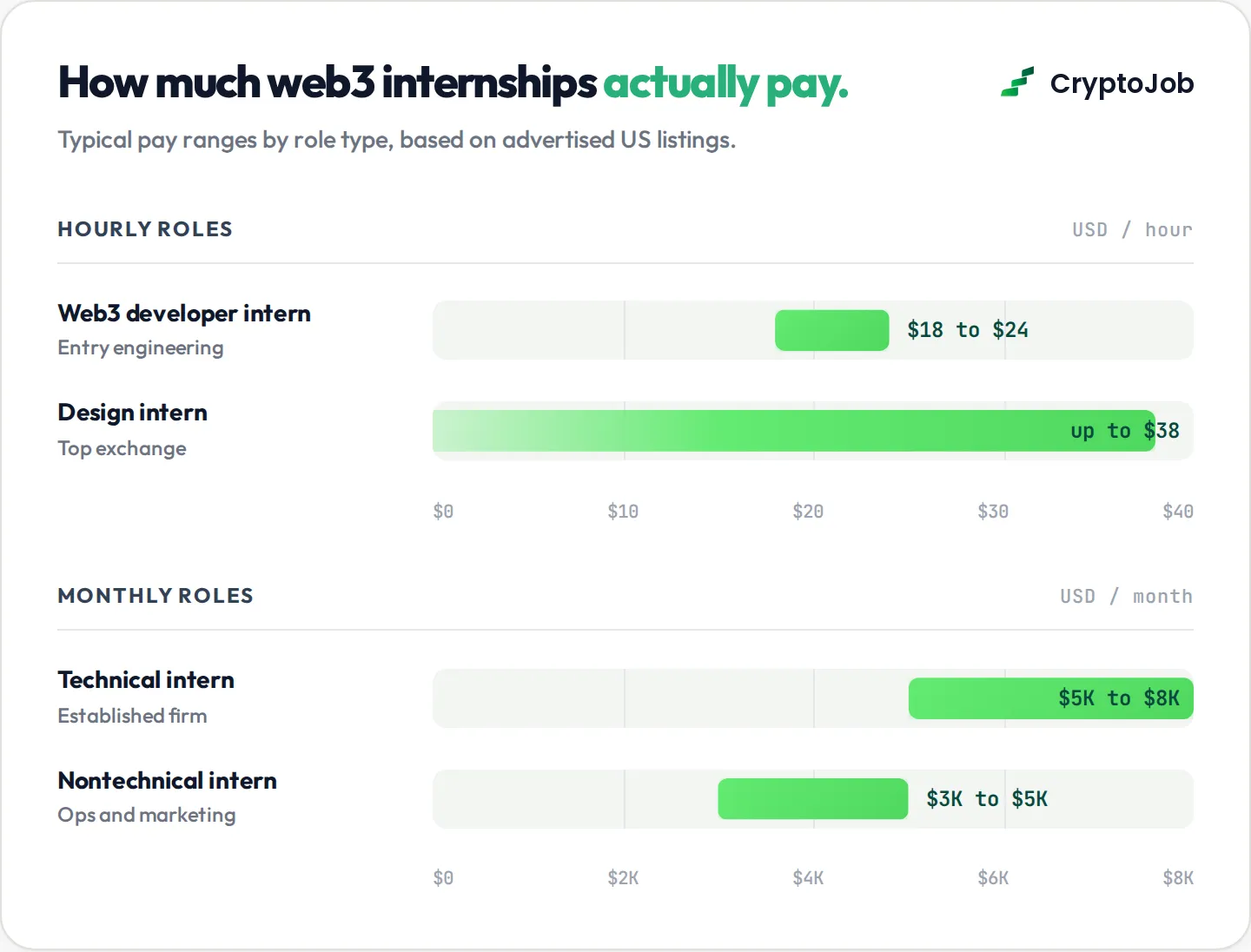
- The average hourly pay for a web3 developer internship in the US is around $23 per hour, with most falling between $18 and $24 according to ZipRecruiter data
- Gemini pays product design interns $38 per hour in New York, California and Washington
- Technical internships at established companies can pay $5,000 to $8,000 per month, while non-technical internships tend to range from $3,000 to $5,000 per month
- Some internships add token grants, equipment budgets or housing stipends on top
Two caveats. First, startup internships often pay below these ranges, sometimes in stablecoins or a mix of fiat and tokens. Second, global remote roles may pay less than US rates, though many crypto companies use location-independent pay bands.
The one hard rule: avoid unpaid internships. In an industry with strong venture funding, a company that claims it cannot pay interns is a red flag.
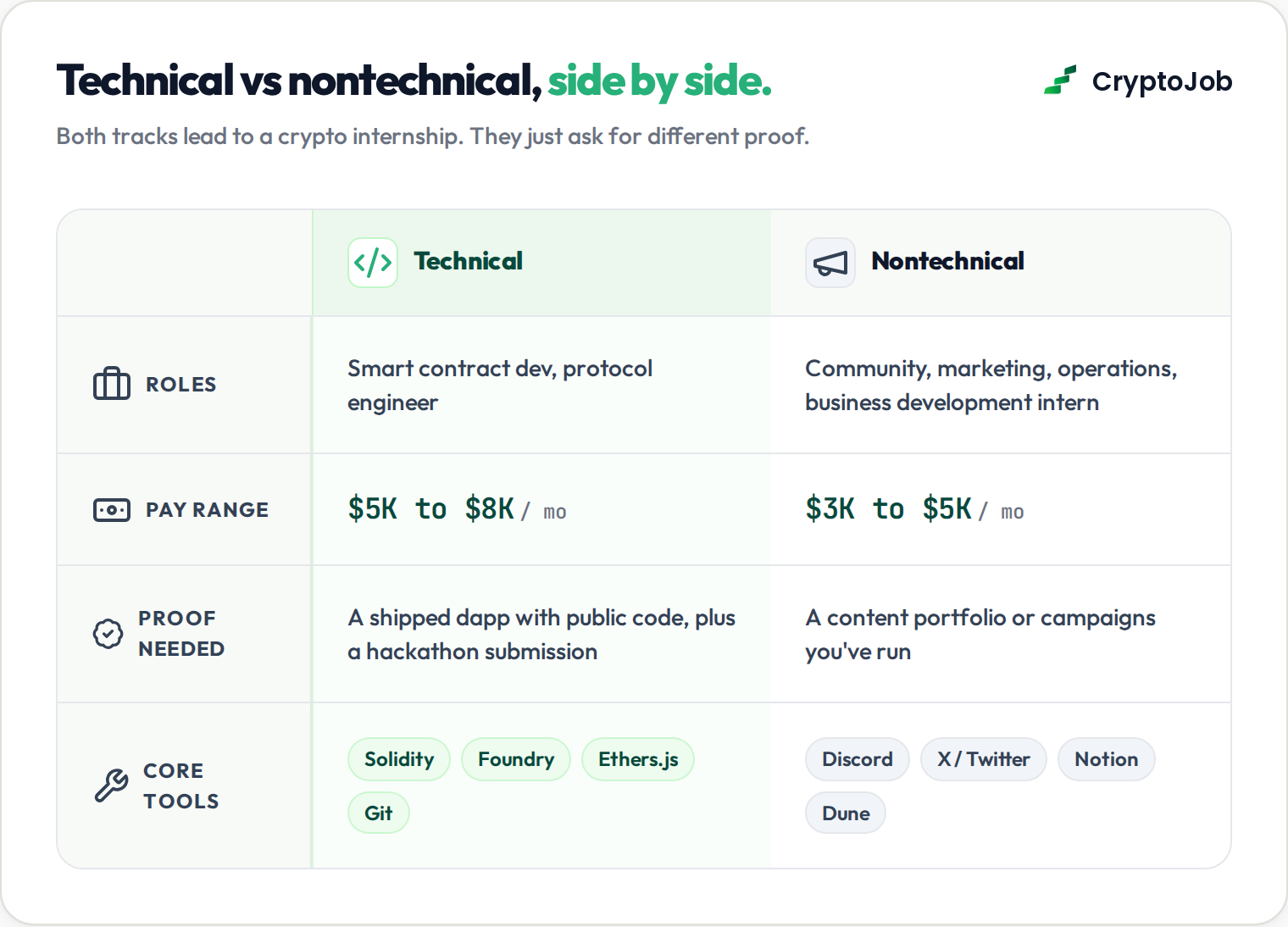
Technical vs Non-Technical Internships Compared
|
|
Technical |
Non-technical |
|
Typical roles |
Smart contract dev, frontend, security, data |
Community, content, marketing, research, design |
|
Typical US pay |
$20 to $38/hr, or $5K to $8K/mo at big firms |
$15 to $25/hr, or $3K to $5K/mo at big firms |
|
Must-have proof |
GitHub with deployed projects |
Published writing, active community presence |
|
Core tools |
Solidity, JavaScript or Rust, Hardhat/Foundry |
Discord, X, Notion, analytics dashboards |
|
Competition |
High for big names, lower at startups |
Lower barrier, but genuine crypto usage expected |
What Skills Do You Need for a Blockchain Internship?
For a technical blockchain internship, hiring managers look for fundamentals plus proof you have touched a chain. In rough priority order:
- One general-purpose language. JavaScript or Python is fine. Rust helps for Solana-adjacent roles.
- Solidity basics. You do not need to be an auditor. You need to have written, tested and deployed a contract to a testnet.
- Tooling. Hardhat or Foundry, ethers.js or viem and comfort with Git.
- Ecosystem literacy. Know what an L2 is, how a DEX works and why gas exists.
Free resources cover all of this. CryptoZombies and Alchemy University teach Solidity, Speedrun Ethereum walks you through building real dapps and hackathons on ETHGlobal give you a deadline and a portfolio piece in one weekend.
For non-technical roles, the skill is demonstrated participation. Use DeFi protocols with small amounts, write threads or blog posts explaining what you learn, join two or three project Discords and contribute visibly. A candidate who has voted in a governance proposal beats one who lists "passionate about blockchain" on a resume.
Do You Need a Degree?
At large exchanges running formal summer programs, usually yes, because those programs recruit from universities. At startups, protocols and DAOs, almost never. Skill and portfolio weigh more heavily than credentials across most of the industry.
Where Do You Find Web3 Internships?
Structured programs and open startup roles live in different places, so cover both:
Job boards. Start with dedicated crypto boards. Browse web3 jobs on CoinTerminal and filter for internships and entry-level roles. LinkedIn and company career pages catch the big exchange programs.
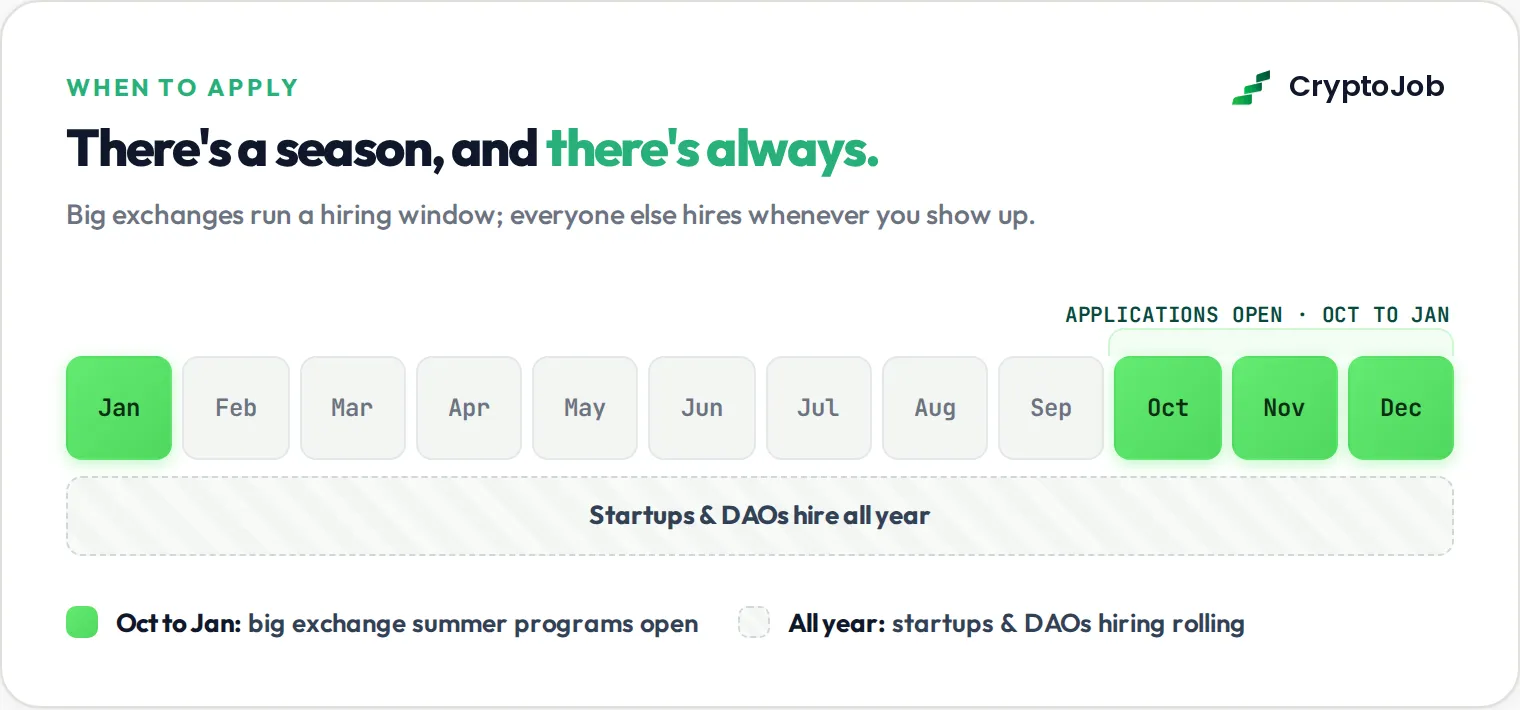
Direct applications. Coinbase, Kraken, Gemini, Consensys, Chainlink Labs and a16z crypto have all run internship or fellowship programs in recent years. Check their careers pages directly in the fall, since summer cohorts often open applications between October and January and fill early.
Hackathons. ETHGlobal, ETHDenver and chain-specific hackathons are hiring pipelines in disguise. Sponsors scout winners and even non-winners with clean projects.
Communities. Many startup internships never hit a job board. They get posted in a Discord announcements channel or filled by someone already active in the community. Pick two or three projects you actually like and become useful there.
Cold outreach. Small teams respond to specific, low-effort-to-accept offers. "I built X on your protocol, here is the repo, I would love to intern this summer" works far better than a generic application.
How Do You Get a Crypto Internship Without Experience?
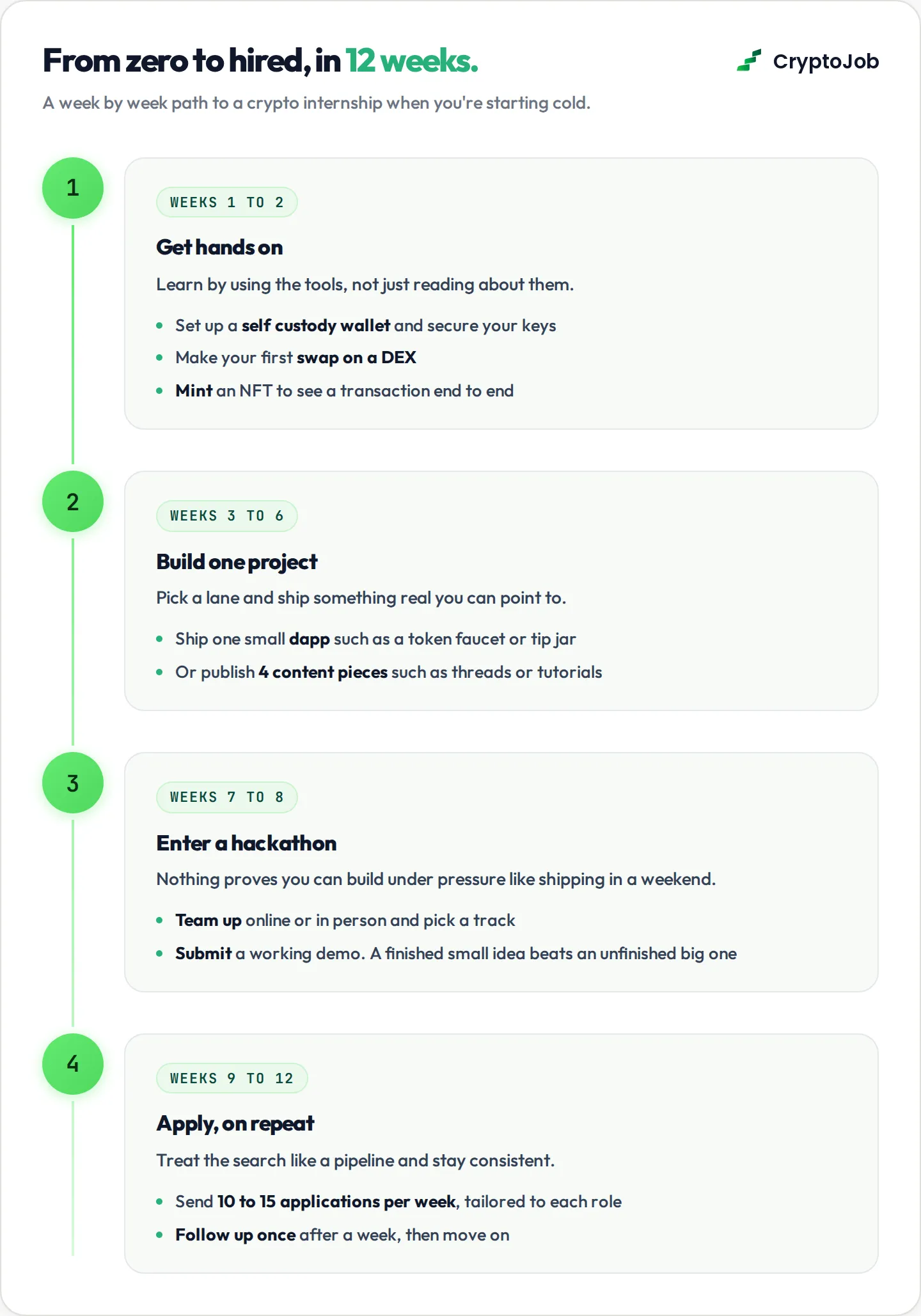
This is the most common situation, so here is a concrete 8 to 12 week plan for landing a crypto internship from zero:
Weeks 1 to 2: Get hands-on. Set up a wallet, bridge a small amount to an L2, swap on a DEX, mint something. You cannot fake this knowledge in an interview.
Weeks 3 to 6: Build one thing. Technical: complete Speedrun Ethereum or ship a small dapp and put it on GitHub with a readme that explains your decisions. Non-technical: publish four pieces of content, like protocol breakdowns, governance summaries or a newsletter.
Weeks 7 to 8: Enter one hackathon. Even a rough submission gives you a deployed project, teammates and something concrete to talk about.
Weeks 9 to 12: Apply in volume, tailor lightly. Aim for 10 to 15 applications a week across boards, direct programs and Discord postings. Reference something specific about each company. Follow up once after a week.
Career changers have an extra lever: your existing skill plus crypto context is more valuable than either alone. A marketer who understands token incentives or an accountant who understands on-chain data is rare and hireable.
How Do You Turn an Internship Into a Full-Time Offer?
Conversion rates at top web3 companies are strong, and some industry job boards report them as comparable to or better than Big Tech. Whatever the exact number at your company, the playbook is consistent:
Ship something the team keeps using. A merged feature, a dashboard, a content series with real numbers behind it. A finished deliverable is the single strongest conversion signal.
Be visible in a remote-first culture. Post updates without being asked, ask questions in public channels rather than DMs and demo your work at team calls.
Ask early. Around the midpoint, tell your manager you want to convert and ask what a yes would require. That turns the last weeks into a targeted audition instead of a hopeful wait.
And if conversion does not happen, the internship still did its job. You now have paid web3 experience, references and a network, which puts you ahead of most entry-level applicants.
FAQ
Are web3 internships paid?
Legitimate ones are. Expect roughly $18 to $38 per hour in the US depending on role and company and $3,000 to $8,000 per month at established firms. Treat unpaid internships as a warning sign, since most serious crypto companies are venture funded and can pay.
Can I get a web3 internship without knowing how to code?
Yes. Community management, content, marketing, research, design and operations internships are all common. You will need to show genuine ecosystem knowledge, like using DeFi protocols yourself and following governance in projects you care about.
When should I apply for web3 internships?
For structured summer programs at large exchanges, applications typically open between October and January. Startup and DAO internships are posted year-round, so check job boards and project Discords continuously.
Are web3 internships remote?
Mostly, yes. The industry is remote-first, though some large companies like Gemini run hybrid programs that require a few days a week in office. Startups and DAOs are usually fully remote and hire globally.
Do web3 internships lead to full-time jobs?
Often. Conversion at top companies is reported to be comparable to or better than traditional tech, and the exact rate varies by company and market conditions. Shipping a real deliverable during the internship is the biggest factor you control.
Ready to Start Applying?
The formula is simple even if the work is not: pick a track, build public proof, apply early and often and show up in the communities where hiring actually happens. The industry rewards people who ship, and internships are the fastest legitimate on-ramp.
New internships and entry-level roles get posted daily. Browse web3 jobs on CoinTerminal and start with three applications today.