

TL;DR
- Web3 sales jobs typically pay $60k to $200k+ base, depending on level
- Mid-level BD managers average around $110k base in the US
- Commission and token grants can add 30 to 100% on top of base
- No crypto experience needed. Sales skills transfer, industry knowledge can be learned
- Most roles are remote and hired through Twitter/X, Telegram and job boards
If you can sell, web3 will pay you well for it. Web3 sales jobs currently advertise base salaries from roughly $60k for entry-level roles up to $200k or more for senior business development leads, with commission and token allocations often stacked on top. The catch is that hiring works differently here. Deals happen on Twitter and Telegram, comp packages include tokens and the best candidates prove they understand the space before they apply.
This guide breaks down what these roles actually pay, what the work involves and a realistic path in, even if your background is pure web2 SaaS. If you want to skip ahead and see what's open right now, you can browse web3 jobs on CoinTerminal.
What do web3 sales jobs actually pay?
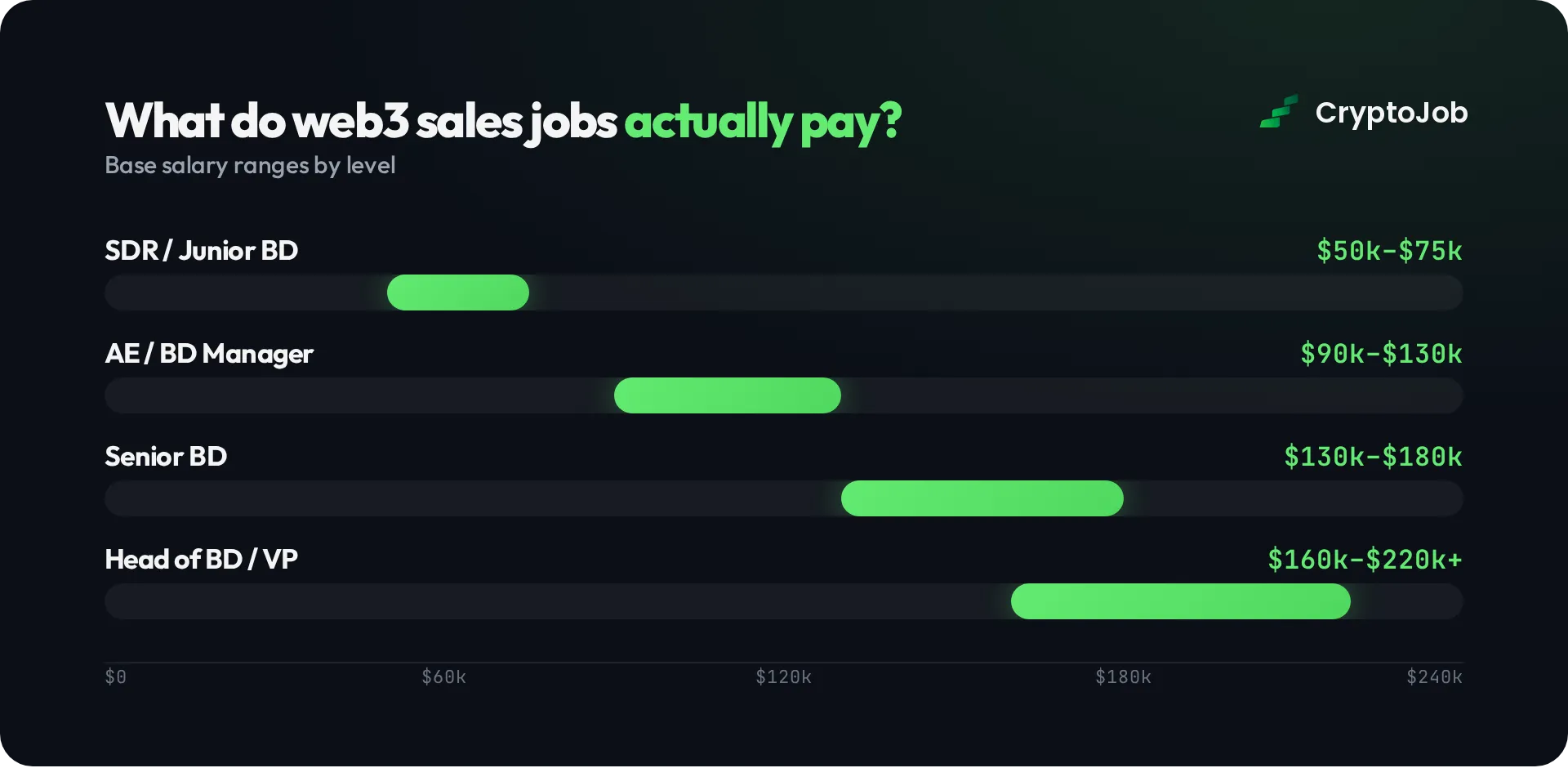
Short answer: more than equivalent web2 roles at the same level, but with wider variance and more of your comp tied to performance and tokens.
Published listings on major crypto job boards in 2026 show sales and BD roles advertised anywhere from around $54k for junior positions to $275k for senior business development leadership. Web3 Business Development Managers average around $110k base, with typical ranges of $90k to $129k. Sales-focused roles on aggregator boards commonly advertise $100k to $240k total.
Here is how it roughly breaks down by level. These are US-skewed base figures and they vary a lot by company size, funding stage and region.
|
Level |
Typical base (USD) |
With commission + tokens (OTE) |
|
SDR / Junior BD |
$50k to $75k |
$65k to $100k |
|
Account Executive / BD Manager |
$90k to $130k |
$120k to $190k |
|
Senior BD / Partnerships Lead |
$130k to $180k |
$170k to $260k |
|
Head of BD / VP Sales |
$160k to $220k+ |
$250k to $400k+ |
Three things skew these numbers. Well-funded exchanges and infrastructure companies (think Coinbase, Kraken, Chainalysis, Fireblocks) pay at the top of these bands. Early-stage protocols pay lower base but heavier token allocations. And remote-global roles often pay the same regardless of where you live, which makes web3 unusually attractive outside the US.
How does token compensation work?
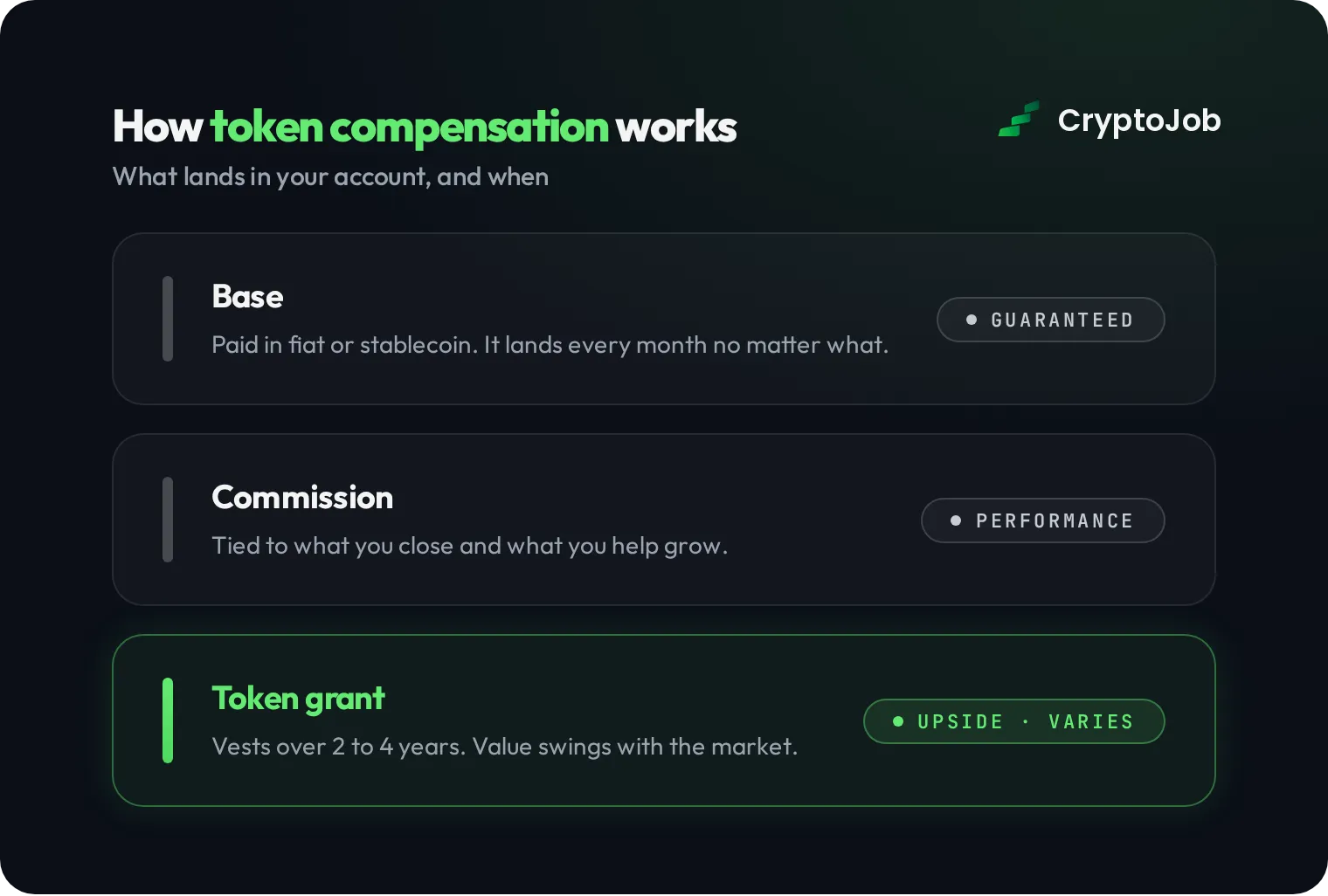
Most offers combine a fiat or stablecoin base salary with a token grant vesting over 2 to 4 years. A $100k token grant sounds great, but its real value depends on the token's liquidity and where the market is when you can actually sell.
Treat tokens as upside, not salary. Negotiate a base you can live on and consider anything token-related a bonus that might be worth zero or might be worth 5x.
What is blockchain business development and how is it different from sales?
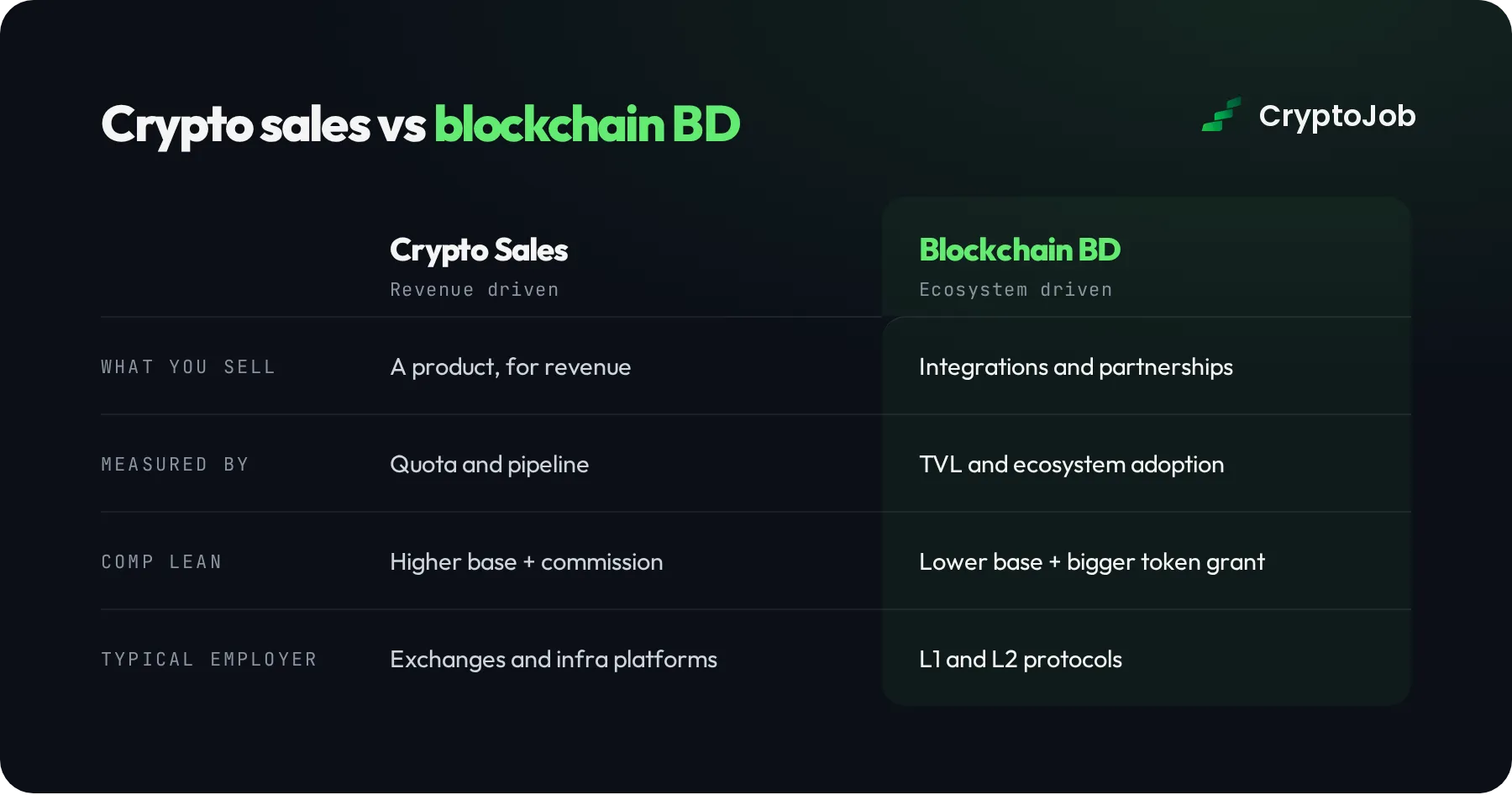
In web2, sales and BD are usually separate functions. In web3 they blur, and blockchain business development is often the umbrella term for both.
A crypto sales role usually means selling a concrete product for money. Think exchange listings, custody solutions, analytics subscriptions, node infrastructure or compliance tooling. You have quotas, a pipeline and commission. It looks a lot like SaaS sales with a different vocabulary.
Blockchain business development is broader. BD people at protocols and L1/L2 ecosystems spend their time on integrations, ecosystem partnerships, getting projects to build on their chain and structuring deals that often involve no direct payment at all. Success is measured in TVL, integrations shipped or developer adoption rather than closed revenue.
Which one pays better? Pure sales roles at revenue-generating companies (exchanges, infra, data providers) tend to have higher and more predictable OTE. Protocol BD roles tend to have lower quotas but bigger token upside. Neither is wrong, they just reward different risk appetites.
What skills do crypto sales jobs actually require?
The good news: the core skill is still selling. Prospecting, discovery, objection handling and closing all transfer directly. Recruiters in this space consistently say a proven sales track record beats crypto nativeness on paper.
But you do need genuine industry fluency, because your buyers are crypto-native and they will sniff out a tourist in the first five minutes. Concretely, that means:
Technical literacy, not technical depth. You should be able to explain the difference between an L1 and an L2, what an exchange listing involves, how staking works and why someone would use a custodian. You do not need to write Solidity.
A live Twitter/X and Telegram presence. This is where the industry actually operates. Many BD deals start as a DM. An empty Twitter account is a red flag to hiring managers because it suggests you are not in the conversation.
Comfort with ambiguity. Quotas change, narratives rotate every few months and your product might pivot mid-quarter. People coming from rigid enterprise sales orgs sometimes struggle with this.
Network as an asset. Senior BD hires are often bought for their rolodex. At junior levels nobody expects one, but you should be actively building it.
How do you break into web3 sales jobs with no crypto experience?
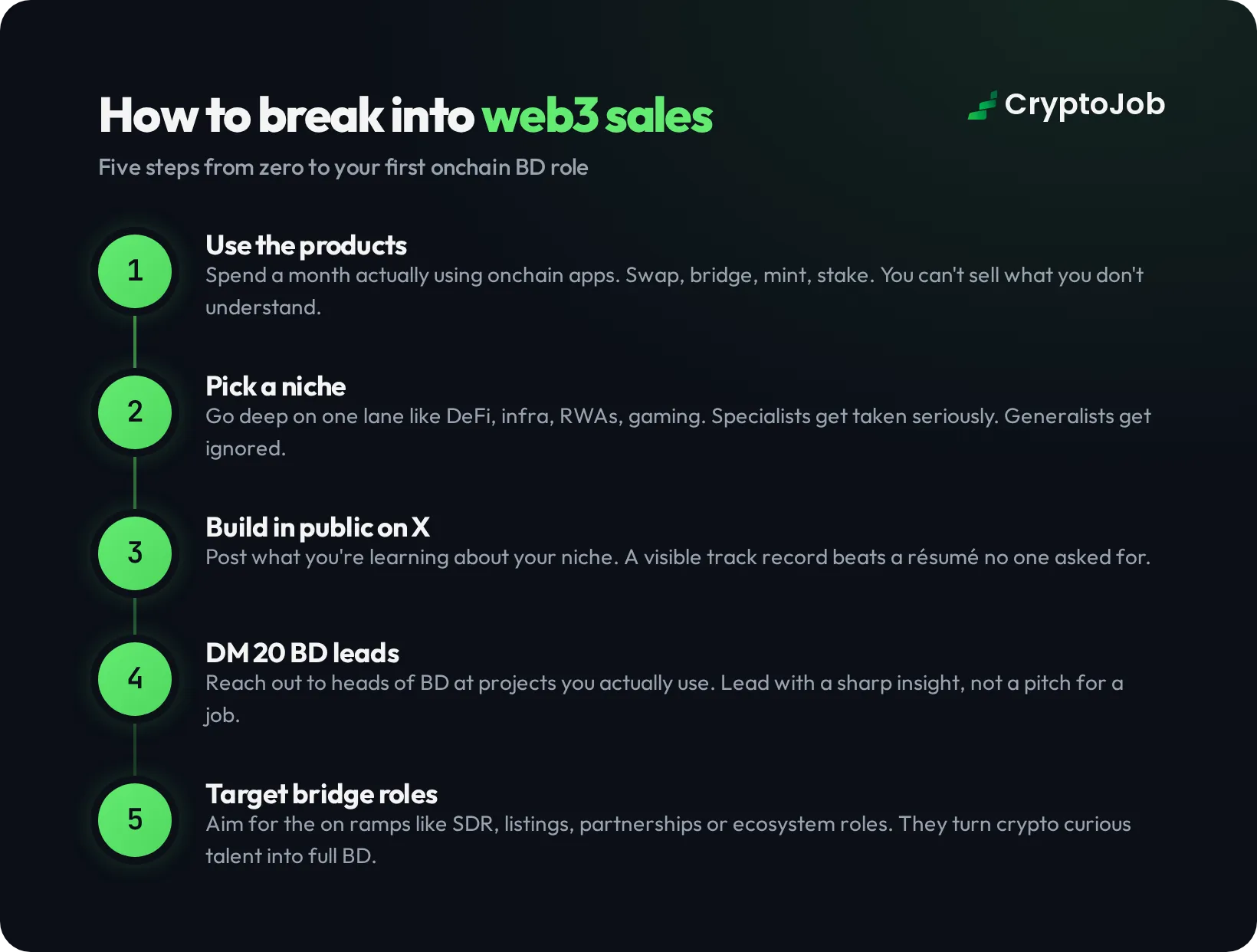
This is the most common situation and it is very doable. Here is a realistic 90-day path that hiring managers respond to.
1. Use the products for a month. Set up a wallet, use a DEX, bridge funds, stake something small, try an on-chain analytics tool. You cannot sell what you have never touched, and interviewers ask about this directly.
2. Pick a niche. "Web3" is too broad. Choose exchanges, DeFi infrastructure, security/compliance, gaming or RWAs. Learn the top 10 companies, what they sell and who buys it. Niche fluency beats shallow breadth in interviews.
3. Build in public on Twitter/X. Post takes on your niche, comment on funding announcements, share what you are learning. Two months of consistent activity gives you a visible footprint and often inbound conversations.
4. Do outreach like it is already your job. DM BD leads at companies you admire. Ask smart questions, not for jobs. A percentage of these conversations turn into referrals, and referrals are how most web3 roles are actually filled.
5. Target bridge roles. SDR roles at crypto infrastructure companies, exchange listing teams and partnerships roles at web2 companies entering crypto are the easiest entry points. They value your web2 sales record and train the crypto side.
One honest caveat: hiring in this industry is cyclical. In bull markets teams overhire and standards drop. In bear markets sales roles get cut first. Time your search accordingly and keep a pipeline of applications, not a single bet.
Where do you find web3 sales jobs?
Job boards are the starting point, not the whole strategy. The main dedicated boards (CoinTerminal, web3.career, CryptoJobsList, Cryptocurrency Jobs) list thousands of open sales and BD roles at any given time, most of them remote.
Beyond boards, three channels consistently produce offers:
Twitter/X. Founders and heads of BD post openings directly, often before they hit any board. Following 50 active companies in your niche functions as a live job feed.
Telegram groups and Discord servers. Ecosystem-specific groups (Solana BD, Base builders, etc.) regularly share roles that never get posted publicly.
Conferences. Token2049, EthCC, Consensus and regional events are where BD people hire other BD people. One conference with intentional networking often outperforms 100 cold applications.
Set alerts, but spend most of your energy on the human channels. This industry hires through relationships more than resumes.
Ready to start looking?
Web3 sales and BD is one of the few paths into crypto where a non-technical background is a feature, not a bug. Pay is strong, the work is remote-first and the skills you already have transfer. The only real entry fee is a few months of genuine immersion in the industry.
Start by picking your niche, building your public presence and getting your first 20 conversations going. And when you are ready to apply, browse web3 jobs on CoinTerminal to see live sales and BD openings.
FAQ
Do web3 sales jobs pay more than web2 sales jobs?
Usually yes at the same level, often 10 to 30% more on base, plus token upside web2 does not offer. The tradeoff is volatility. Comp can vary a lot between companies and roles are more exposed to market cycles.
Can I get a crypto sales job with no crypto experience?
Yes. A strong sales track record is the main requirement. You will need to demonstrate real industry knowledge in interviews, which takes roughly 2 to 3 months of serious immersion, but companies regularly hire from SaaS and fintech backgrounds.
Are web3 sales and BD jobs remote?
Mostly. The industry has been remote-first from the start, and the majority of listings are fully remote or hybrid. Exchange and institutional sales roles in hubs like New York, London, Singapore and Dubai are the main exception.
Is business development a good career in crypto?
It is one of the strongest non-technical paths in the industry. Demand is steady, senior roles advertise up to $275k and BD experience compounds because your network becomes more valuable every cycle. The main risk is cyclicality, so build savings during good markets.
What is the difference between a BD role at a protocol vs an exchange?
Exchange BD is closer to classic sales: revenue targets, listings, institutional clients and commission. Protocol BD is about ecosystem growth, integrations and partnerships, with success measured in adoption rather than revenue and comp weighted more toward tokens.