

TLDR
- A web3 product manager earns roughly $110k to $200k base in the US, with total comp often higher through tokens
- Most web2 PMs can transition in 3 to 6 months of focused prep
- You don't need to code. You do need to understand wallets, tokens and smart contracts
- Ship something on-chain before you apply. It beats any certificate
If you're a web2 product manager eyeing crypto, here's the short answer: your core skills transfer, the pay is usually equal or better and the main gap is domain knowledge, not PM ability. A web3 product manager still writes specs, prioritizes roadmaps and talks to users. What changes is the tech stack, the user base and the pace. This guide covers what the job actually involves, what it pays, the real differences from web2 and a step-by-step plan to make the switch.
When you're ready to see what's actually open, you can browse web3 jobs on CoinTerminal and filter by product roles.
One thing up front. Crypto hiring moves in cycles tied to the market, so timing matters. But teams building infrastructure, wallets and exchanges hire through downturns too.
What Does a Web3 Product Manager Actually Do?
The core loop is the same as any PM job. You identify user problems, define solutions, work with engineers and designers to ship and measure whether it worked.
The differences show up in the details. You'll write specs that involve smart contracts, which are expensive to change after deployment. You'll think about wallet UX, gas fees, custody and what happens when a user loses their seed phrase.
Your users are also different. Depending on the product, they might be DeFi power users, NFT traders, institutions or complete crypto newcomers. Community channels like Discord and X often replace traditional user research and your roadmap can be public, debated by token holders in governance forums.
Typical products you might own include exchanges, wallets, DeFi protocols, NFT marketplaces, blockchain infrastructure and on/off-ramps. Compliance-heavy areas like KYC and payments are a growing chunk of open roles, especially at exchanges.
How Much Does a Web3 Product Manager Earn?
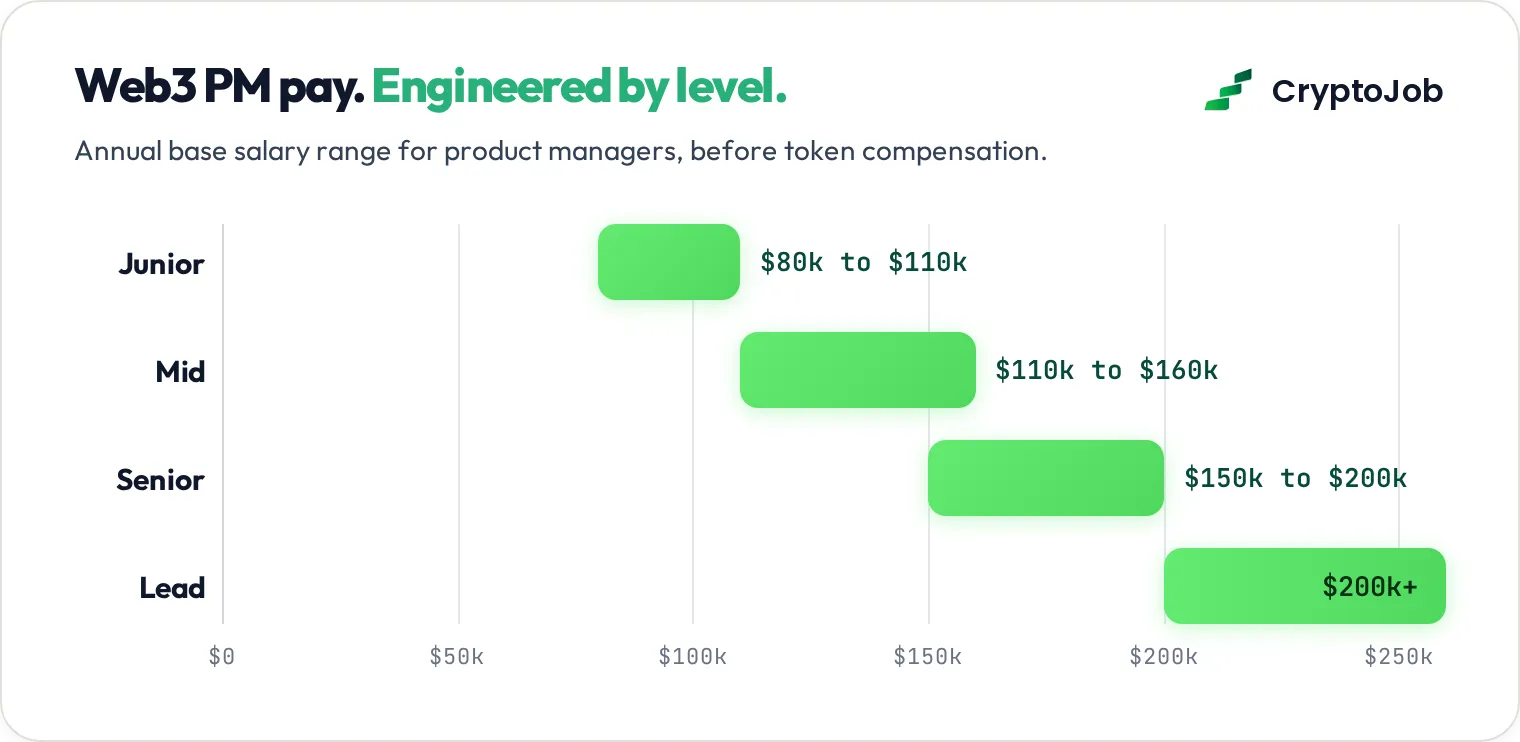
Short version: comparable to fintech, often with more upside and more variance.
Based on job board and salary data from 2025 and 2026, US base salaries mostly land between $110k and $200k, with averages around $160k to $170k. Entry-level roles tend to start around $80k to $110k. Senior and lead roles can clear $200k base.
Total compensation is where crypto gets interesting. Many companies add token allocations or equity, which can push total comp well past $250k at well-funded companies or end up worth very little if the project fails. Treat tokens as a lottery ticket, not salary.
|
Level |
US base salary (typical) |
Notes |
|
Junior / Associate PM |
$80k to $110k |
Rare in crypto, most teams hire experienced PMs |
|
Mid-level PM |
$110k to $160k |
The bulk of open roles |
|
Senior PM |
$150k to $200k |
Often plus tokens or equity |
|
Lead / Principal PM |
$200k+ |
Common at exchanges and infrastructure companies |
These figures vary a lot by region, company funding and market cycle. Remote roles paid from global companies often benchmark against US or Western Europe rates, which is a real advantage if you live somewhere cheaper. Well-funded exchanges and infrastructure companies like Coinbase, Circle and Consensys pay at fintech levels, while small protocols may offer lower base plus larger token packages.
How Is Being a Web3 Product Manager Different From Web2?
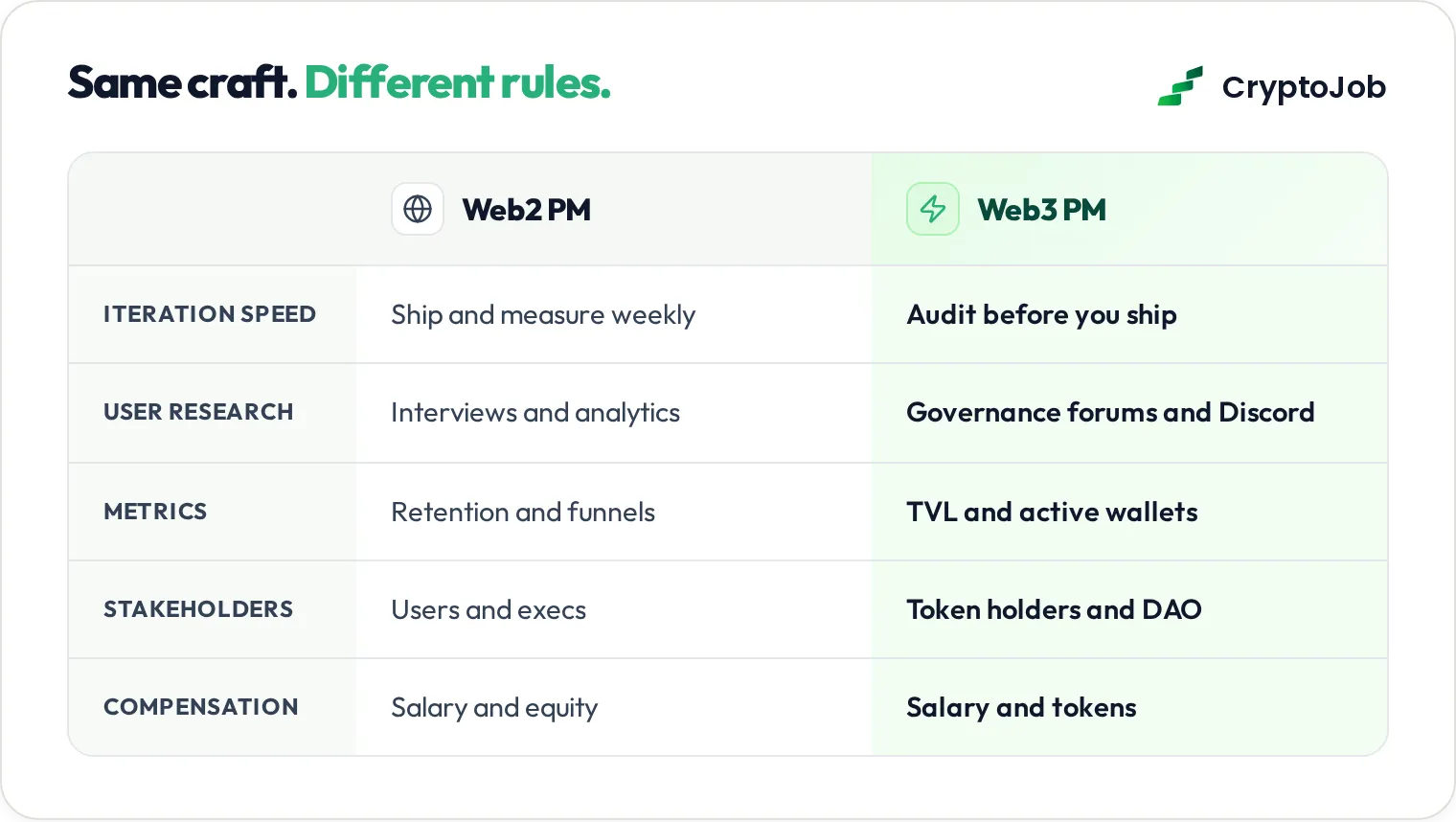
This is the part most career guides gloss over. Here's an honest comparison.
|
Area |
Web2 PM |
Web3 PM |
|
Iteration speed |
Ship, measure, fix weekly |
Smart contracts are hard to change post-launch, more upfront rigor |
|
User research |
Interviews, analytics, surveys |
Plus Discord, governance forums, on-chain data |
|
Metrics |
DAU, retention, revenue |
Plus TVL, wallet activity, token metrics |
|
Stakeholders |
Execs, sales, engineering |
Plus token holders, DAOs, sometimes anonymous communities |
|
Regulation |
Mostly settled rules |
Evolving rules across jurisdictions |
|
Job stability |
Tied to company performance |
Also tied to market cycles |
|
Compensation |
Salary plus equity |
Salary plus tokens and/or equity |
Two things surprise most web2 transplants. First, the transparency. Your product's usage data is often public on-chain, and so is your competitor's. Second, the speed of narrative shifts. A product category can go from hot to dead in six months, so you learn to separate durable user needs from hype.
None of this makes the job harder in PM terms. It makes it different, and companies pay a premium for people who've learned those differences.
What Skills Do You Need for Crypto Product Manager Jobs?
You need two buckets: your existing PM skills, framed well and a baseline of crypto fluency.
From web2, the most valued transferable skills are shipping 0-to-1 products, working with technical teams, data-driven prioritization and any experience in fintech, payments, security or regulated industries. If you've done marketplaces, trading products or developer tools, say so loudly. Those map directly to exchanges, DeFi and infrastructure.
On the crypto side, hiring managers typically expect you to understand:
- How wallets, private keys and transactions actually work
- What smart contracts are and why immutability changes product decisions
- The basics of major ecosystems, at minimum Ethereum plus one or two others like Solana or an L2
- Tokenomics fundamentals, enough to reason about incentives
- The regulatory picture at a high level, especially if you target exchanges or stablecoin companies
You do not need to write Solidity. You do need to read a block explorer without panicking.
Does a Blockchain PM Need a Technical Background?
No, and the job postings back this up. Most listings ask for 3 to 5+ years of product experience plus a "strong understanding of" or "interest in" web3, not an engineering degree.
That said, a blockchain PM who can sketch how a transaction flows through a protocol will beat one who can't. The bar is technical literacy, not technical execution. If you've been a PM on any API-heavy or infrastructure product, you're closer than you think.
Security literacy is the one area worth extra effort. Crypto products custody real money and PMs who understand attack vectors, key management and smart contract risk command higher pay.
How Do You Transition From Web2 to Web3 in 5 Steps?
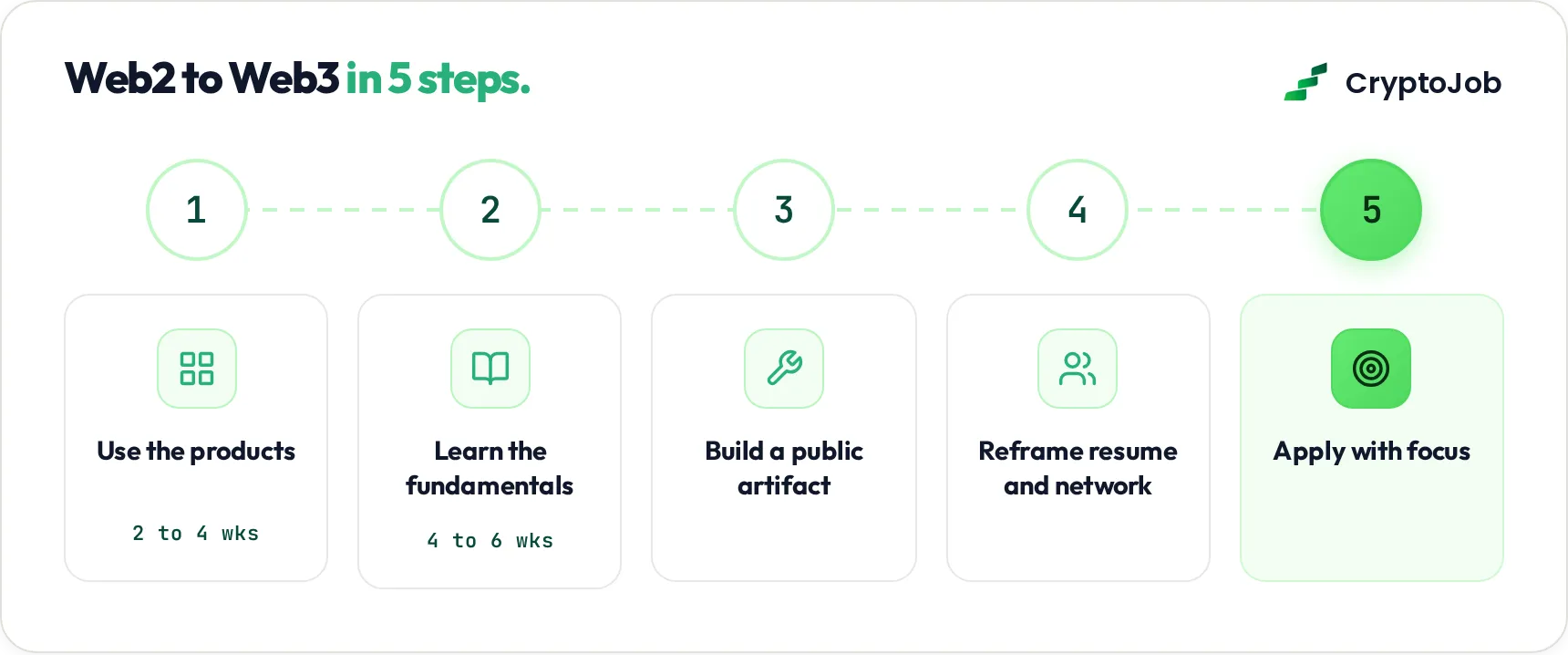
Here's the roadmap that actually works, based on how people get hired in this space.
Step 1: Use the products for 2 to 4 weeks. Set up a proper wallet, bridge funds to an L2, swap on a DEX, mint an NFT, try a lending protocol. Take notes on every UX failure you hit. Those notes become interview material.
Step 2: Learn the fundamentals in parallel. Free resources cover most of it: Ethereum.org docs, protocol whitepapers, podcasts and newsletters like Bankless or Messari research. Budget 4 to 6 weeks of evenings. Paid courses exist but aren't required.
Step 3: Build a public artifact. Write a teardown of a crypto product's onboarding, propose a feature in a protocol's governance forum or contribute product thinking to an open-source project. One good public artifact outperforms any certificate on your resume.
Step 4: Reframe your resume and network in the open. Translate your web2 wins into crypto-relevant language. Then show up where crypto people are: X, Discord servers of products you use and local or online web3 events. A large share of crypto hiring happens through community visibility, not cold applications.
Step 5: Apply with focus. Target the segment that matches your background. Payments experience maps to stablecoins and on-ramps. Marketplace experience maps to NFT platforms and exchanges. B2B SaaS maps to infrastructure and developer tools.
Done consistently, this takes 3 to 6 months alongside a full-time job. Faster if you're already a crypto user.
Where Do You Find Web3 Product Manager Jobs?
Crypto hiring is fragmented, so use a mix of channels.
Dedicated web3 job boards list thousands of PM roles at any given time and let you filter by remote, salary and ecosystem. Company career pages matter more than in web2, since big names like Coinbase, Kraken, OKX, Chainlink Labs and Consensys post there first. VC portfolio job boards, like those from a16z crypto and Paradigm, surface well-funded startups.
Then there's the informal layer. Many roles get filled through Discord announcements, X posts from founders and referrals from community members. This is why Step 4 above matters so much.
A practical filter for quality: prioritize companies with real revenue or recent funding, products you can verify on-chain and teams that survived at least one bear market. That screens out most of the roles that vanish when prices drop.
Ready to Make the Move?
The gap between a web2 PM and a web3 product manager is smaller than the job titles suggest. It's mostly domain knowledge, and domain knowledge is learnable in a few months of deliberate effort. Use the products, build one public artifact, network where crypto people actually are and target companies that match your background.
The best time to start is before you need the job, so the learning compounds while you're still employed. When you're ready to see live openings, browse web3 jobs on CoinTerminal and set up alerts for product roles.
FAQ
How long does it take to transition from web2 to web3 PM?
Most people need 3 to 6 months of part-time preparation: a few weeks using crypto products hands-on, a few weeks of study and the rest building a public artifact and networking. If you already use DeFi or hold crypto actively, you can compress that to 1 to 3 months.
Do web3 product managers get paid in crypto?
Sometimes. Base salary is usually paid in fiat or stablecoins and many companies add token allocations on a vesting schedule, similar to startup equity. Some remote-first teams offer the option to receive salary in stablecoins. Always evaluate an offer on the base salary alone, since token value can go to zero.
Is a web3 PM job risky compared to web2?
Riskier, yes. Hiring and layoffs track market cycles, and startups fail more often. You can reduce the risk by targeting infrastructure companies, exchanges and stablecoin issuers with real revenue, rather than early-stage protocols whose runway depends on token prices.
Do I need certifications to become a blockchain PM?
No. Hiring managers care about demonstrated understanding, not certificates. A product teardown, a governance proposal or visible participation in a crypto community carries far more weight than a paid credential.
Can I get a web3 PM job with no crypto experience at all?
It's hard but possible if your web2 background maps closely to the product. Payments, trading, marketplaces and security backgrounds transfer best. Even then, spend a month using crypto products first. Interviewers can tell within minutes whether you've actually held a wallet.