

TLDR
- Most web3 offers have room to move 10 to 20% on base salary
- Always ask for token details in writing: allocation, vesting, cliff and lockups
- Typical vesting is 2 to 4 years with a 1 year cliff
- Counter within 48 hours with a specific number, not a range
- Web3 salary negotiation works best when you value tokens at a discount, not at FDV
Web3 salary negotiation comes down to two things: knowing what the role pays across the market and understanding what the token part of your offer is actually worth. Most crypto companies expect a counter, and the first offer usually sits 10 to 20% below what they can approve. This guide covers real salary ranges, how to read a token package and the exact steps to counter without losing the offer.
If you are still comparing options, you can browse web3 jobs on CoinTerminal to see what similar roles are paying right now.
One thing before we get into numbers. Web3 offers are messier than traditional tech offers. You might be paid in fiat, stablecoins, tokens or a mix and the company might be a Cayman foundation rather than a Delaware corp. That mess is your leverage, because most candidates never ask the questions that follow.
What Should You Know Before Starting Web3 Salary Negotiation?
Three facts change how you negotiate in this industry.
First, salary bands are wide and inconsistent. A Solidity developer can earn $90k at a small DAO and $250k at a well funded L2 for nearly identical work. There is no Levels.fyi equivalent with deep data, so companies rely on candidates not knowing the range.
Second, remote is the default. Many crypto companies pay one global band rather than adjusting for location, which means candidates in lower cost regions can often negotiate closer to US rates than they would in traditional tech.
Third, tokens are not equity. They vest differently, they are liquid sooner and their value can swing 80% in a year. Treat any token number the company quotes as a marketing figure until you have verified the assumptions behind it.
Do your homework before the first call. Check public salary data from sources like web3 salary reports and job boards that list ranges, ask people in similar roles on Telegram or Farcaster and note what funding stage the company is at. A project that raised a Series A six months ago has more cash flexibility than one running on treasury tokens.
How Much Do Web3 Roles Actually Pay?
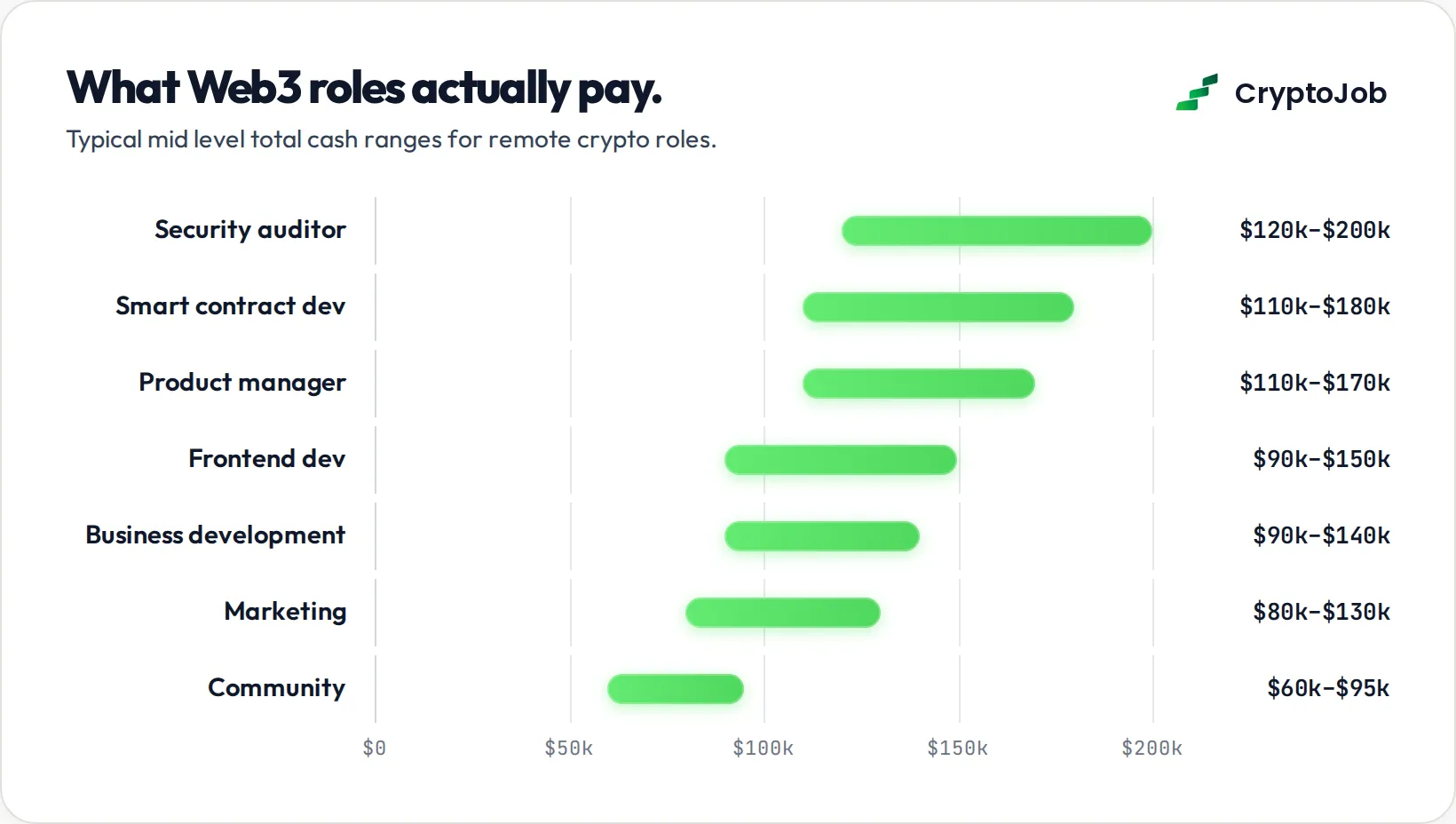
Ranges below reflect typical full time remote offers as of 2026. They vary a lot by region, funding stage and whether the project is pre or post token, so treat these as orientation, not gospel.
|
Role |
Junior / Entry |
Mid |
Senior |
|
Smart contract developer |
$70k to $110k |
$110k to $180k |
$170k to $260k+ |
|
Frontend / full stack dev |
$60k to $95k |
$90k to $150k |
$140k to $200k |
|
Security auditor |
$80k to $120k |
$120k to $200k |
$200k to $300k+ |
|
Product manager |
$70k to $110k |
$110k to $170k |
$160k to $220k |
|
Marketing / growth |
$50k to $80k |
$80k to $130k |
$120k to $180k |
|
Community manager |
$40k to $65k |
$60k to $95k |
$90k to $130k |
|
Business development |
$60k to $90k |
$90k to $140k |
$130k to $190k+ (plus commission) |
A few patterns worth knowing. Security and smart contract roles command the biggest premiums because mistakes cost real money. Non technical roles pay closer to traditional tech, sometimes below it, but often come with larger token allocations to compensate. US based candidates at US registered companies tend to land at the top of these bands.
If the base offer sits in the bottom third of the range for your experience level, that is your opening to negotiate. Companies rarely rescind offers over a reasonable counter. In practice, the worst realistic outcome is a "we can't move on base, but here's more tokens" reply.
How Does Token Compensation Work in a Web3 Offer?
Token compensation is where most candidates leave money on the table, or accept paper money that never materializes. Here is what to pin down before you sign anything.
What questions should you ask about tokens?
Get written answers to all of these:
- What percentage of total token supply is my allocation, or how many tokens at what assumed valuation?
- What is the vesting schedule and cliff? The market standard is 2 to 4 years with a 1 year cliff.
- Has the token launched? If not, what happens to my allocation if it never does?
- Are there lockups after the token generation event, on top of my vesting?
- Do I keep vested tokens if I leave or get let go?
If a recruiter dodges these questions or says "we'll figure that out later", that is a red flag about the whole company, not just the comp package.
How do you value a token grant?
Companies love quoting your grant at fully diluted valuation. Say you get 0.1% of supply and the project's last round implied a $300M FDV. The recruiter will call that a $300k grant. It is not.
Discount for three realities. You cannot sell during the cliff and lockups, most tokens trade well below their private round FDV once liquid and pre launch tokens might never launch at all. A reasonable rule of thumb is to mentally value pre launch token grants at 20 to 40% of the quoted FDV number and launched liquid tokens at 50 to 70% after accounting for vesting.
Then negotiate base salary as if tokens were worth zero. If the base alone does not cover your life, the offer does not work no matter how exciting the token story sounds.
Should you take pay in stablecoins or tokens?
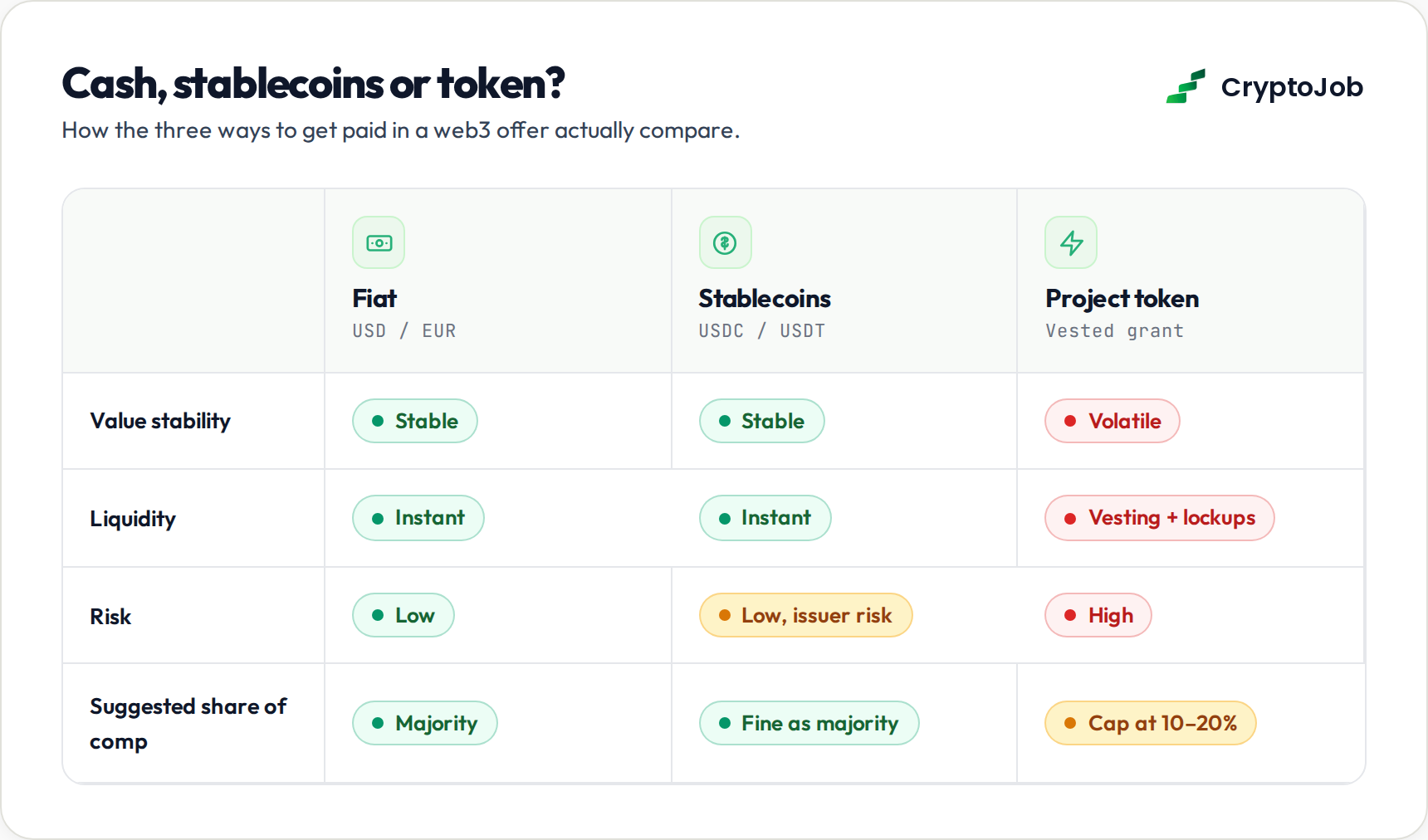
Some projects offer to pay part of your salary in their own token or in stablecoins like USDC. Stablecoins are fine and often convenient, though check the tax treatment in your country since they are usually taxed as income at receipt either way.
Taking salary in the project's native token is a different bet. You are doubling down on an asset your income already depends on. If you accept it at all, cap it at 10 to 20% of comp and ask for a top up mechanism if the token drops below the agreed rate.
What Are the Steps in Crypto Job Offer Negotiation?
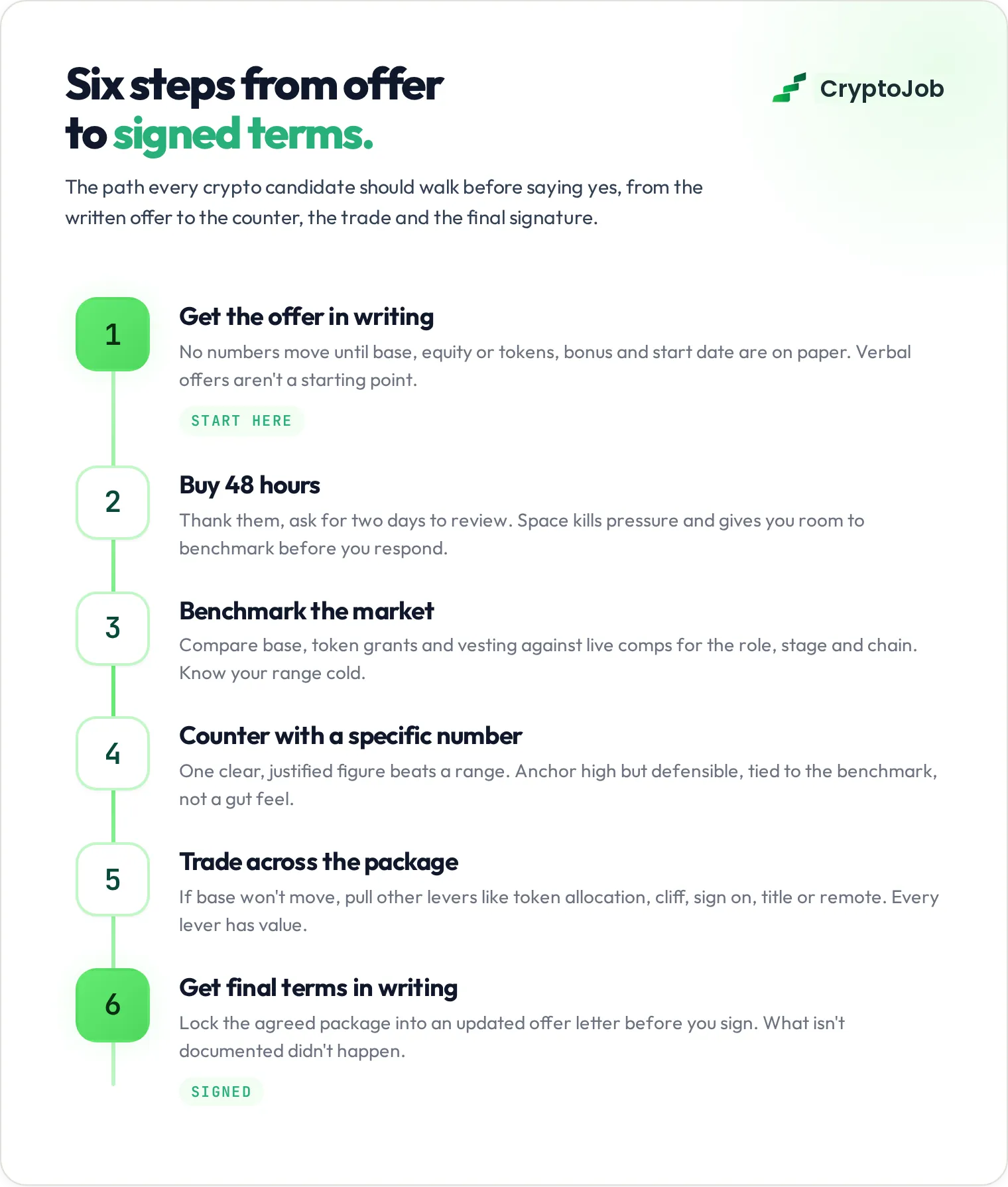
Here is the sequence that works, whether the company is a 10 person DAO or a listed exchange.
1. Get the full offer in writing. Base, tokens, vesting, benefits, payment currency and legal entity. Verbal numbers do not count in crypto job offer negotiation, ever.
2. Say thanks and buy time. "Really excited about this. Give me 48 hours to review the details." Nobody reasonable objects, and urgency pressure is itself a warning sign.
3. Benchmark fast. Compare the base against the ranges above and against live listings for the same role. Ask one or two people in your network what they would expect for this offer.
4. Counter with a specific number. Not a range. "Based on the market for senior Solidity roles and my audit experience, I'd need $175k base to say yes today" beats "I was hoping for a bit more". Anchor 10 to 15% above your true target.
5. Trade across the package. If base is capped, push on tokens, a shorter cliff, a signing bonus in USDC or a guaranteed 6 month review. Startups often have more flexibility on tokens than cash.
6. Get the final version in writing before resigning anywhere. Including the token agreement, not just the employment contract. These are usually separate documents and the token one matters more.
One real world shape this takes: a mid level developer gets offered $120k plus 0.05% of supply. They counter at $140k, the company comes back at $130k plus 0.08% and everyone signs. That extra $10k and 60% more tokens took two emails.
What Mistakes Kill a Web3 Salary Negotiation?
Accepting on the call is the most common one. Excitement is not a reason to skip 48 hours of diligence.
Negotiating tokens before base is another. Base salary is real and guaranteed, tokens are a call option. Lock in the base first, then improve the option.
Comparing your offer to bull market anecdotes also backfires. The person who "made $2M on their token grant" in a past cycle is a lottery story, not a benchmark. Negotiate against current market data.
Finally, do not skip the legal entity question. If you are a contractor for an offshore foundation, you have fewer protections and different tax obligations than an employee. That is often fine, but it should be priced into your number.
Final Thoughts
Web3 salary negotiation rewards preparation more than aggression. Know the range for your role, force clarity on the token package, counter once with a specific number and get everything in writing. Most candidates who do this land 10 to 20% more than the first offer, plus a token package they actually understand.
Ready to put this into practice? Browse web3 jobs on CoinTerminal and start comparing offers with real leverage.
FAQ
Can you negotiate salary at a crypto startup?
Yes, and most expect it. First offers typically leave 10 to 20% of room on base salary, and token allocations are often more flexible than cash. A polite counter with a specific number almost never costs you the offer.
How much of a web3 offer should be tokens?
There is no fixed rule, but a healthy structure covers your living costs entirely with base salary, with tokens as genuine upside on top. If the offer only works when you assume the token moons, negotiate a higher base or walk.
What is a standard vesting schedule for token compensation?
The market standard is 2 to 4 years of vesting with a 1 year cliff, mirroring startup equity. Watch for extra lockups after the token launches, since those can delay your ability to sell even after tokens have vested.
Should I accept salary paid in crypto?
Stablecoins like USDC are generally fine and common for global teams. Being paid in the project's own token is riskier, so if you accept it, keep it to a small share of total comp and confirm how your country taxes crypto income.
Is it safe to negotiate with a DAO?
Yes, but confirm who or what you are actually contracting with. Ask which legal entity signs your agreement, how disputes are handled and whether contributor payments have a track record. Ranges and tactics are the same, the paperwork just needs more scrutiny.