

TLDR
- Web3 vs web2 jobs in short: web3 typically pays 10 to 30% more base salary for equivalent roles
- US web3 developers average roughly $110k to $150k, seniors reach $200k+
- Token grants can add 30 to 100% on top of base pay
- Roughly 70 to 75% of web3 roles are remote
- Tradeoff: less job security and more volatility
If you're weighing web3 vs web2 jobs, here's the short answer. Web3 usually pays more in base salary, adds token upside and offers remote work almost by default. Web2 gives you stability, predictable equity and clearer career ladders. Which one wins depends on your risk tolerance more than anything else.
This guide breaks down the actual numbers, the perks you'll see in offer letters and what daily life looks like on each side. If you're already leaning crypto, you can browse web3 jobs on CoinTerminal while you read.
One thing up front: crypto salary data varies a lot between sources because the market is smaller and more volatile than traditional tech. Every figure below is a realistic range, not a guarantee.
What's the real difference between web3 vs web2 jobs?
The core difference is structural. Web2 companies sell products or ads and pay you in salary plus stock. Web3 companies build protocols and pay you in salary plus tokens and often the "company" is a foundation, a startup or a DAO.
That structure changes everything downstream: how you're paid, how stable your job is and how you work day to day.
|
|
Web3 jobs |
Web2 (traditional tech) jobs |
|
Base salary (US dev) |
~$110k to $150k average, $200k+ senior |
~$120k to $160k average, $180k+ senior at big tech |
|
Equity/upside |
Token grants, 2 to 4 year vesting, liquid sooner but volatile |
RSUs or options, predictable at public companies |
|
Remote work |
~70-75% of roles fully remote |
Mostly hybrid, many RTO mandates |
|
Job security |
Low. Tied to funding cycles and token markets |
Moderate to high, especially at large firms |
|
Career ladder |
Loose titles, portfolio-driven progression |
Defined levels (L3 to L8 style ladders) |
|
Hiring signal |
GitHub, shipped projects, on-chain work |
Degree, brand-name experience, leetcode interviews |
[IMAGE PLACEHOLDER, Visual 1: Side-by-side web3 vs web2 comparison graphic], ALT TEXT: "Web3 vs web2 jobs compared on salary, remote work, equity and job security"
(Ranges compiled from web3.career, ZipRecruiter, LaborX and CryptoJobsList data, 2026. Actuals vary by role, region and company stage.)
Do you need different skills for web3?
Mostly no, and that surprises people. Most web3 work is frontends, APIs, wallet flows and data pipelines that happen to touch smart contracts. The deep specialization (Solidity, Rust, protocol engineering, security auditing) is where the top salaries sit and it takes time to build.
If you're a solid backend or full-stack engineer, you can transition without a pay cut. Many protocols actively recruit from big tech.
Crypto vs tech salary: who actually pays more?
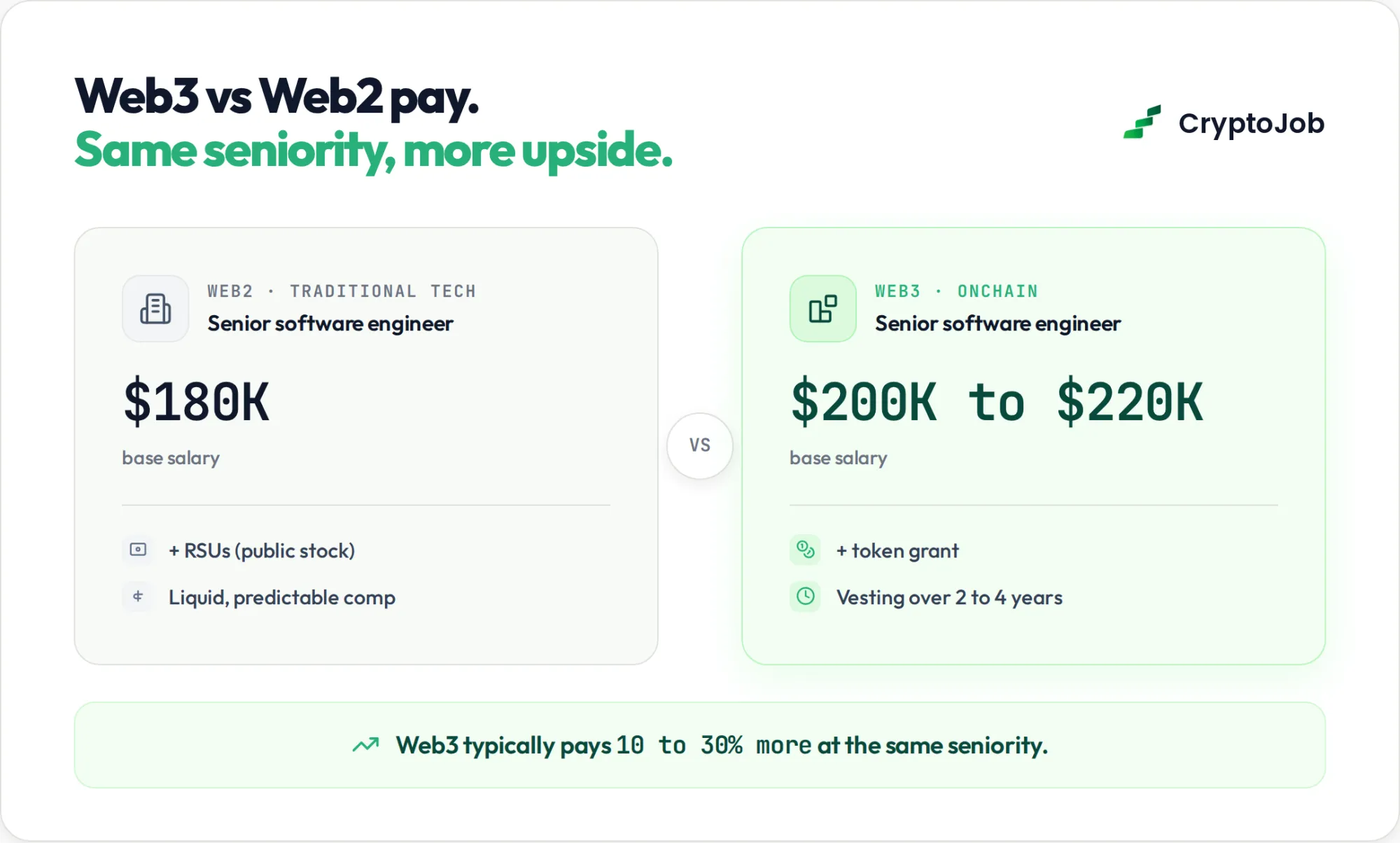
For equivalent seniority, crypto tends to pay more. Industry salary guides put web3 base salaries roughly 10 to 30% above comparable web2 roles. A senior backend engineer earning around $180k base at a large web2 company might see $200k+ base at a well-funded protocol, before any token grant.
Some real ranges from current market data:
- Web3/blockchain developer (US): roughly $84k to $135k for the middle 50%, averages between $110k and $150k depending on the source
- Solidity developer: about $100k to $250k, median near $150k. Juniors start around $80k to $100k
- Smart contract security auditor: $200k+ is common and demand has grown sharply since 2023
- AI + blockchain integration engineer: roughly $140k to $250k, one of the fastest-growing roles in tech right now
- Senior web2 software engineer at big tech: typically $150k to $220k base, with RSUs often doubling total comp at top firms
The catch is variance. Web2 salary bands are tight and predictable. Web3 pay swings with the market: the same role can pay 30% more in a bull market and get cut entirely in a bear market.
How does token compensation work?
[IMAGE PLACEHOLDER, Visual 3: Token compensation flowchart: offer, vesting, unlock, outcome], ALT TEXT: "Flowchart showing how token compensation works in web3 jobs from offer to vesting"
Most web3 companies pay base salary in fiat or stablecoins, then add token grants that vest over 2 to 4 years. Total compensation including tokens can run 30 to 100% above base, but that upside is speculative.
Treat tokens like startup equity with extra volatility. Plenty of people who took token-heavy packages in 2021 watched them collapse in 2022. Negotiate a base you can live on and treat tokens as a bonus, not rent money.
Does location still matter for web3 pay?
Less than in web2, but it's not zero. North American web3 developers average around $143k while some regions average under $60k for similar titles. Remote-global roles increasingly pay one rate regardless of location, which is a huge arbitrage if you live somewhere cheap.
What perks do web3 jobs offer that web2 doesn't?
Beyond salary, the offer letters look genuinely different.
Web3 perks you'll actually see:
- Remote-first by default, often async with no core hours
- Payment flexibility: fiat, stablecoins or a mix
- Conference travel budgets (crypto runs on events like ETHDenver and Token2049)
- Token allocations even for non-engineering roles like marketing and community
- Flat structures where a 2-person team can ship to mainnet
Web2 perks web3 rarely matches:
- Real health insurance, 401k matching and parental leave (many crypto startups are thin here, especially DAOs that treat you as a contractor)
- Job security and severance
- Structured mentorship, promotion cycles and L&D budgets
- Visa sponsorship
A practical note: if a web3 company hires you as a contractor, you're covering your own taxes, insurance and retirement. Price that into any comparison, because a $160k contract role can net less than a $140k salaried one.
Is web3 work-life balance better or worse?
Honest answer: it varies more than in any other industry, and web3 work-life balance depends heavily on the company stage and the market cycle.
The good side: remote and async work is the norm, nobody cares when you work as long as you ship and you skip the commute and the open-plan office. Many people describe the flexibility as impossible to give up once they've had it.
The rough side: crypto markets run 24/7 and incidents don't wait for Monday. If a protocol gets exploited at 3am on a Sunday, someone's getting paged. Early-stage teams move at a pace that makes web2 startups look relaxed, and bull markets amplify that.
Which web3 roles have the best balance?
Roles at established players (major exchanges, L1/L2 foundations, infrastructure companies) tend to look like normal tech jobs with better flexibility. Roles at pre-launch startups and trading firms lean intense. DAO contributor gigs offer maximum freedom but zero structure, which suits some people and burns out others.
If balance is your priority, filter for later-stage companies with real HR functions and on-call rotations. Ask directly in interviews how incidents are handled and what happened to the team in the last bear market.
Should you pick web3 vs web2 jobs in 2026?
[IMAGE PLACEHOLDER, Visual 4 (optional): Decision checklist graphic: pick web3 if... / pick web2 if...], ALT TEXT: "Checklist for choosing between web3 vs web2 jobs based on risk and priorities"
Pick web3 if you want higher pay ceilings, remote-first work, faster ownership and you can stomach volatility. It helps to have 6+ months of savings, because layoffs track token prices.
Pick web2 if you need stability, benefits, visa sponsorship or a predictable path to senior titles. There's zero shame in that, and the skills transfer both ways.
A popular middle path: keep your web2 job, build web3 side projects and contribute to open source or bounties. In crypto, shipped work counts for more than your resume, so you can build a portfolio nights and weekends and jump when an offer beats your current package.
Ready to test the market? Browse web3 jobs on CoinTerminal and see what companies are actually paying this week.
FAQ
Do web3 jobs pay more than web2 jobs?
Usually yes, by roughly 10 to 30% in base salary for equivalent roles, plus token upside. But web3 pay is more volatile and job security is lower, so total risk-adjusted compensation is closer than the headline numbers suggest.
Can I get a web3 job without blockchain experience?
Yes. Most web3 roles are standard engineering, design, marketing or ops work applied to crypto products. A couple of shipped side projects, hackathon entries or open source contributions are typically enough to prove interest and get interviews.
Are web3 jobs remote?
Roughly 70 to 75% of web3 placements are fully remote, which is far above traditional tech. Some larger exchanges and foundations have hubs, but remote-first is the industry default.
Is web3 work-life balance bad?
It depends on the company. Established companies offer flexibility that beats most web2 employers, while early-stage startups and anything close to live markets can be intense. Ask about on-call and bear-market history before signing.
Should I take tokens instead of salary?
Take a base salary you can live on first. Tokens can add 30 to 100% to total comp if the project succeeds, but they're speculative. Never accept a below-market base for token promises alone.
Related guides
- Web3 Jobs in 2026: Complete Guide
- How to Switch From Web2 to Web3: Career Transition Guide
- Web3 Developer Salary Guide 2026
- How to Negotiate a Web3 Job Offer
Related reading: Crypto Jobs vs Web3 Jobs.