

TL;DR
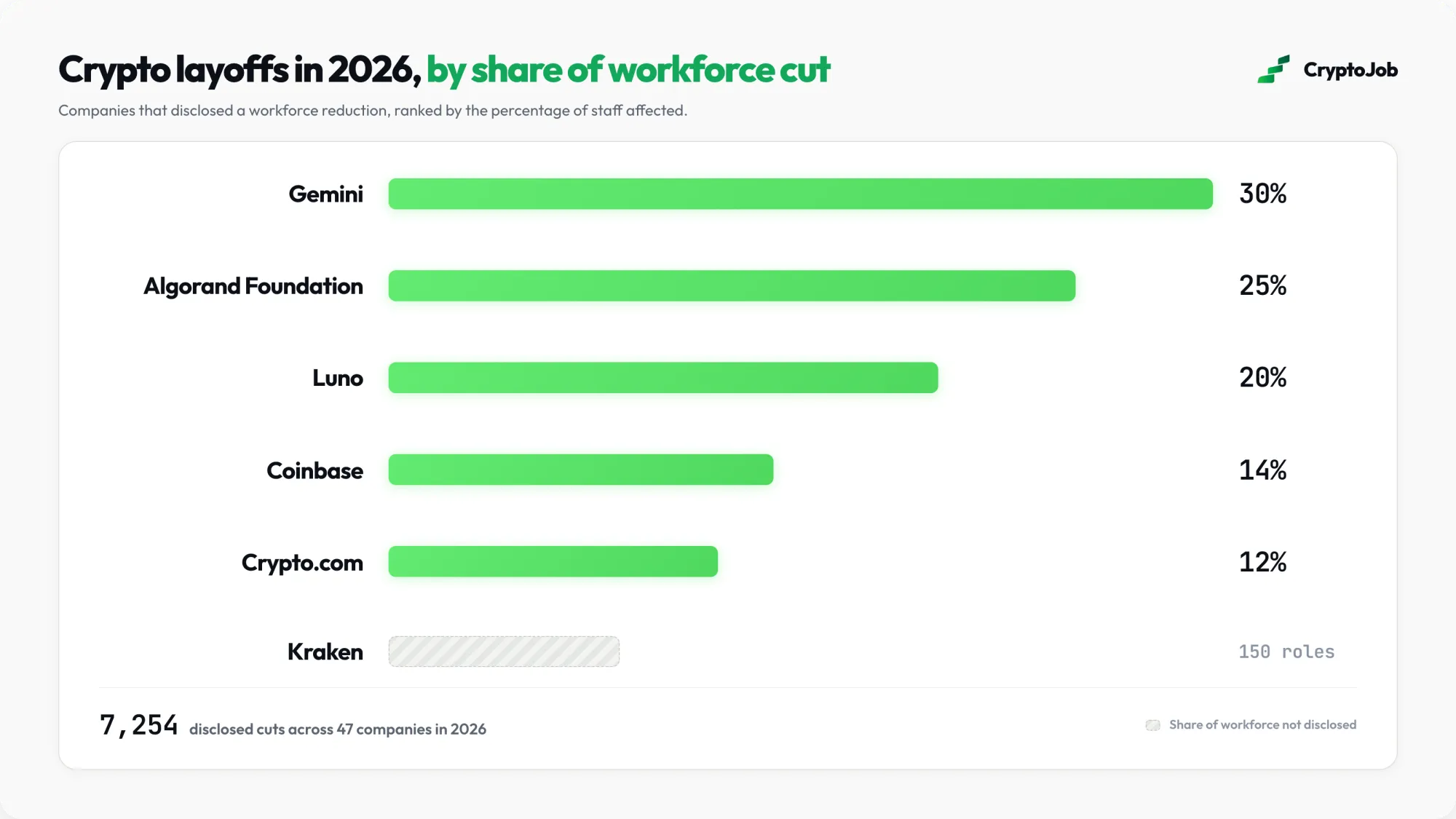
- Crypto layoffs hit 7,254 disclosed cuts across 47 companies in 2026.
- AI restructuring is cited as often as market conditions.
- Coinbase cut 14%, Gemini roughly 30%, Luno around 20%.
- Security and compliance roles are still hiring hard.
Crypto layoffs in 2026 have already exceeded 7,254 disclosed job cuts across 47 companies, according to public tracking. July alone accounted for twelve companies and 894 positions.
If you have just been cut, or you are watching your company's runway nervously, the useful thing to understand is that this downturn is structurally different from 2022 and that difference changes where you should look next.
When you are ready to start looking, browse web3 jobs to see which categories are still actively hiring.
How bad are crypto layoffs in 2026?
The headline numbers are significant, and they are concentrated among names most people would consider safe.
| Company | Reduction | Stated reason |
|---|---|---|
| Coinbase | ~700 people, 14% of workforce | Restructuring, announced May 2026 |
| Gemini | ~30% since January, headcount near 445 | AI efficiency, market exits |
| Algorand Foundation | ~25% | Macro environment and market downturn |
| Luno | ~20% globally | Automation, pivot to institutional |
| Crypto.com | ~12%, around 180 roles | AI pivot |
| Kraken | 150 positions | Restructuring |
The market backdrop is real. Bitcoin reached an all time high near $126,200 in October 2025 and had lost roughly half that value by late July 2026, trading somewhere between $60,000 and $64,000.
Why is this downturn different from 2022?
In 2022 the cause was straightforward: valuations collapsed, Terra failed and FTX contagion spread. Companies cut because they were running out of money.
This time a large share of executives are citing artificial intelligence rather than insolvency. Crypto.com's CEO framed its cuts around roles that "do not adapt in our new world." Gemini attributed reductions to AI allowing fewer staff to do more.
The distinction matters enormously for your job search. A company cutting because it is dying will not rehire. A company cutting because it restructured around AI is still building, and in many cases still hiring, just for different roles.
One analysis tracking careers pages across 67 crypto companies found exactly that: firms making headline cuts were simultaneously posting significant numbers of new roles, clustered in specific functions.
Which crypto roles are still hiring?
Demand has not disappeared evenly. Two categories have held up markedly better than the rest, and both for the same underlying reason.
Security and auditing
One exploit can end a protocol permanently. That makes security spending the last line any sensible team cuts, and smart contract auditors, penetration testers and security engineers remain among the hardest roles in crypto to fill.
Compliance and regulatory
Regulatory frameworks have tightened considerably, and the people who can navigate them are scarce. Compliance officers with genuine expertise in current regimes command pay comparable to senior engineering roles.
Stablecoin and payments infrastructure
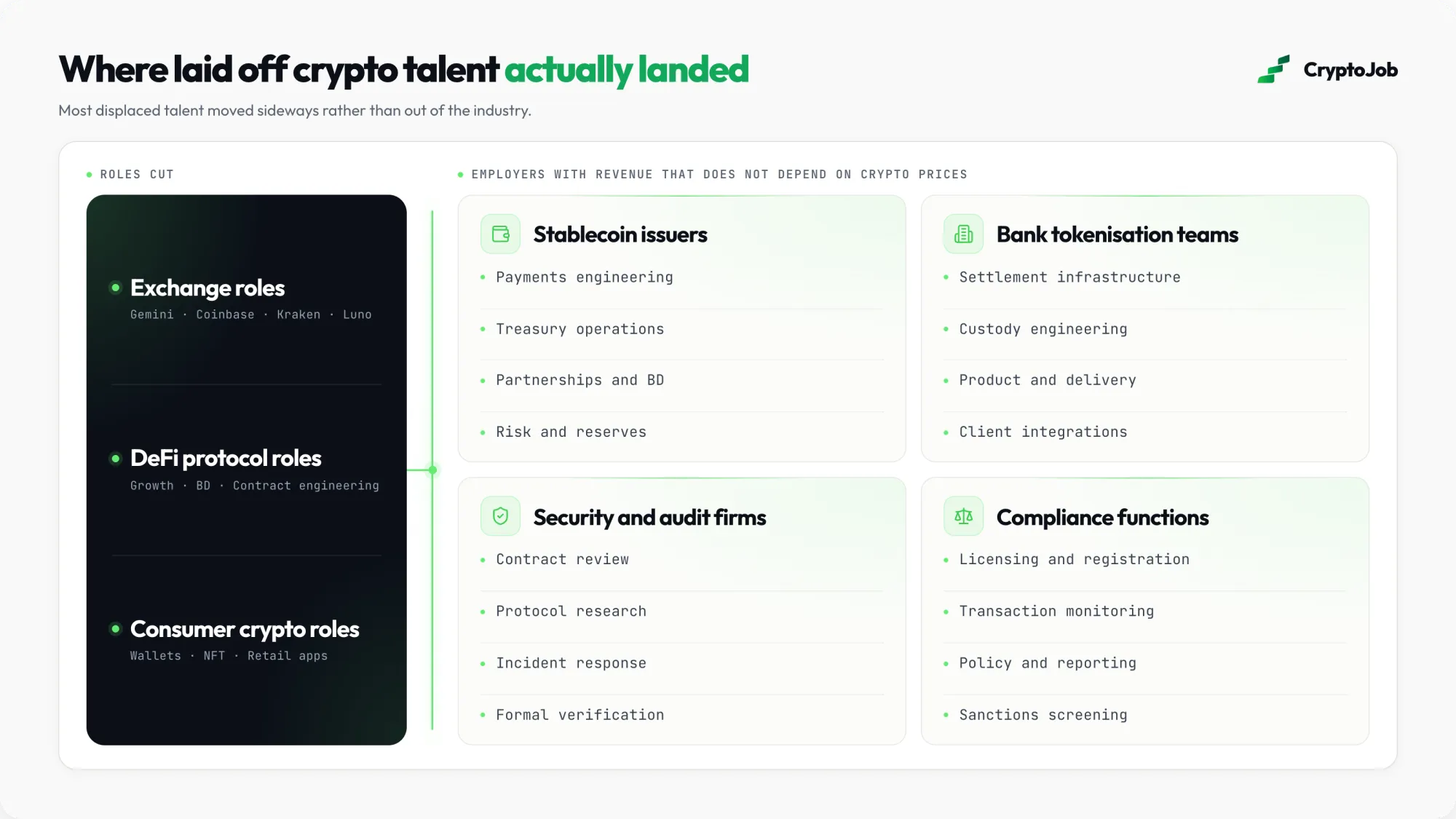
Stablecoin issuers, infrastructure providers and the banks building settlement rails are actively absorbing displaced blockchain talent. The skills transfer almost directly.
Where does displaced crypto talent actually go?
The pattern from this cycle is that most people did not leave the industry, they moved sideways into places where blockchain expertise solves a larger business problem.
An Ethereum core developer laid off from a consumer startup turns up at a stablecoin issuer designing minting systems. An auditor cut from a DeFi fund ends up reviewing exchange and fintech code. A frontend engineer joins a bank's tokenisation team.
The common thread is a move toward employers with revenue that does not depend on crypto prices. Those roles often carry higher base salaries and considerably more stable funding, at the cost of slower moving environments.
What should you do in the first two weeks after a layoff?
Sort out your token situation immediately
This is the step people skip and later regret. Find out exactly what happens to unvested tokens, whether any accelerate and what your post termination exercise window is for company equity.
These windows are often short and they do not pause while you process the news. Get the answer in writing from someone who can give it authoritatively.
Capture your work before access is revoked
Save what you are permitted to save: contribution records, public repositories, audit reports you authored, metrics you owned. Once accounts are deactivated, reconstructing your track record is far harder.
Be scrupulous about what is actually yours to take. Confidential material is not, and a reputation for taking it will follow you.
Tell people specifically what you want
Crypto hiring runs heavily on networks, and vague availability announcements produce vague results. Say the role, the stack and the kind of company.
How do you position yourself for the roles that are hiring?
If you are coming from a cut function and targeting one that is growing, the gap is usually smaller than it appears.
An engineer moving toward security should start with public audit contests, where results are visible and verifiable. A generalist moving toward compliance should get specific about which regulatory regimes they can actually speak to.
Be honest in interviews about why you were cut. "The company restructured around AI and my function was reduced" is a complete and credible answer in 2026, and hiring managers have heard it many times this year.
Frequently asked questions
How many crypto jobs were lost in 2026?
More than 7,254 disclosed cuts across 47 companies as of late July 2026, based on public announcements. The real figure is higher, since smaller companies often do not announce reductions.
Are crypto layoffs caused by the bear market or by AI?
Both, and the split is unusual. Bitcoin lost roughly half its value from its October 2025 high, but many executives cite AI driven restructuring rather than financial distress as the primary reason.
Which crypto jobs are safest right now?
Security, auditing and compliance have proven most resilient, because the cost of failure in those functions is existential rather than incremental.
Should I leave crypto after being laid off?
Not necessarily. Most displaced talent from this cycle moved into adjacent roles: stablecoin infrastructure, bank tokenisation teams, security firms, rather than leaving the industry entirely.
How long is the job search taking in this market?
Longer than in 2021, and it varies sharply by function. Security and compliance candidates are moving quickly, while generalist and growth roles are facing a considerably slower market.
Where to go from here
This cycle is genuinely difficult, but it is not uniform. The categories still hiring are hiring seriously, and the skills gap between where you are and where the demand sits is often a few months of deliberate work rather than a career change.
To see which functions are actively recruiting right now, browse web3 jobs.