

TLDR: Crypto compliance jobs pay roughly $60k to $95k entry, $85k to $130k mid and $120k to $170k senior in the US., Heads of compliance and Chief AML Officers reach $250k to $350k+., Core tools are Chainalysis, Elliptic, TRM Labs; the key cert is ACAMS/CAMS., It's one of the strongest non-technical entry points into web3.
Crypto compliance jobs are among the fastest-growing and most accessible roles in web3, and you don't need to write code to land one. Pay runs from around $60,000 for entry analysts to $350,000 for compliance leadership, with most mid-level roles between $85,000 and $130,000. Tighter regulation has made these some of the hardest hires in the industry.
If you have AML, KYC or sanctions experience from banking or fintech, you're closer than you think. This is a genuine bridge from traditional finance into crypto. To see what's live, you can browse web3 jobs as you read.
What do crypto compliance jobs involve?
Crypto compliance jobs center on keeping an exchange or crypto firm on the right side of financial-crime law. That means monitoring transactions, running KYC and sanctions checks, filing reports and translating on-chain activity into regulator-ready narratives. The work blends investigation, data analysis and clear writing.
In 2026 the regulatory backdrop is stricter, with frameworks like the GENIUS Act and CLARITY Act clarifying how crypto assets are treated. AML standards have shifted toward perpetual KYC, meaning continuous monitoring rather than one-time checks. That shift is a big reason demand keeps climbing.
What do crypto AML jobs cover?
Crypto AML jobs focus specifically on anti-money-laundering: transaction monitoring, suspicious-activity detection, sanctions screening and Travel Rule compliance. Analysts trace wallet flows across chains, flag suspicious patterns and build cases that hold up to regulatory scrutiny. The role sits at the crossroads of investigation and data work.
Because a single missed pattern can carry enormous cost, these roles reward precision and careful reasoning. Many combine centralized (CeFi) and decentralized (DeFi) flow analysis, which is where crypto-native experience earns a premium over traditional AML work.
What is the average blockchain compliance salary in 2026?
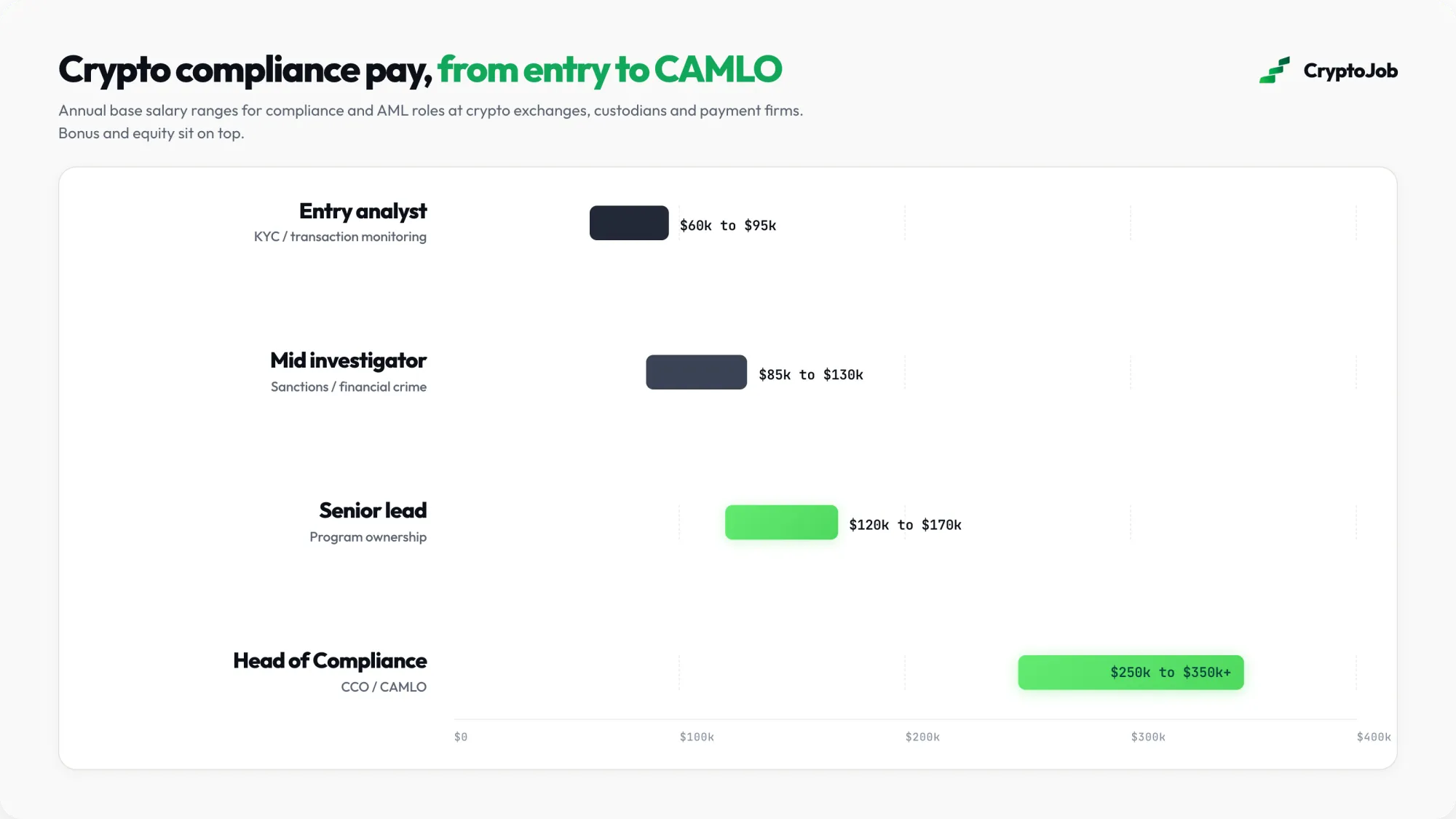
The average blockchain compliance salary varies widely by seniority and specialization. Entry analyst roles start around $60,000 to $95,000, while experienced investigators and senior compliance staff earn considerably more. Leadership roles at major platforms sit in a different tier entirely.
Here's a realistic breakdown by level. Treat these as US ranges that shift with location, certifications and company size.
| Level | Typical role | Pay (US) |
|---|---|---|
| Entry | Compliance / AML analyst | $60k to $95k |
| Mid | Forensic investigator / sanctions analyst | $85k to $130k |
| Senior | Compliance / financial-crime lead | $120k to $170k |
| Leadership | Head of Compliance / Chief AML Officer | $250k to $350k+ |
What do entry-level crypto compliance roles pay?
Entry-level crypto compliance and AML analyst roles generally run $60,000 to $95,000. Many are open to people with 1 to 2 years of AML or KYC experience from banking or fintech, and some accept strong analytical backgrounds with a relevant certification. It's one of the more attainable ways into web3.
What do senior and leadership roles pay?
Senior compliance and financial-crime leads typically earn $120,000 to $170,000, while heads of compliance and Chief AML Officers at major platforms can see total packages of $250,000 to $350,000 or more. Stablecoin-sector leadership sits at the top of that range. These are among the best-paid roles in finance and technology, reflecting how critical the function has become.
How do you become a KYC analyst in crypto?
Becoming a KYC analyst in crypto usually starts with transferable experience plus a certification. If you've done onboarding, due diligence or transaction monitoring in banking or fintech, you already have the core skills. Adding blockchain-analytics fluency is what makes you crypto-ready.
A practical path looks like this: learn the major analytics platforms, get a recognized AML certification and build familiarity with crypto-specific rules like the Travel Rule. Entry KYC and onboarding roles are a common first step, and they open quickly into investigations and sanctions work. Because much of this is non-technical, our guide to web3 jobs without coding is a useful companion.
What skills and certifications do crypto compliance jobs need?
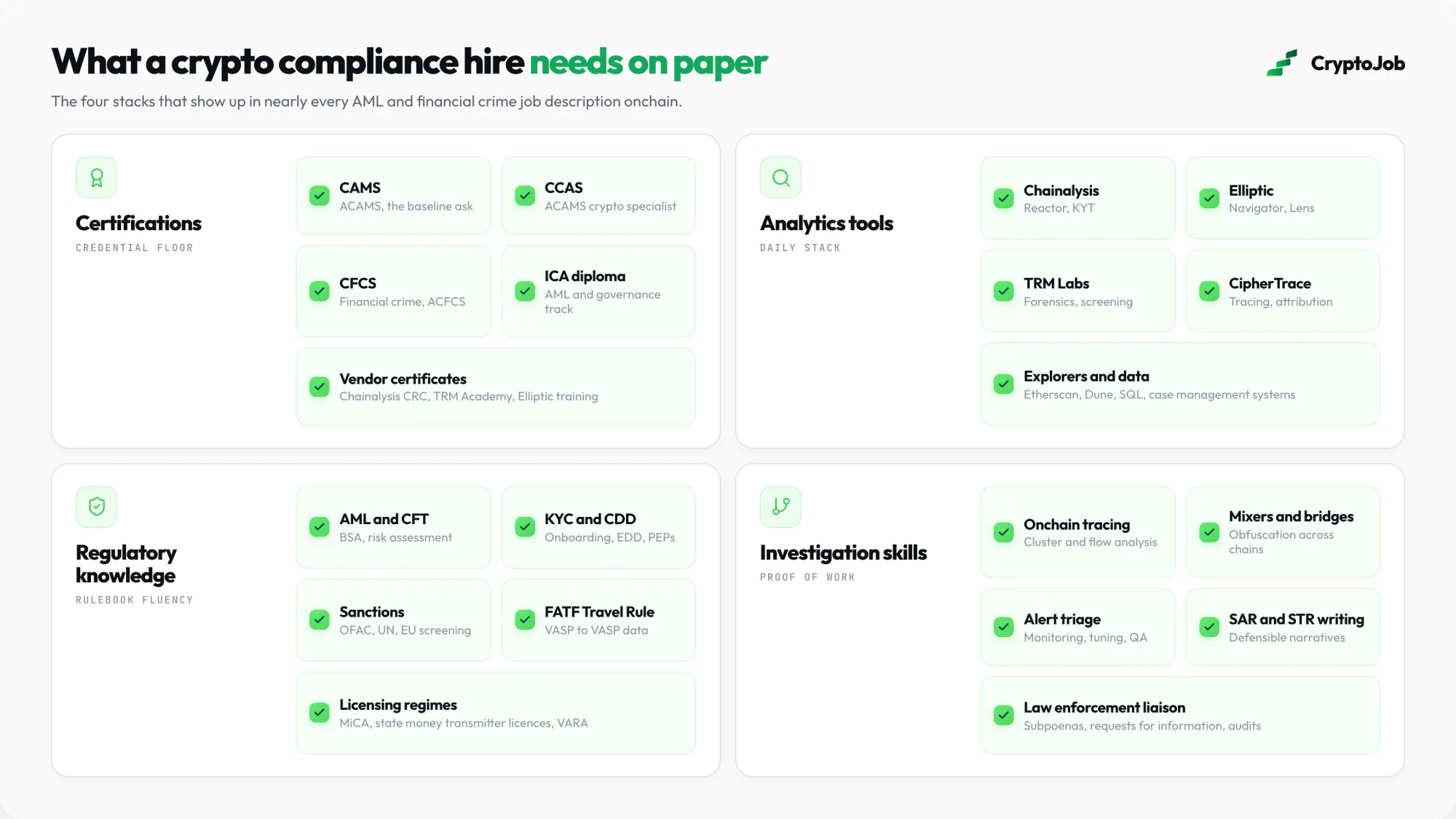
Crypto compliance jobs need a specific blend of AML fundamentals and blockchain-analytics fluency. The regulatory core is standard financial-crime knowledge: KYC, sanctions and Travel Rule literacy. The crypto layer is the ability to trace wallet activity and interpret on-chain flows.
A competitive profile usually includes:
- Certification: ACAMS (CAMS) is the most recognized AML credential.
- Analytics tools: Chainalysis, Elliptic, TRM Labs and CipherTrace.
- Regulatory knowledge: AML, KYC, sanctions and the Travel Rule.
- Investigation skills: evidence writing and clear, defensible reasoning.
It's worth understanding why this specific blend commands a premium. Regulators increasingly expect crypto firms to demonstrate not just that they run KYC and sanctions checks, but that they can explain, in plain language, how a given wallet or transaction was assessed. That translation work: from raw on-chain activity to a defensible written narrative, is the hardest part of the job and the skill that separates a junior analyst from a senior one. Strong investigators pair tool fluency with careful reasoning about probability, because attribution on-chain is rarely certain. They document their logic so a decision holds up under audit or in front of a regulator months later, and building that habit early is one of the fastest ways to move up.
How do you break into crypto compliance jobs?
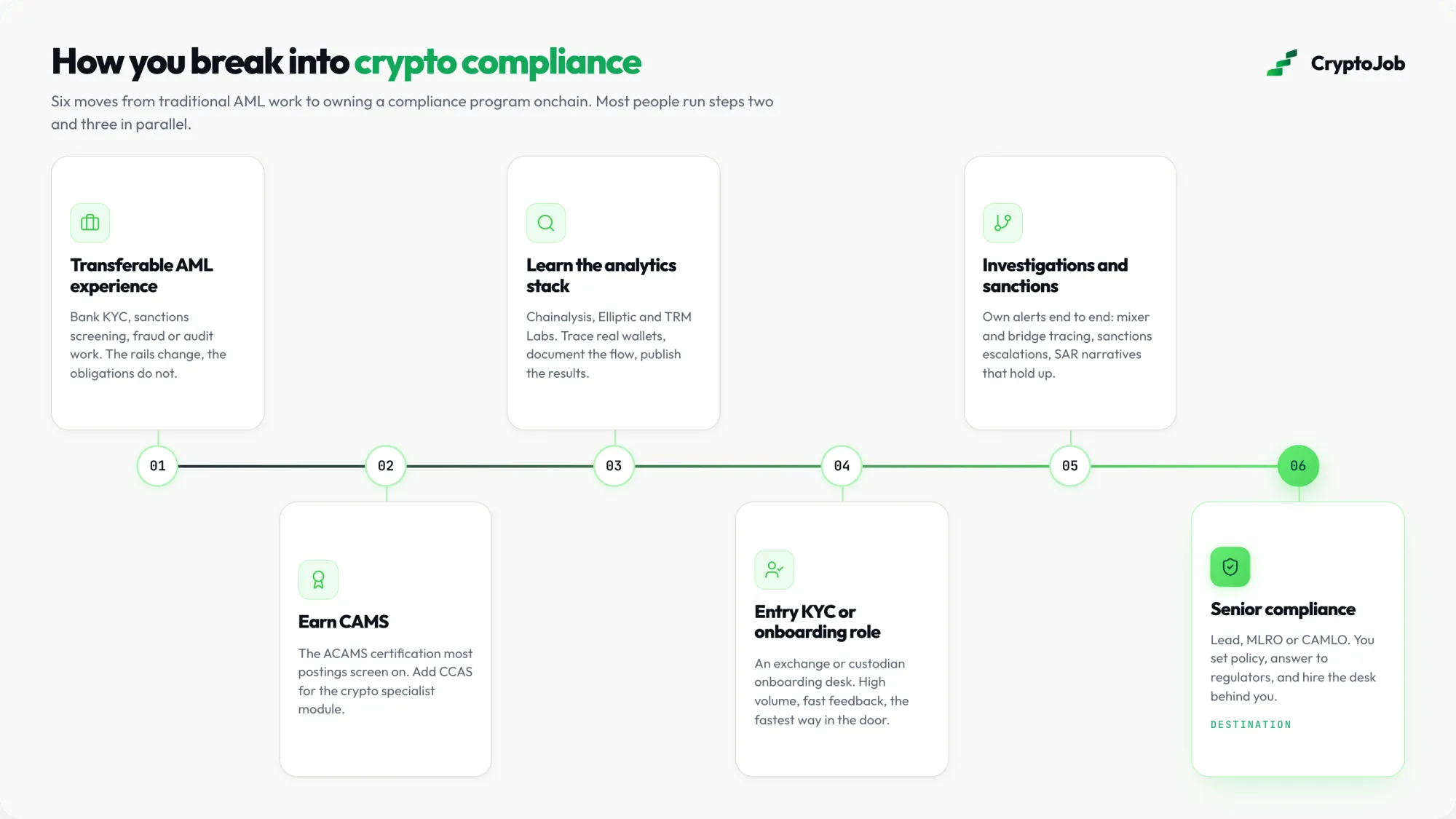
Breaking into crypto compliance jobs is easier than most web3 roles because the skills transfer directly from traditional finance. The fastest route is to pair existing AML or KYC experience with a certification and hands-on familiarity with blockchain-analytics tools. If you're pivoting from banking, that combination is often enough for an analyst role.
If you're newer to the field, entry KYC, onboarding or surveillance roles are the on-ramp, many of which are remote and contract-friendly. Exchanges hire these roles continuously, so our guide to getting a job at a crypto exchange is worth reading. When you're ready, browse web3 jobs and filter for compliance and analyst roles.
Which companies hire crypto compliance staff?
Crypto compliance hiring is led by the major exchanges and the analytics firms that serve the whole industry. Platforms like Coinbase, Kraken, Bitget and Binance hire compliance and AML staff continuously, from entry analysts to Chief AML Officers. Stablecoin issuers and custodians add further demand as regulation tightens.
The blockchain-analytics firms themselves, Chainalysis, Elliptic and TRM Labs, also hire investigators and analysts, as do the consulting firms supporting crypto clients. Many of these roles are remote and open to people transitioning from traditional finance. That breadth is part of why compliance is such a reliable entry point.
How do crypto compliance jobs compare to traditional finance AML roles?
Crypto compliance work rewards a specific twist on traditional AML: the same fundamentals plus the ability to trace activity on public blockchains. Analysts still handle KYC, sanctions and reporting, but they also translate wallet flows into regulator-ready narratives. That crypto-native layer is what earns a premium over comparable bank roles.
The upside for career switchers is that most of the skill transfers directly. If you've done AML or KYC in banking or fintech, adding blockchain-analytics fluency is often enough to move across, frequently without a pay cut.
Frequently asked questions
Do you need a finance background for crypto compliance jobs?
It helps a lot but isn't strictly required. AML, KYC or sanctions experience from banking or fintech is the most common route, though strong analytical skills plus a certification can open entry roles. Crypto-specific knowledge can be learned on the job.
What certification is best for crypto compliance?
ACAMS (Certified Anti-Money Laundering Specialist, often called CAMS) is the most widely recognized credential. It's frequently listed as preferred or required on crypto compliance job posts.
Are crypto compliance jobs technical?
Mostly no. They're investigation- and analysis-heavy rather than coding roles, which makes them one of the strongest non-technical entry points into web3. Comfort with analytics tools and data is more important than programming.
What tools do crypto compliance analysts use?
Chainalysis, Elliptic, TRM Labs and CipherTrace are the main blockchain-analytics platforms, alongside block explorers and internal case-management systems. Familiarity with any of them is a strong signal to employers.
Are crypto compliance jobs remote?
Many are, especially analyst and investigator roles, though some senior and licensed positions require specific locations. Contract and remote arrangements are common in this space.
The bottom line
Crypto compliance and AML jobs are a fast-growing, code-free path into web3, paying from around $60,000 at entry to $350,000 for compliance leadership. If you have financial-crime experience, add a certification and analytics fluency and you're well positioned. With regulation tightening and the underlying skills highly transferable, few web3 roles offer a clearer route from where you are now to a six-figure career. When you're ready, browse web3 jobs and target the compliance and analyst roles that fit your background.