

TL;DR
- Crypto remote work survived 2026 while the wider economy reversed
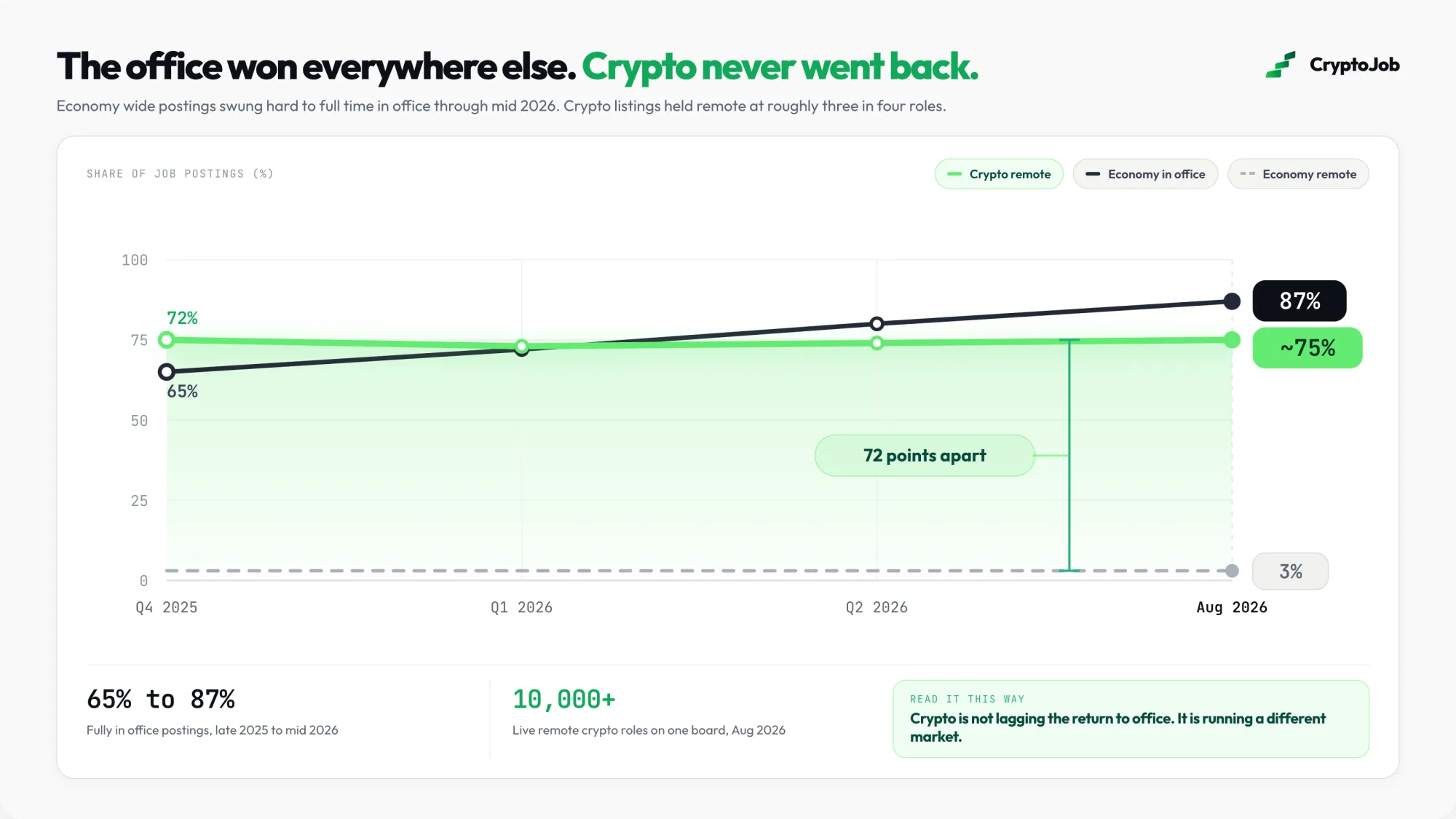
- Fully in office postings hit 87 percent economy wide per Robert Half
- Over 10,000 remote crypto listings remain live on major boards
- The exceptions cluster in trading desks and leadership cores
Is crypto remote work ending? The economy wide answer is brutal: Robert Half's posting analysis shows fully in office roles jumping from 65 percent in late 2025 to 87 percent by mid 2026, with pure remote collapsing to 3 percent of general listings. Crypto's answer is the counter story, with over 10,000 remote crypto jobs live on a single board this month and recruiters describing the industry as doubling down while traditional tech retreats. This piece maps where the holdout is real, where it is eroding and how to position for either world.
The stakes changed precisely because the rest of the market reversed: crypto's remoteness went from standard perk to scarce asset in eighteen months. Check the live remote share yourself anytime when you browse web3 jobs and toggle the remote filter.
The honest headline is a split verdict, and the split follows money and speed.
How remote is crypto actually in 2026?
Structurally remote still. Roughly three quarters of web3 listings have carried remote tags through recent tracking, one major board shows 10,149 remote crypto roles this August and specialist recruiters counted more than 15,000 active remote positions in spring, spanning engineering through operations.
The infrastructure never unwound: globally distributed teams, async rituals, multi entity payroll and offsite budgets remain the operating system at exchanges and protocol firms alike.
Culture keeps enforcing it too, since companies built on permissionless participation struggle to argue for badge readers, and candidates in this industry still list location freedom among their top decision factors.
Why is the wider economy going the other way?
Because the leverage flipped. Softer tech labor markets let employers enforce preferences they shelved during the talent wars, and the Robert Half numbers show implementation rather than announcements: 87 percent of analyzed postings fully onsite by the second quarter, with over a third of employers increasing required office days in a year.
Surveys capture the tension underneath: large shares of workers say they would quit over lost flexibility even as roughly 30 percent of organizations plan to reduce remote work this year, which is exactly the standoff crypto employers now recruit against.
The AI industry's in person intensity added cultural gravity, exporting the idea that frontier work happens in rooms, and some crypto founders imported it wholesale.
Where inside crypto is remote genuinely ending?
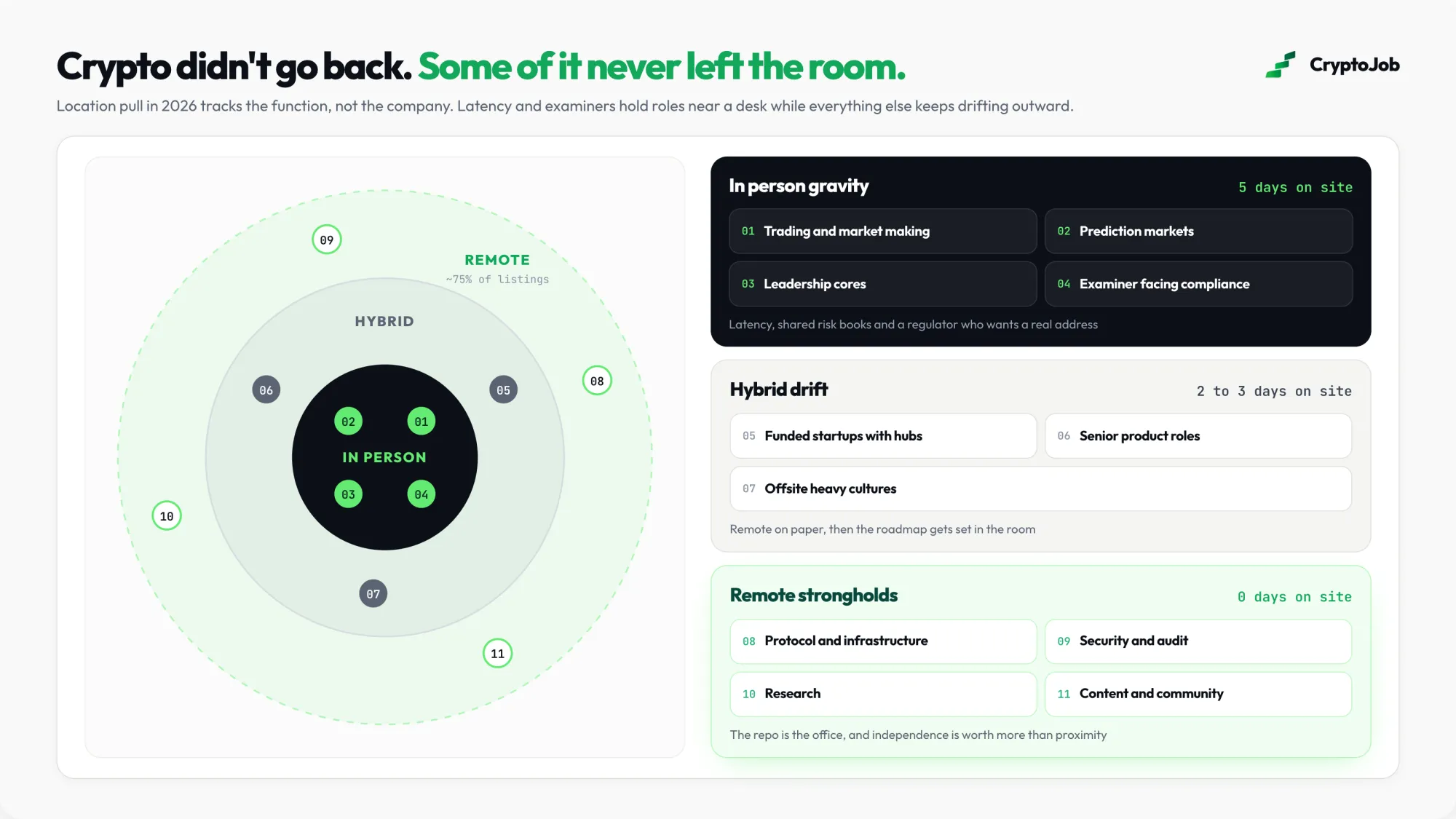
Wherever speed meets money in one room. Trading firms and the prediction market wave hire heavily in person, with the hottest New York names building trading floor cultures on purpose, and their premium pay lets them insist.
Leadership and frontier product teams drift officeward too: founders citing AI era shipping velocity pull core groups into hubs, senior roles increasingly list hybrid expectations and fresh funding rounds often arrive with lease announcements attached.
Regulated functions add their own gravity, since examiner facing compliance, custody operations with controlled environments and IPO preparation teams anchor naturally to specific rooms in specific cities.
Where does remote remain untouchable?
Across the industry's distributed core: protocol engineering and reliability rotations that follow the sun by design, plus the security and community functions that were never office shaped.
Global talent arithmetic protects it, because the specialists these teams need live everywhere and relocation offers lose to remote offers for scarce skills, a dynamic every validator firm and audit shop confirms by hiring across dozens of countries.
Even the hybrid drift stays soft here, expressed as offsites and optional hubs rather than mandates, with perks like covered lunches on office days signaling invitation rather than requirement at companies straddling the line.
What does the split mean for pay and negotiation?
A location premium is quietly re emerging at the in person frontier: hub mandated trading, prediction market and leadership roles pay above remote equivalents partly to purchase the compliance, which candidates should price as compensation for optionality lost.
Remote roles gained a different currency, scarcity: as the wider economy's remote supply collapsed to a sliver, crypto's distributed jobs now compete against far fewer alternatives, strengthening employer leverage on everything except the flexibility itself.
Negotiators should therefore name the trade explicitly, exchanging office days for cash or seniority where mandates exist and defending documented remote status in writing where they do not, with our web3 versus web2 comparison covering how the industries now differ on exactly this axis.
How should remote first candidates adapt?
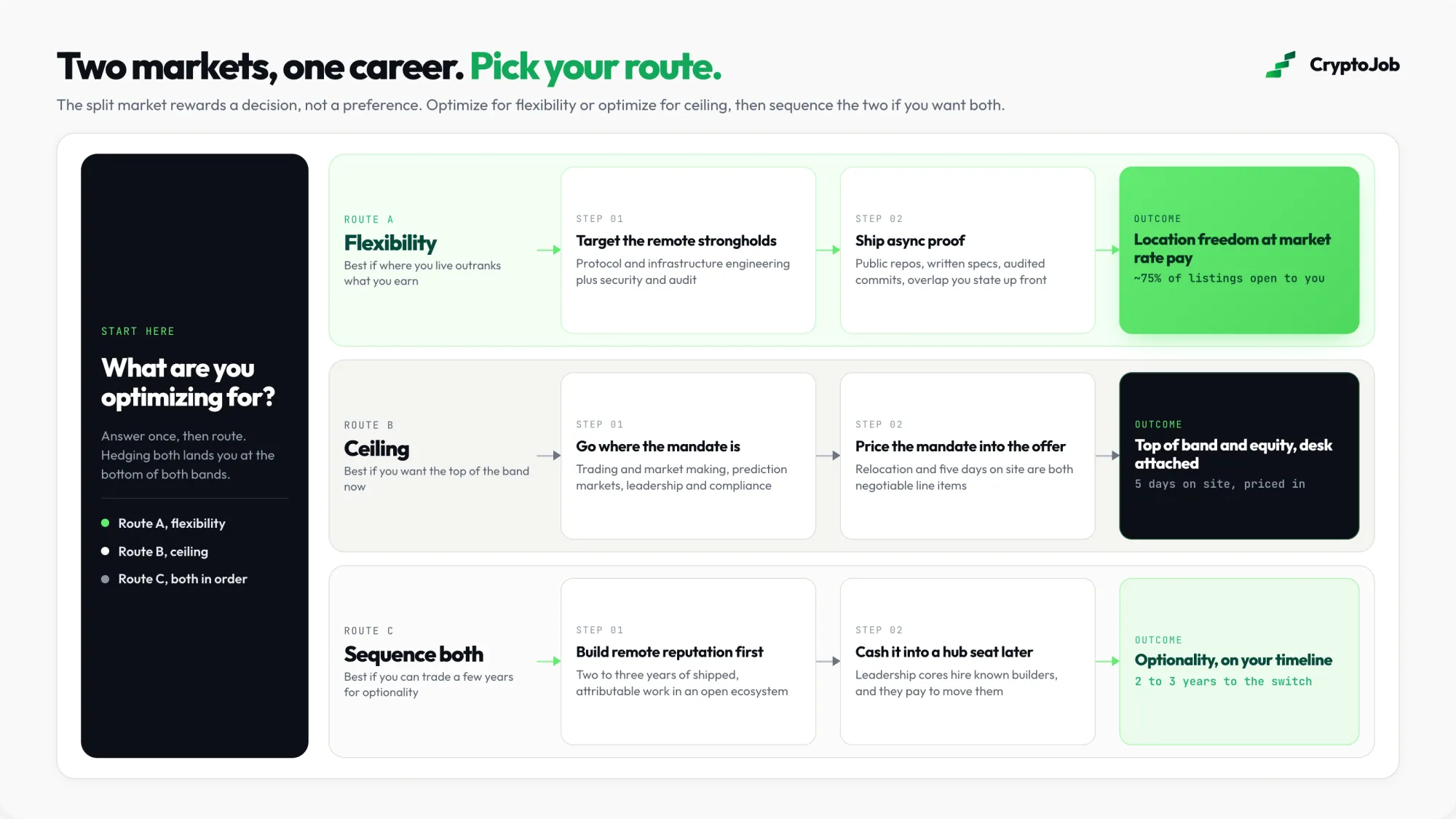
Target the strongholds deliberately, filtering for the functions and firm types above rather than fighting mandates role by role, and treat globally distributed employers' offsite cadences as the new social contract worth showing up for.
Sharpen the async evidence, since remote hiring bars rose with scarcity: written communication samples, public work, documented decisions and demonstrated self direction now separate offers, exactly the toolkit our remote web3 jobs guide assembles.
And keep one hub relationship warm anyway, because the highest compensation ceilings in the industry currently sit in rooms, and knowing which city you would say yes to keeps that option priced rather than foreclosed.
How do the work models compare in 2026?
| Model | Where it dominates | Compensation texture | Career tradeoff |
|---|---|---|---|
| Fully remote | Protocols, infra, security, content | Market pay, global competition | Freedom, thinner mentorship |
| Hybrid hub | Funded startups, senior product | Market pay plus offsite culture | Balance, some relocation pull |
| Fully in person | Trading, prediction markets, leadership | Premium pay, fastest promotion | Ceiling access, optionality lost |
| Economy wide baseline | Non crypto employers | 87 percent onsite postings | Crypto's remoteness now scarce |
Pay localization is the last negotiation frontier inside the remote stronghold, since distributed employers split between global bands and location adjusted ones, and the difference on identical roles can reach tens of thousands. Ask which model applies before discussing numbers, because it reframes every figure that follows.
One practical note for anyone reading listings this month: remote tagged does not always mean location free. A growing share of postings pair the remote label with a timezone band or a quarterly travel expectation, so read the fine print before assuming the map is fully open.
What would actually end crypto's remote era?
A prolonged winter concentrating survivors into trading style businesses would do it, since the in person exceptions are exactly the revenue models that thrive when speculation dominates, while a broad application economy keeps the distributed core funded.
Watch three tells over the next year: whether new funding announcements keep pairing with hub leases, whether senior listings keep adding hybrid language and whether the giant boards' remote counts hold above five figures.
The likeliest 2027 is the current split hardened into structure: a distributed majority that treats remoteness as identity and an in person premium tier that pays for rooms, with careers routing between them deliberately, including via the hub cities in our best cities for crypto jobs guide.
How do you interview for remote roles in this market?
Lead with async evidence rather than claims: a written design doc, a public postmortem or a project README that reads cleanly does more than any sentence about being a self starter, because distributed teams hire on writing.
Expect process probes as their core screen: how you structure updates without meetings and how you escalate when blocked across time zones. Have real artifacts ready to share for each.
Treat the offsite question as culture reconnaissance in both directions, asking how often the team gathers and who pays, since healthy distributed employers answer instantly and defensive ones reveal themselves.
And verify the remote promise contractually: location language in writing and any hub expectations named explicitly, because the market shift has made informal remote arrangements the first thing reorganizations revisit.
So is the remote first era over or not?
Over economy wide, yet alive in crypto: the industry became the labor market's remote refuge exactly as its own frontier tier went back to rooms. That scarcity is your leverage if you name it.
Decide which side of the split you are optimizing for this year, build the evidence that side respects and scan this week's openings to see how many still let you choose your own map.
FAQ
Are most crypto jobs still remote in 2026?
Yes by listing share, with roughly three quarters of web3 postings remote tagged and over 10,000 live remote roles on major boards, even as specific niches pull in person.
Which crypto jobs now require office presence?
Trading and market making plus examiner facing compliance and custody functions lead the in person list, typically compensating with premium pay.
Do remote crypto jobs pay less than in office ones?
Bases remain comparable across most functions, while the in person trading and leadership tier pays a genuine premium that partly purchases the mandate itself.
Will crypto follow tech back to the office?
The distributed core shows no sign of it, since global talent needs and culture both resist, but expect the hybrid and in person tier to keep growing at the industry's fastest moving frontier.