

TLDR
- Students can realistically earn $15 to $30 per hour in part-time web3 roles like community moderation, content writing and research
- Top crypto internships pay well. Coinbase engineering interns report $50 to $67 per hour
- Most web3 jobs for students are remote and need 10 to 20 hours a week
- No degree required for most non-technical roles
Yes, there are real web3 jobs for students and many of them pay in actual money, not just "exposure" or tokens. The most accessible options are part-time roles like community moderation, content writing and social media, which typically pay $15 to $30 per hour. If you want something more structured, paid internships at companies like Coinbase, Kraken and Chainalysis run every summer and pay competitively.
This guide covers what roles exist, what they actually pay, where to find them and how to land one with zero work experience. You can browse web3 jobs right now on CoinTerminal to see what's live, then come back here for the strategy.
One thing upfront: pay in web3 varies a lot by company, region and whether you're paid in fiat or tokens. Every number below is a realistic range, not a guarantee.
What are the best web3 jobs for students?
The best student roles share two traits. They're remote and they're judged on output, not hours in an office. That makes them compatible with a class schedule. Here are the ones students actually land.
Community moderator
Every crypto project runs a Discord or Telegram. Someone has to answer questions, flag scams and keep discussions civil. That someone is often a student in a different timezone.
Pay typically lands between $15 and $25 per hour, though smaller projects sometimes pay less or partly in tokens. Requirements are basically fluency in the community's language, genuine knowledge of the project and reliability. Many mods start as active unpaid community members and get hired from within.
Content writer
Projects need blog posts, documentation, newsletters and thread-style explainers. If you can explain staking to your roommate, you can do this job.
Junior crypto writers commonly earn $0.10 to $0.30 per word freelance, or $20 to $35 per hour on retainer. A single 1,000-word article at $0.15 per word is $150. Two articles a week fits around classes and pays better than most campus jobs.
Social media and marketing assistant
Running an X account, clipping content for TikTok, designing memes and coordinating giveaways. Part-time retainers of $500 to $1,500 per month are common for 10 to 15 hours a week, though this varies widely with project size.
Research analyst
Exchanges, media outlets and DAOs pay for token research, market summaries and protocol comparisons. Finance and economics students do well here. Part-time research gigs typically pay $18 to $30 per hour. It's also the single best portfolio builder if you want a full-time analyst job after graduation.
Junior developer or QA tester
If you code, even a little, you can test dApps, write scripts or contribute to open source. Paid QA and junior dev work usually starts around $20 to $40 per hour. Bug bounties are a wilder option. Platforms like Immunefi list bounties from a few hundred dollars to six figures for critical smart contract vulnerabilities, but treat those as a lottery ticket, not income.
Campus ambassador
Many chains and exchanges run student ambassador programs. You host events, post content and onboard classmates. Compensation is usually a monthly stipend of $100 to $500, sometimes in tokens, plus swag and conference tickets. The pay is modest but the network you build is the real payment.
How much do part time crypto jobs pay?
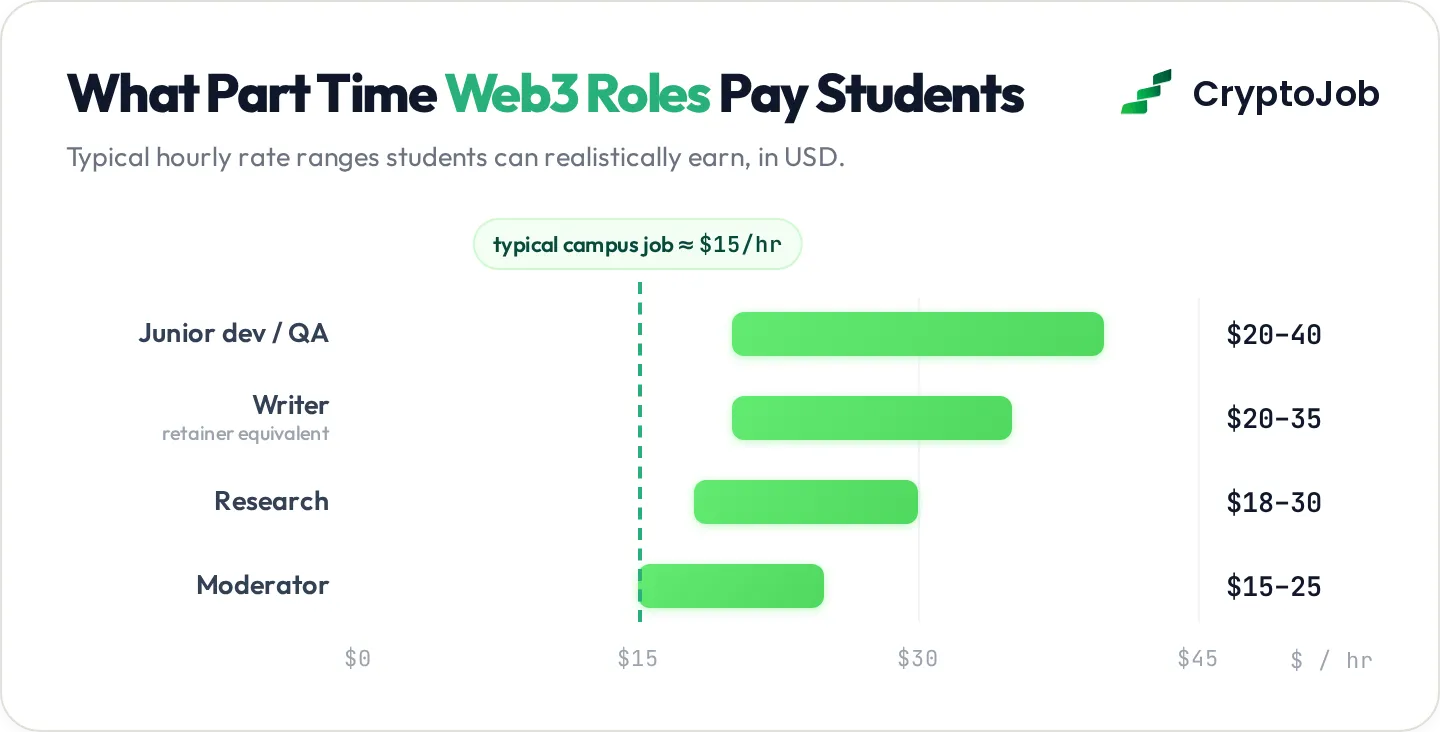
Here's the honest picture across the common student roles. All figures are typical ranges and vary by project size, your experience and region.
|
Role |
Typical pay |
Hours per week |
Experience needed |
|
Community moderator |
$15 to 25/hr |
10 to 20 |
None, just be active in the community |
|
Content writer |
$0.10 to 0.30/word |
Flexible |
Writing samples |
|
Social media assistant |
$500 to 1,500/mo |
10 to 15 |
A decent personal X account helps |
|
Research analyst |
$18 to 30/hr |
10 to 15 |
Coursework or published research |
|
Junior dev / QA |
$20 to 40/hr |
10 to 20 |
GitHub with real commits |
|
Campus ambassador |
$100 to 500/mo stipend |
5 to 10 |
Enrolled student, social presence |
Two caveats. First, some projects pay partly or fully in their own token. Ask before you start, because a token salary can drop 50% before your first payout. Second, well-funded companies (exchanges, infrastructure firms, VC-backed startups) pay at the top of these ranges. Anonymous meme coin projects pay at the bottom, when they pay at all.
Compare that to the average US campus job at roughly $15 per hour and part-time crypto work looks pretty good, especially since it doubles as career experience.
Which crypto internships for students actually pay?
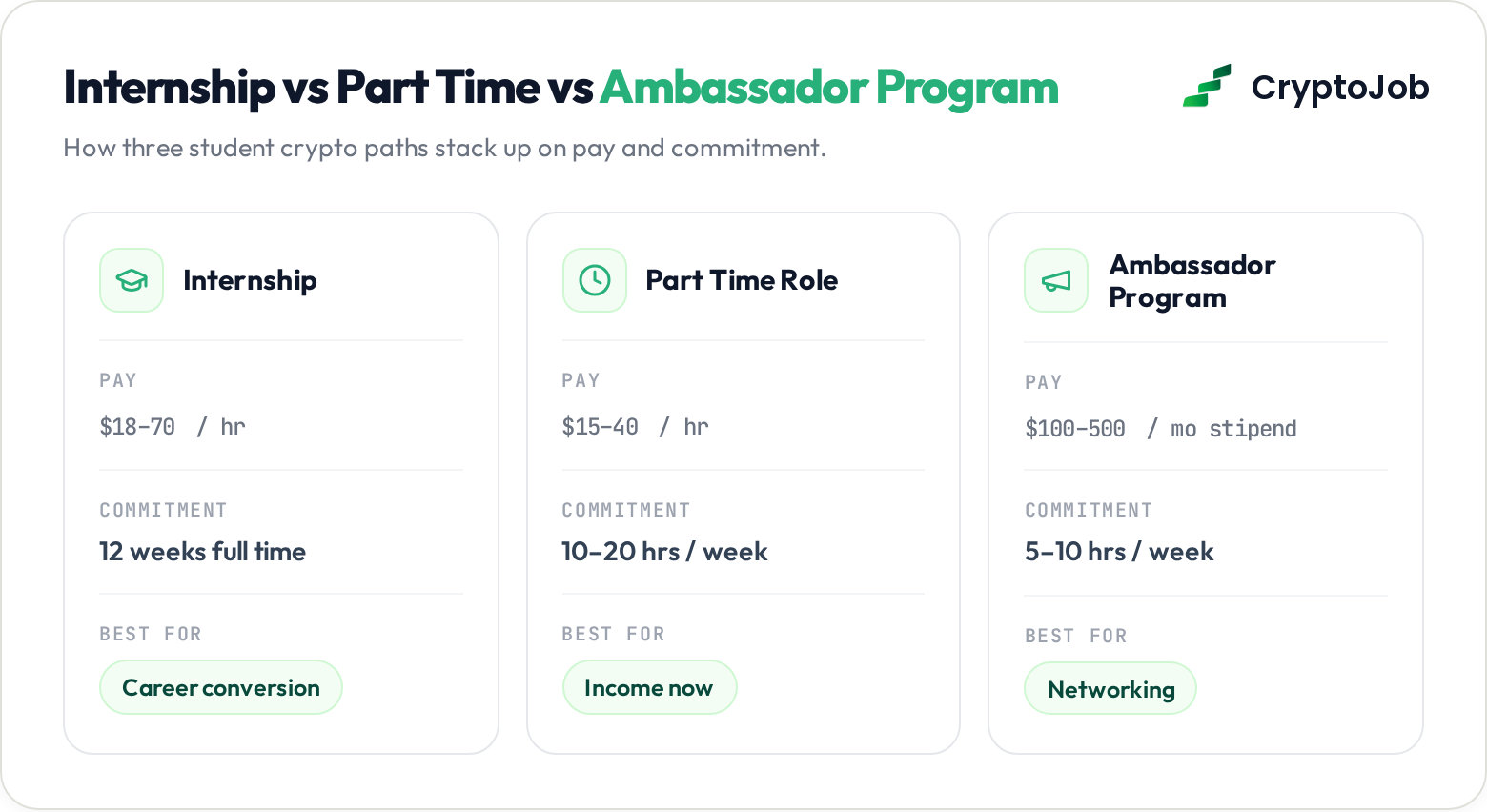
Plenty of them, and some pay shockingly well. The structured summer internship route is the strongest option if you want a full-time web3 career after graduation, because top programs are designed to convert interns into employees.
Coinbase runs the best-known program. Internships are typically 12 weeks over the summer, with hybrid and remote options, housing stipends for hybrid interns and a stated goal of converting top performers to full-time. Software engineering interns there report $50 to $67 per hour on Levels.fyi and Glassdoor, which works out to roughly $10,000 per month. Non-engineering intern roles pay less but are still competitive.
Other companies that have run paid internship or early-talent programs include Kraken, Ripple, Chainalysis, Circle, ConsenSys and Fidelity Digital Assets. Traditional finance firms like JPMorgan and Visa also have blockchain teams that take interns, which is an underrated backdoor into the industry. Programs change year to year, so always verify on the company's careers page.
Realistic pay expectations by track:
- Engineering internships at major exchanges and infrastructure firms: $40 to $70 per hour
- Non-technical internships (marketing, ops, research, legal): $18 to $30 per hour is common, though top firms pay more
- Startup internships: anywhere from unpaid (avoid these) to $25 per hour, sometimes with a token grant
Application timing matters more than students expect. Big programs open applications in early fall for the following summer and review on a rolling basis. If you wait until spring, most seats are gone. Set a calendar reminder for September.
How do you get web3 jobs for students with no experience?
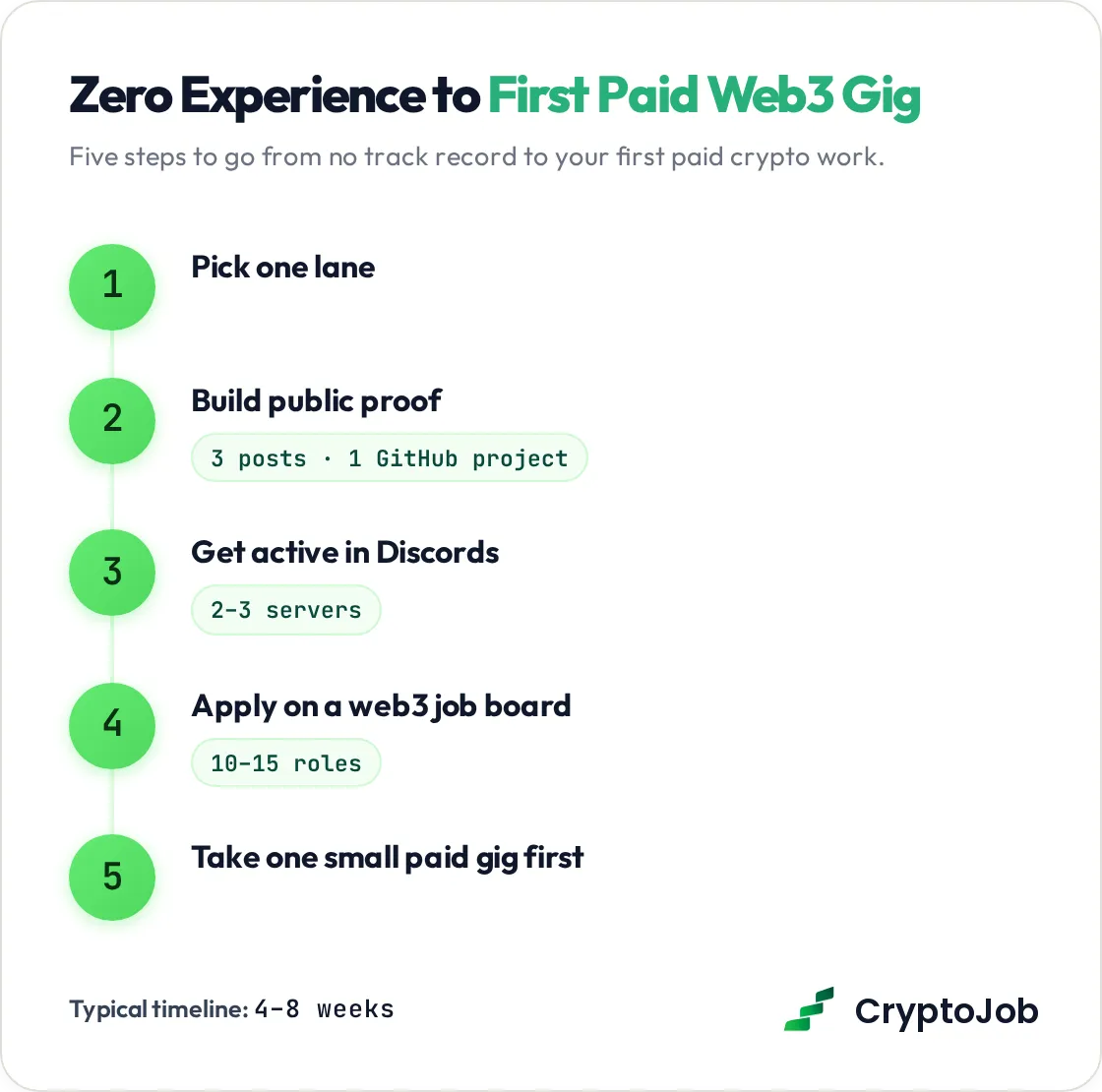
Nobody in web3 cares about your GPA. They care about proof you can do the work. Here's the roadmap that actually works, in order.
Step 1: Pick one lane. Writing, community, research, design or code. Trying to be everything reads as being nothing.
Step 2: Build public proof. Write three solid explainer threads or blog posts. Push a small project to GitHub. Publish a token research report on a free Substack. This takes two to four weeks and replaces the experience section of your CV.
Step 3: Join two or three project communities and be genuinely useful. Answer newcomer questions in Discord. Report bugs. Suggest improvements. A meaningful share of paid mod and ambassador roles are filled from inside the community before they're ever posted.
Step 4: Apply where jobs are actually listed. Use a dedicated web3 job board rather than generic sites, since crypto-native companies post there first. Apply to 10 to 15 roles with a short, specific pitch that links your proof of work.
Step 5: Do small paid gigs before chasing the big internship. One $150 article or one month of paid moderation makes your internship application concrete instead of hypothetical.
Students who follow this usually land their first paid gig in four to eight weeks. It's not instant, but it's faster than almost any traditional industry.
Are web3 jobs safe for students?
Mostly yes, but the space has scammers and you're a target precisely because you're new. Three rules keep you safe.
Never pay to get a job. No legitimate project charges an "onboarding fee" or asks you to buy their token to start work. Never share your seed phrase or connect your wallet to a site a "recruiter" sends you. And insist on at least partial payment in stablecoins or fiat if the project is small, so a token crash doesn't erase your paycheck.
If a role only exists in someone's DMs and not on an official careers page or reputable job board, treat it as fake until proven otherwise.
Where should you start today?
If you have 30 minutes right now: pick your lane, draft one piece of proof of work and shortlist five projects you actually use. Then browse web3 jobs on CoinTerminal and filter for part-time and internship roles. Applying early in a posting's life dramatically raises your response rate, so make checking listings a twice-weekly habit.
The students who break into web3 aren't the smartest ones. They're the ones who shipped something public and applied before everyone else.
FAQ
Can students work in web3 without knowing how to code?
Yes. Community moderation, content writing, social media, research and ambassador roles need zero code. Non-technical roles make up a large share of student-friendly web3 jobs, and they typically pay $15 to $30 per hour.
Are crypto internships remote?
Many are. Coinbase offers both hybrid and remote internships, and most startups hire interns fully remote. Larger firms sometimes require office time but often include a housing stipend when they do.
How many hours a week do part-time web3 jobs require?
Most student roles run 10 to 20 hours per week and many are async, meaning you work when your schedule allows as long as tasks get done. That flexibility is the biggest advantage over campus jobs.
Should I accept payment in tokens?
Be careful. Tokens can drop sharply between agreeing on pay and receiving it. A reasonable compromise is majority stablecoins or fiat with a small token bonus. Also check how crypto income is taxed where you live, because in most countries it's taxable the moment you receive it.
When should I apply for summer crypto internships?
Early fall of the previous year. Major programs like Coinbase's open applications in the fall and review candidates on a rolling basis, so applying in September or October gives you the best odds.