

TL;DR
- Most blockchain certifications carry little weight with technical interviewers
- Prices run from free up to $4,000 for university programs
- Certificates help most in enterprise, consulting and HR screened roles
- A public portfolio beats every certificate for developer hiring in 2026
Blockchain certifications work for a narrow set of situations and waste money in the rest, so the honest answer to whether they are worth it is: it depends on who reads your resume. HR screeners and enterprise consultancies recognize badges, technical interviewers at crypto companies largely ignore them and prices span from free courses to university programs near $4,000. This guide sorts the credentials that help, the ones that do not and what to do instead.
The industry norm is skill proof over paper proof, which cuts both ways depending on your target employer. Before spending anything, browse web3 jobs and read twenty listings for your target role, then count how many mention certifications at all.
Spoiler from that exercise: crypto native companies almost never do, while banks and consultancies sometimes do.
Do employers actually care about blockchain certifications?
Crypto native employers mostly do not. Hiring managers at protocols and exchanges screen GitHub activity, shipped projects, audit contest results and referrals, and a certificate line changes little in that stack.
Enterprise and corporate employers sometimes do. Consultancies and IT departments run HR screening where recognized badges pass filters, and reviewers note that firms like the big consulting and enterprise software players employ certified professionals for client facing credibility.
The chairman of the Global Blockchain Business Council put it plainly years ago and it still holds: certification is a default mechanism when you are starting out and lack a body of experience. Once experience exists, it speaks louder.
Which blockchain certifications are worth considering in 2026?
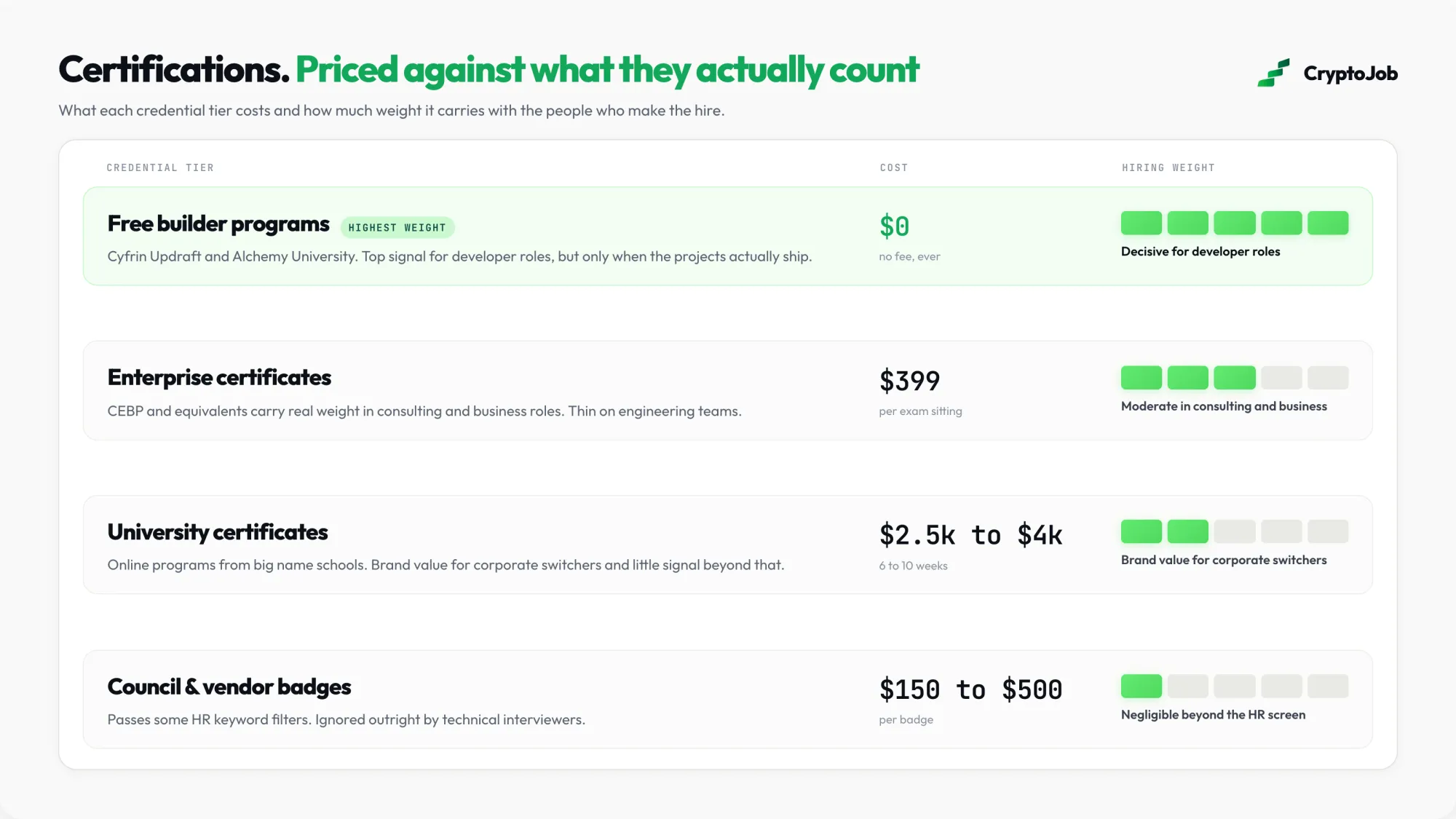
The Certified Enterprise Blockchain Professional from 101 Blockchains, at roughly $399 over about five weeks, earns the most consistent respect for enterprise and business roles, with reviewers calling it the credential large employers actually recognize. Its stated weakness is equally consistent: near zero weight for coding roles.
University programs from names like MIT and Wharton, typically $2,500 to $4,000 for online blockchain courses, buy brand recognition that helps corporate career switchers and looks strong on finance resumes. You are paying for the university name more than the syllabus.
Vendor and council certificates, including the Blockchain Council and Blockchain Training Alliance catalogs at roughly $150 to $500, verify effort and provide structure. Sites promoting them cite six figure salaries for certified roles, but those figures describe the jobs, not what the certificate caused, so read the marketing skeptically.
What do the free alternatives offer?
More than the paid ones, for developers. Cyfrin Updraft delivers serious smart contract and security curriculum at no cost, Alchemy University covers full stack web3 development free and both end in exactly what interviews test: working code you wrote.
Ecosystem programs add credibility through selectivity. Bootcamps and fellowships run by major protocol foundations and developer communities cost nothing, filter by application and signal harder than any purchased badge because acceptance itself is the credential.
The pattern to notice: in this industry, credentials you earn by building outrank credentials you buy by studying. Our self taught web3 roadmap sequences the free resources into a plan.
One more reason the free tier outranks the paid one: finishing a build program leaves you holding the code. A certificate leaves you holding a PDF, and only one of those survives a technical interview.
When is paying for a certification the right call?
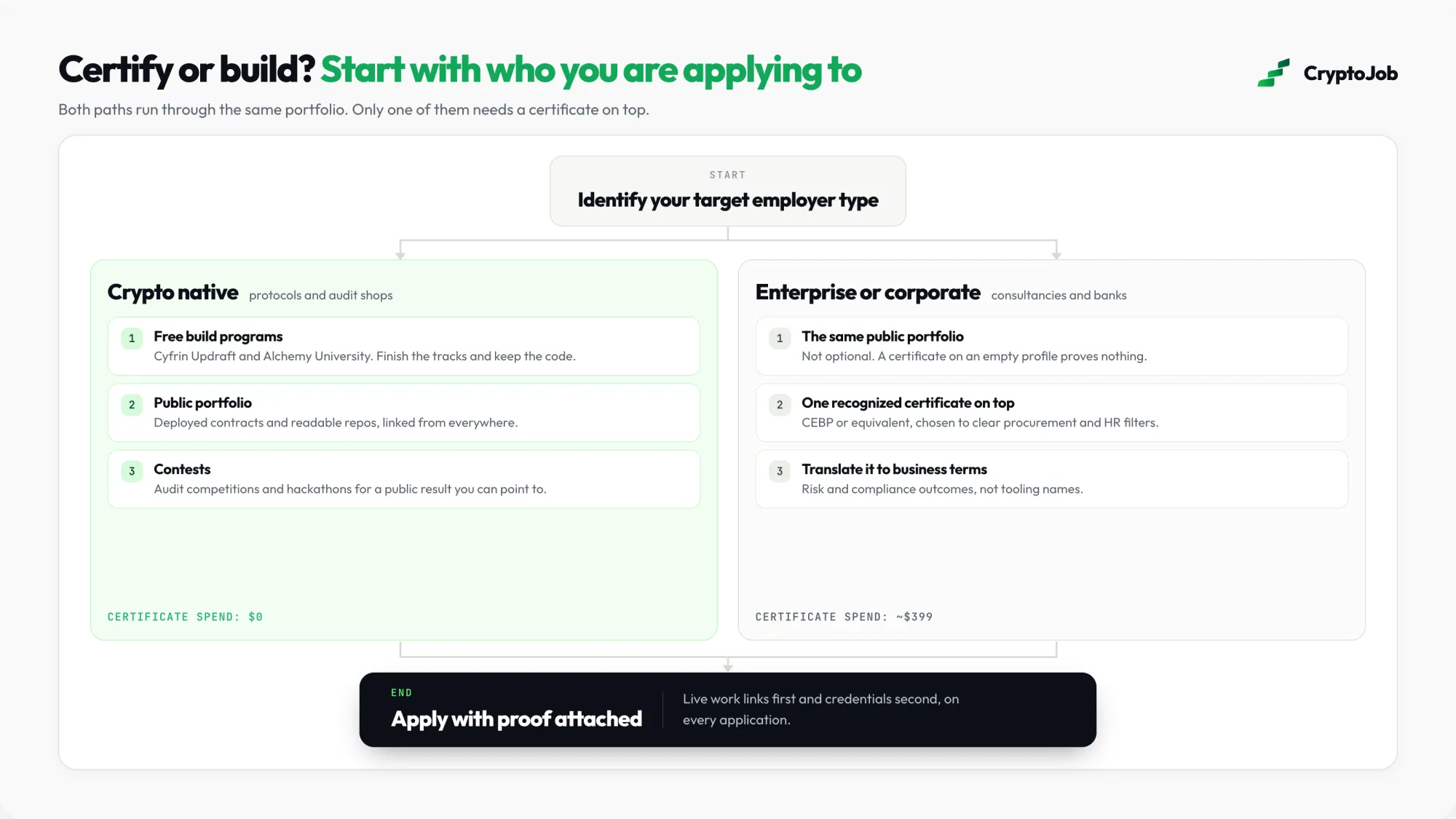
Four situations justify it. Your target employer is a bank or consultancy with HR screening. Your country's job market or visa process formally values certificates. Your employer reimburses education and the structure keeps you accountable. Or you are pivoting from a corporate role where a university badge reframes your story.
Outside those, redirect the budget. The $399 to $4,000 a certificate costs funds months of building time or the conference tickets where referrals actually happen.
Regional markets shift the answer too. Hiring in India, the Gulf and parts of Southeast Asia runs through HR portals and formal filters more often than Western crypto hiring does, so a recognized badge earns more shortlist value there and candidates targeting those markets can weight certificates a notch higher.
If you do buy, buy once and small. One recognized credential plus visible work beats a wall of badges, which can actually read as substitution for experience. Degrees follow the same logic, unpacked in our piece on whether you need a CS degree for web3 jobs.
What do hiring managers rank above certificates?
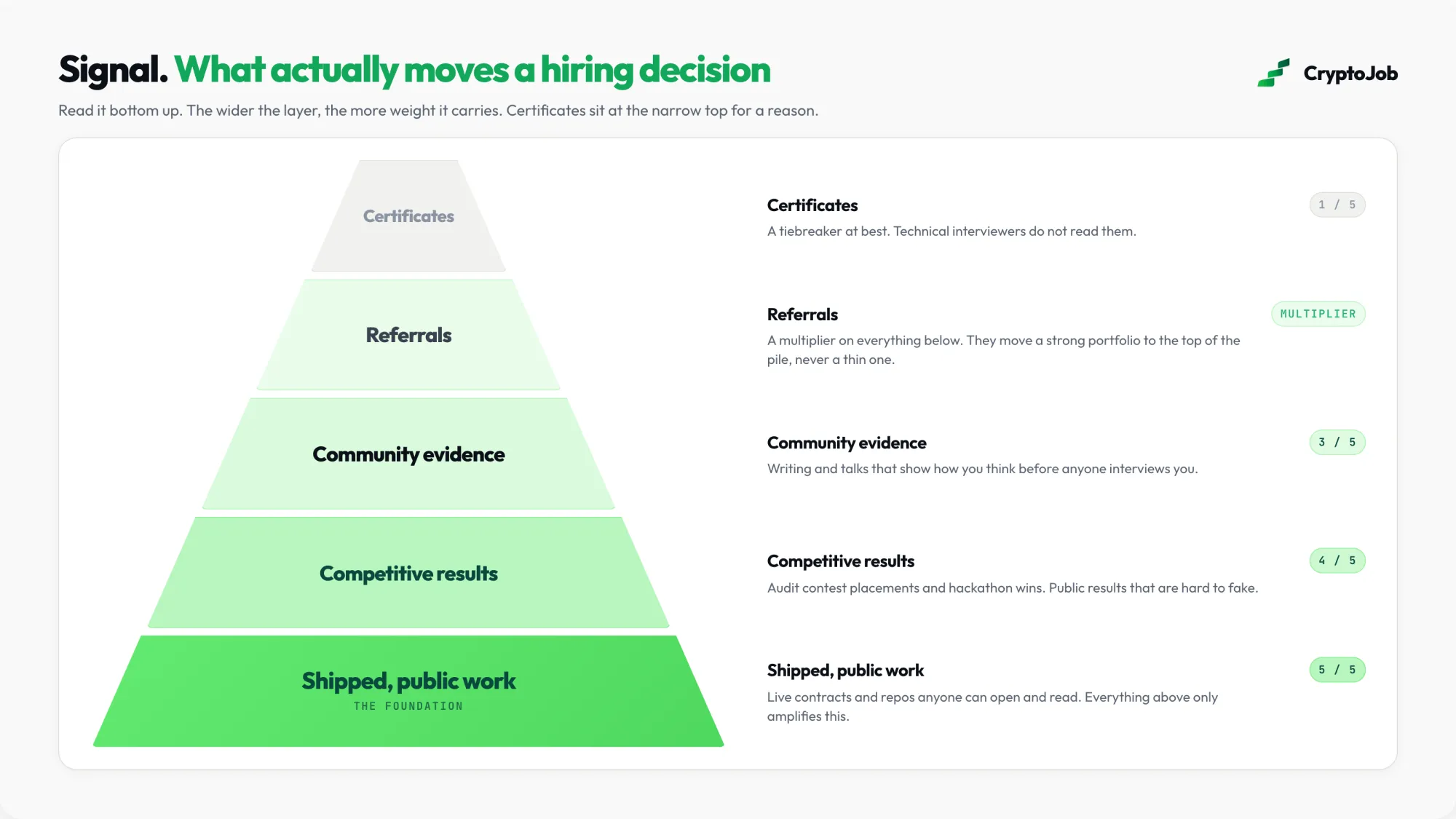
Shipped work sits first: contracts on mainnet, contributions to known repos, a dApp with real users or documented protocol experiments. Second comes competitive proof, meaning audit contest placements and hackathon wins, because ranked performance is unfakeable.
Third is community evidence: talks given, technical writing, answers in developer forums where your handle carries history. Referrals thread through all of it, since a trusted engineer vouching for you compresses every other signal.
Certificates sit below all four for crypto native roles. They are not worthless, they are simply the weakest signal in the stack, and our guide to web3 portfolio projects shows what to build instead.
How do the main options compare?
| Option | Cost | Time | Helps most with |
|---|---|---|---|
| Cyfrin Updraft or Alchemy University | Free | 2 to 4 months | Developer and security roles |
| CEBP by 101 Blockchains | About $399 | About 5 weeks | Enterprise and business roles |
| Council and BTA certificates | $150 to $500 | 2 to 6 weeks | HR screened corporate filters |
| University online certificates | $2,500 to $4,000 | 6 to 10 weeks | Corporate switchers, brand value |
What should your plan look like instead of collecting badges?
Run a ninety day build cycle. Complete one free structured program, ship two small public projects along the way and write one clear explainer about something you broke and fixed, because that trio produces interview material a certificate never will.
Keep the receipts organized as you go: a single page linking the programs finished, the projects shipped and the results earned turns three months of work into a scannable credential.
Add one competitive rep. Enter a beginner friendly audit contest or hackathon in month three, since even a modest placement converts directly into resume lines with numbers attached.
Only then decide on paper. If your target list includes enterprise employers, add the single most recognized certificate for that lane and let it ride on top of real work rather than substitute for it.
What about security certifications specifically?
Smart contract security has no dominant certificate, and that absence is informative. The field's real credentials are contest leaderboards and published audit findings, both of which are public, ranked and impossible to purchase.
Traditional security certificates still travel in the regulated corners. CISSP and similar credentials help at custodians and banks where procurement and audit checklists expect them, especially for infrastructure and governance roles rather than contract auditing.
If security is your target, structure beats certification: complete a security focused curriculum, then rebuild four or five famous exploits in a local environment before entering your first contest. That sequence produces exactly the evidence audit firms screen for.
How do recruiters and hiring managers weigh certificates differently?
Recruiters scan for keywords under time pressure, so a recognized certificate can help you survive the first thirty seconds at HR screened companies. This is the one honest service paid badges perform.
Hiring managers then re evaluate from zero. Technical interviewers probe until your real understanding shows, which is where certificate holders without projects stall and portfolio holders without certificates accelerate.
Play both screens deliberately: mirror the listing's exact terminology in your resume for the scan, then let linked work carry the human round. A certificate can open the door it was designed for, and only shipped proof walks through it.
So are blockchain certifications worth it?
Worth it as a targeted tool for enterprise facing careers, and never worth it as a substitute for shipped work. The market prices proof, and the free paths generate more proof per hour than any paid badge.
Audit your target employers first, then build throughout and spend only where it clears a filter. Whichever route you choose, keep it pointed at real openings by taking ten minutes to browse web3 jobs and reverse engineer what your target roles actually screen for.
FAQ
Which blockchain certification is most respected?
For enterprise and business roles, the CEBP from 101 Blockchains earns the most consistent recognition. For developer roles, no certificate outranks a public portfolio and contest results.
Are free blockchain courses taken seriously?
Yes, because employers evaluate what you built during them rather than the completion badge. Cyfrin Updraft and Alchemy University alumni get hired on their repos, not their PDFs.
Can a certification get me a web3 job with no experience?
Alone, rarely. Paired with two shipped projects and targeted applications it can help you pass corporate HR filters, which is the one screen certificates reliably move.
How much should I budget for blockchain certifications?
Between zero and $400 covers the useful range for most people. Spend beyond that only for a university brand you specifically need for a corporate or regional market reason.