

TLDR: You can learn web3 entirely self-taught: most working blockchain developers did., Pick one language: Solidity for the deepest job market or Rust for a scarcity premium.: A realistic timeline is 4 to 8 months for an existing programmer, around a year for a beginner.: The goal isn't courses completed, it's one deployed project you can show.
Figuring out how to learn web3 in 2026 is more straightforward than it looks, and you don't need a bootcamp or a CS degree to do it. Most working blockchain developers are self-taught, and the whole field rewards shipped work over credentials. The path is simple to describe: learn one stack deeply, build real projects and deploy them.
What separates people who get hired from people who stall is finishing and deploying something public. To see the kinds of roles this leads to, you can browse web3 jobs as you read.
Can you really learn web3 on your own in 2026?
Yes, you can learn web3 on your own and it's the norm rather than the exception. The learning resources are abundant and mostly free, the tooling is mature and hiring managers care far more about what you've built than where you learned it. Self-study plus open-source contribution is a well-trodden path into the industry.
The catch is discipline and direction. Because there's so much material, it's easy to drift between tutorials without building anything. The people who succeed pick one lane, go deep and treat every concept as something to apply in a project rather than just watch. A structured plan matters as much as the material itself. Deciding in advance what you'll build at each stage turns an overwhelming field into a sequence of concrete, finishable steps and finishing things is what ultimately separates people who get hired from people who stall.
How do you start to learn web3 development?
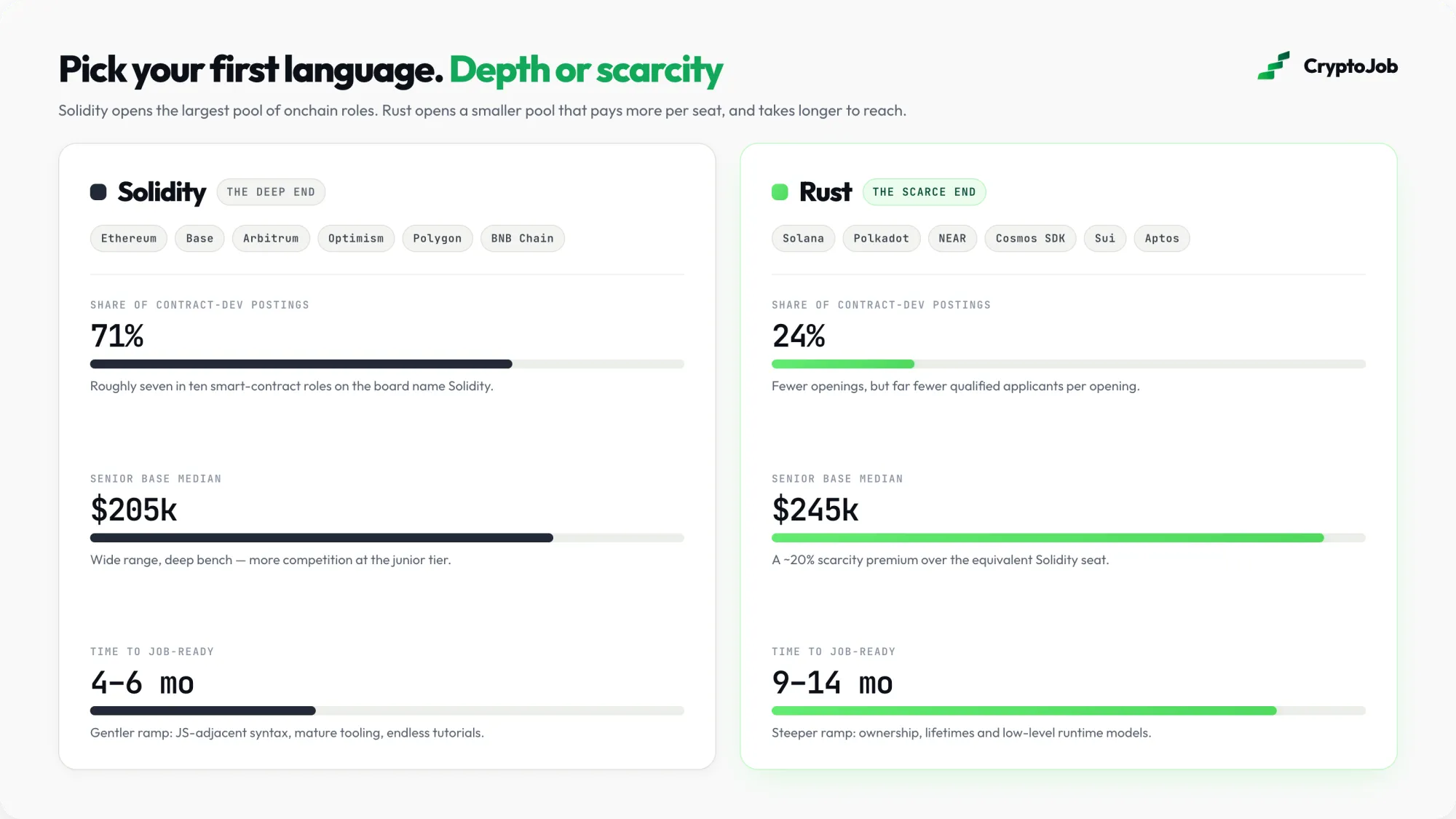
To start learning web3 development, begin with programming fundamentals if you don't have them, then move to blockchain basics. You need to understand how transactions, gas and smart contracts work before writing much code. From there, pick your first language based on the ecosystem you want to join.
A sensible starting sequence looks like this:
- Fundamentals first: JavaScript/TypeScript, or Rust if you're aiming at Solana.
- Blockchain basics: accounts, transactions, gas and how contracts execute.
- Pick a language: Solidity for EVM chains, or Rust for Solana and Polkadot.
- Use free resources: interactive tutorials, docs and beginner project guides.
What does a self-taught blockchain developer path look like?
The self-taught blockchain developer path is a loop of learning a concept, building something with it and deploying it publicly. Rather than finishing a course and hoping, you write and ship increasingly ambitious projects. Each one teaches more than passive study and doubles as portfolio material.
Concretely, that means building a token, then an NFT contract, then a small DeFi app, deploying each to a testnet and then mainnet. Along the way you learn security by practicing on capture-the-flag challenges. This build-first approach is exactly what our guides to Solidity developer jobs and blockchain developer jobs describe as the real hiring bar.
What is a realistic web3 skills roadmap?
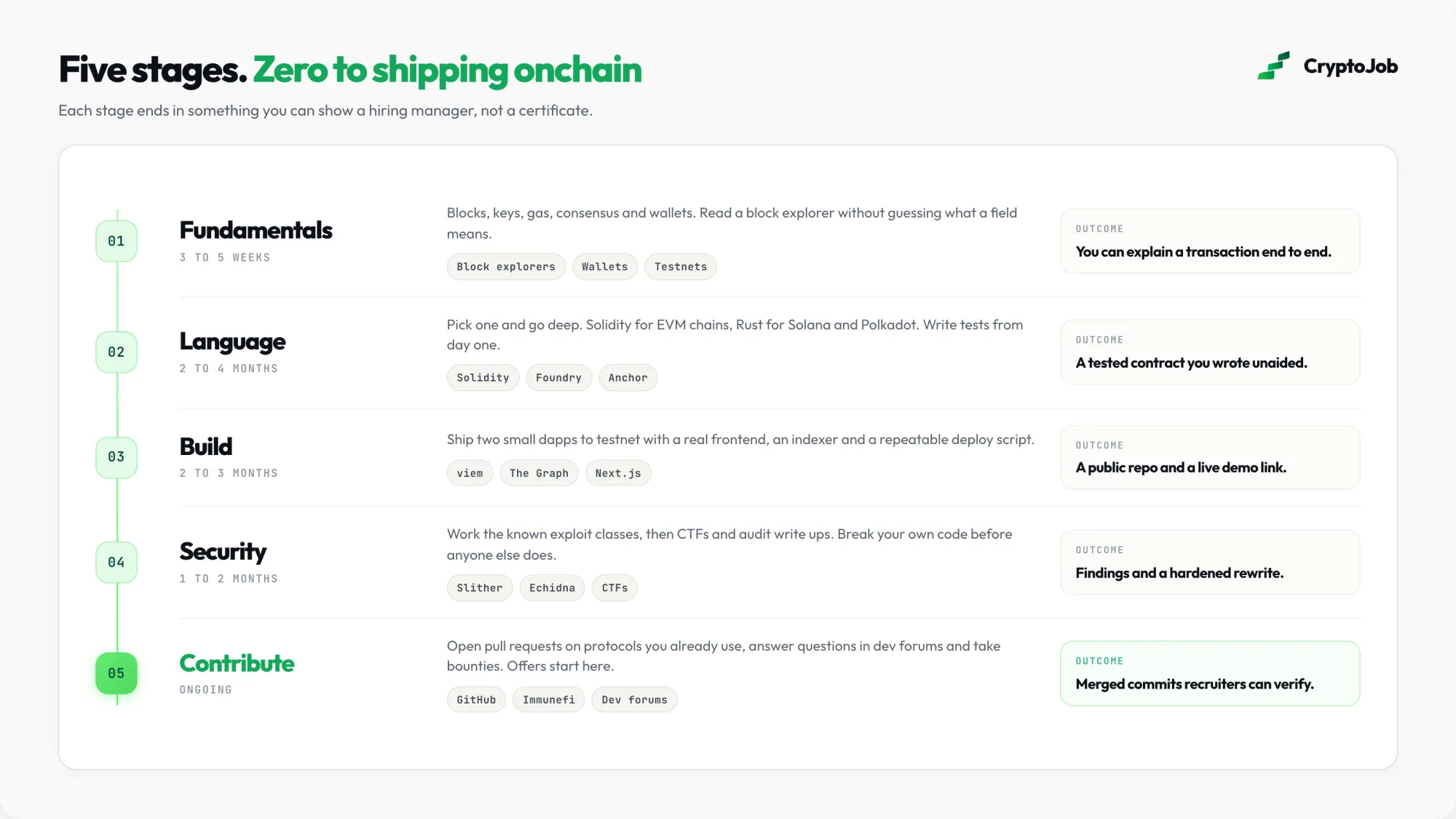
A realistic web3 skills roadmap moves from fundamentals to a shipped, security-aware project, then into open source. The point is to build momentum with each step producing something concrete. Skipping the "ship it" part is the most common reason people stall.
| Stage | Focus | Outcome |
|---|---|---|
| 1. Fundamentals | Programming + blockchain basics | Comfortable reading and writing code |
| 2. Language | Solidity or Rust, plus tooling | First working contract or program |
| 3. Build | Token, NFT or small dApp | Deployed on testnet then mainnet |
| 4. Security | Vulnerability classes, CTFs | Can reason about exploits |
| 5. Contribute | Open-source repos and bounties | Public track record and referrals |
By the end of that sequence you have exactly what hiring managers look for: demonstrated skill, a deployed project and public contributions.
How long does it take to learn web3?
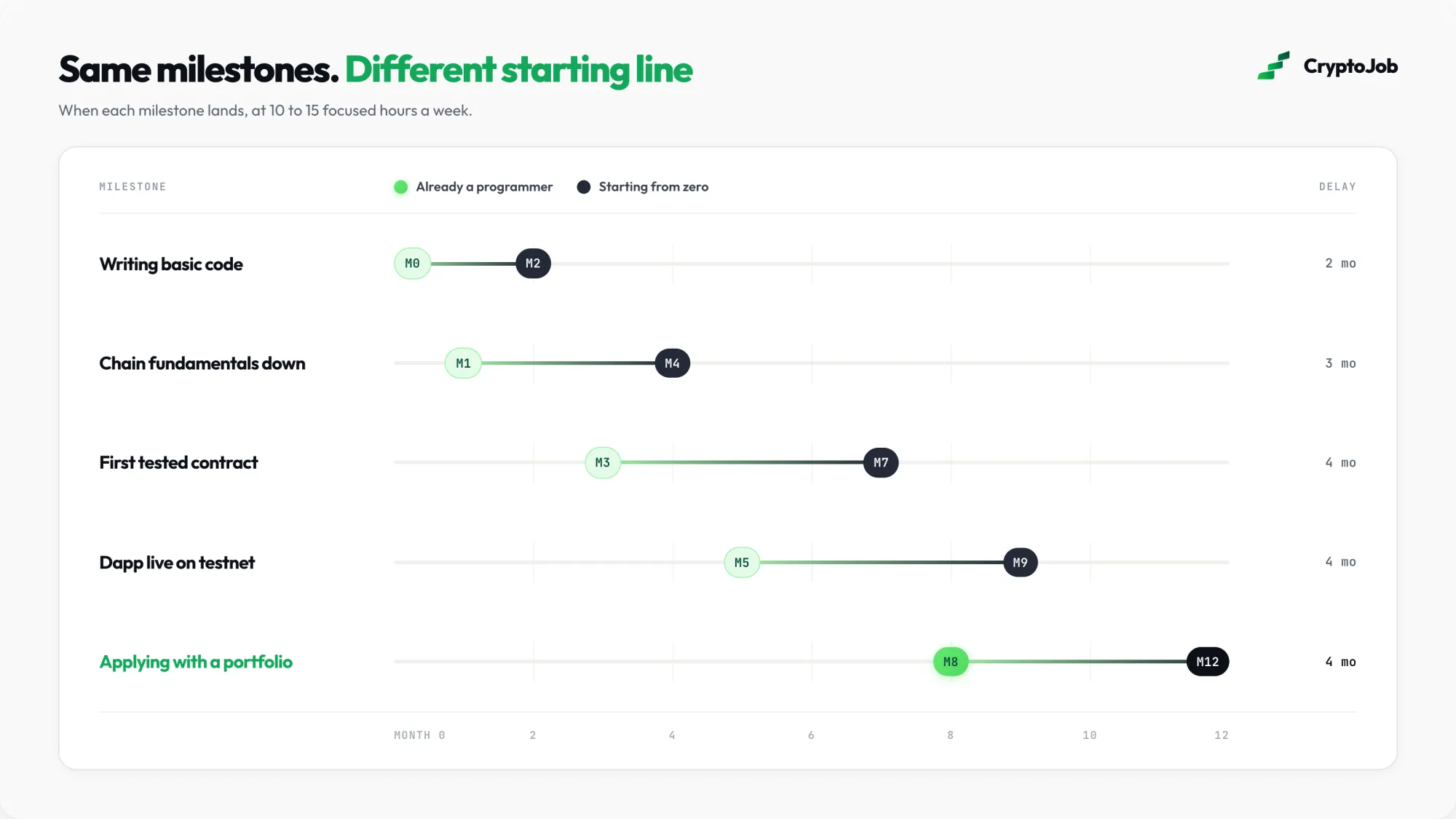
How long it takes to learn web3 depends mostly on your starting point. An experienced programmer can typically become job-ready in four to eight months of focused effort, including a deployed project. A complete beginner should plan closer to a year, since they're learning programming and blockchain at once.
The bigger variable than raw time is how quickly you produce real work. Someone who ships projects steadily will be ready far sooner than someone who accumulates course certificates without building. Consistency beats intensity, and applied practice beats passive learning.
How do you turn web3 learning into a job?
Turning web3 learning into a job comes down to converting your projects into proof and your presence into opportunities. A public GitHub, a deployed and documented project and a short write-up of something you built are the core of a strong application. Open-source contributions add credibility because maintainers and hiring managers overlap.
From there, networking accelerates everything, since much of web3 hiring happens through communities and referrals. Contribute in Discords, build in public and apply with a portfolio that shows you can ship. Our guide to getting a web3 job with no experience walks through that final step in detail.
What free resources help you learn web3?
A large part of learning web3 can be done with free, high-quality resources, which is one reason a self-taught path is so viable. Official documentation for whichever chain you choose is the single most valuable resource, since it's accurate and current in a fast-moving field. Beyond docs, interactive coding tutorials and beginner project guides teach by having you build rather than just read.
For deeper understanding, foundational writing from core developers and researchers is worth working through, especially for concepts like consensus and, if you go that route, zero-knowledge proofs. Security-focused practice platforms let you learn vulnerabilities hands-on by solving deliberately broken contracts. These are among the highest-leverage ways to build the security instincts employers screen for.
The key is to use resources as scaffolding for building, not as an end in themselves. Watching tutorials feels productive but rarely gets you hired; the moment you start applying each concept in a project of your own, your learning accelerates and you begin producing the portfolio that actually matters. Treat every free resource as a prompt to build something small and real.
What web3 learning mistakes should you avoid?
The most common web3 learning mistake is tutorial hell, endlessly consuming courses and videos without building anything of your own. Passive study feels like progress but produces no portfolio, and hiring in this field is portfolio-first. The fix is to start building early and often, even when your projects are small and imperfect.
A second mistake is spreading too thin across ecosystems and languages. Trying to learn Solidity, Rust and everything at once usually means mastering none of them. Picking one lane and going deep is far more effective, and you can always branch later once you have real depth in one stack.
The third pitfall is skipping security. Because on-chain bugs are public and irreversible, employers weight security awareness heavily and developers who ignore it tend to stall at the mid-level. Building security practice into your learning from the start: not as an afterthought, is one of the clearest ways to stand out.
Frequently asked questions
Can you learn web3 without a computer science degree?
Yes. Most blockchain developers are self-taught or come from other fields, and hiring is portfolio-first. A deployed project and open-source contributions matter far more than a formal degree.
Should you learn Solidity or Rust first?
Learn Solidity if you want the deepest, most accessible job market on Ethereum and its Layer 2s. Learn Rust if you're targeting Solana or Polkadot and want a scarcity premium. Pick based on the ecosystem you want to build in.
How long does it take to learn web3 development?
For an existing programmer, roughly four to eight months to job-ready with a deployed project. Complete beginners should plan closer to a year, since they're learning programming fundamentals alongside blockchain concepts.
Are web3 bootcamps worth it?
They can accelerate learning and provide structure, but they aren't necessary: the same skills can be learned free with discipline. Whatever route you choose, employers still want to see a deployed project and public contributions.
What's the most important thing when learning web3?
Building and deploying real projects. Passive study rarely gets you hired; a public, working project that you can explain and defend is what turns learning into a job.
The bottom line
Learning web3 in 2026 is a self-taught, build-first journey: pick Solidity or Rust, ship real projects, get security-aware and contribute to open source. Plan for four to eight months if you already code, and focus on deploying something public. When you're ready, browse web3 jobs and apply with a portfolio that proves it.