

TL;DR
- Web3 designer jobs average about $133K to $140K globally per job board data
- Senior product designers at top wallets reach $200K to $238K base
- Portfolios beat resumes, case studies on crypto UX problems convert best
- Wallets, exchanges and infrastructure firms are the steadiest employers in 2026
Web3 designer jobs pay well above general design market rates because making crypto usable is still an unsolved problem. Job board data in 2026 puts the average web3 designer around $133K to $140K per year with a range from $70K to about $245K, and Phantom recently listed a senior product designer at $200K to $238K base plus equity. This guide covers who hires, what each design specialty pays and the portfolio that actually gets interviews.
Demand concentrates where users struggle: onboarding, wallets, transaction confidence and trading interfaces. While you read, browse web3 jobs with a design filter to see which product teams are hiring this week.
The bar has risen since the NFT era. Decorative work dried up with that market, and what remains is serious product design for financial software.
What kinds of web3 designer jobs exist?
Product design is the core market: end to end flows for wallets, exchanges, DeFi apps and payment products. These roles want interaction design depth, prototyping skill and enough crypto fluency to know why a signing prompt terrifies new users.
Brand and marketing design forms the second lane. Infrastructure companies like Alchemy hire brand designers to translate technical products into clear visual communication across web and sales materials, increasingly with AI assisted workflows expected.
Two smaller lanes round it out: UX research, which is rare but growing at consumer wallets, and motion or visual design for campaigns and product moments. Pure illustration work has largely moved to freelance.
What is a realistic web3 designer salary in 2026?
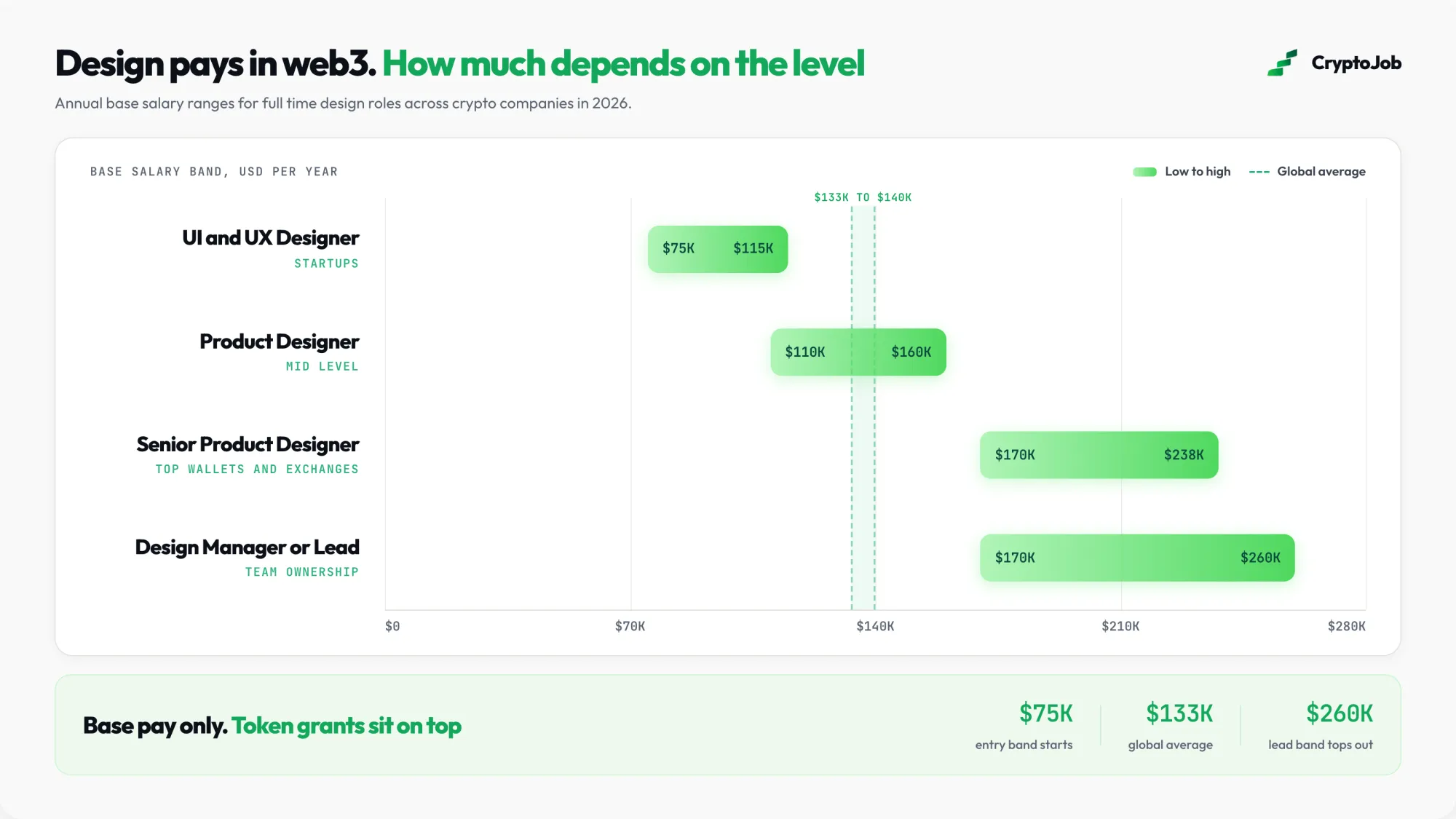
Aggregated listings on web3.career put the average at roughly $133K with a floor near $70K and a ceiling around $237K, while a sister index reads $140K average and $245K top. Treat those as global blends across seniority, since regional and junior roles pull the floor down.
The top of market is concrete. Phantom advertised $200K to $238K base for a senior product designer, and listings aggregators show ranges like $145K to $210K at Alchemy and Binance. Mid level product designers sit at roughly $110K to $160K, seniors at $170K to $238K, and design manager or lead bands run $170K to $260K before rare outliers beyond that.
Below the headline roles, expect $75K to $115K for UI and UX designers at smaller protocols and startups, often with a token package on top. Equity and tokens vary enormously, so price offers on cash first.
Which companies hire web3 designers right now?
Wallets lead the market because usability is their entire moat. Phantom, MetaMask, Rainbow and the wallet teams inside exchanges hire consumer grade product designers and pay top of market for mobile first experience.
Exchanges and trading platforms come second, with Kraken, Crypto.com, OKX and Coinbase running large product design orgs across retail and pro surfaces. Infrastructure and developer tool companies like Alchemy round out the steady employers, hiring both product and brand designers.
Protocols and DAOs hire in bursts around launches. Those roles skew contract and token weighted, which suits freelancers building a client base, and our guide to web3 freelance and contract jobs covers how to price that work.
What should a web3 design portfolio contain?
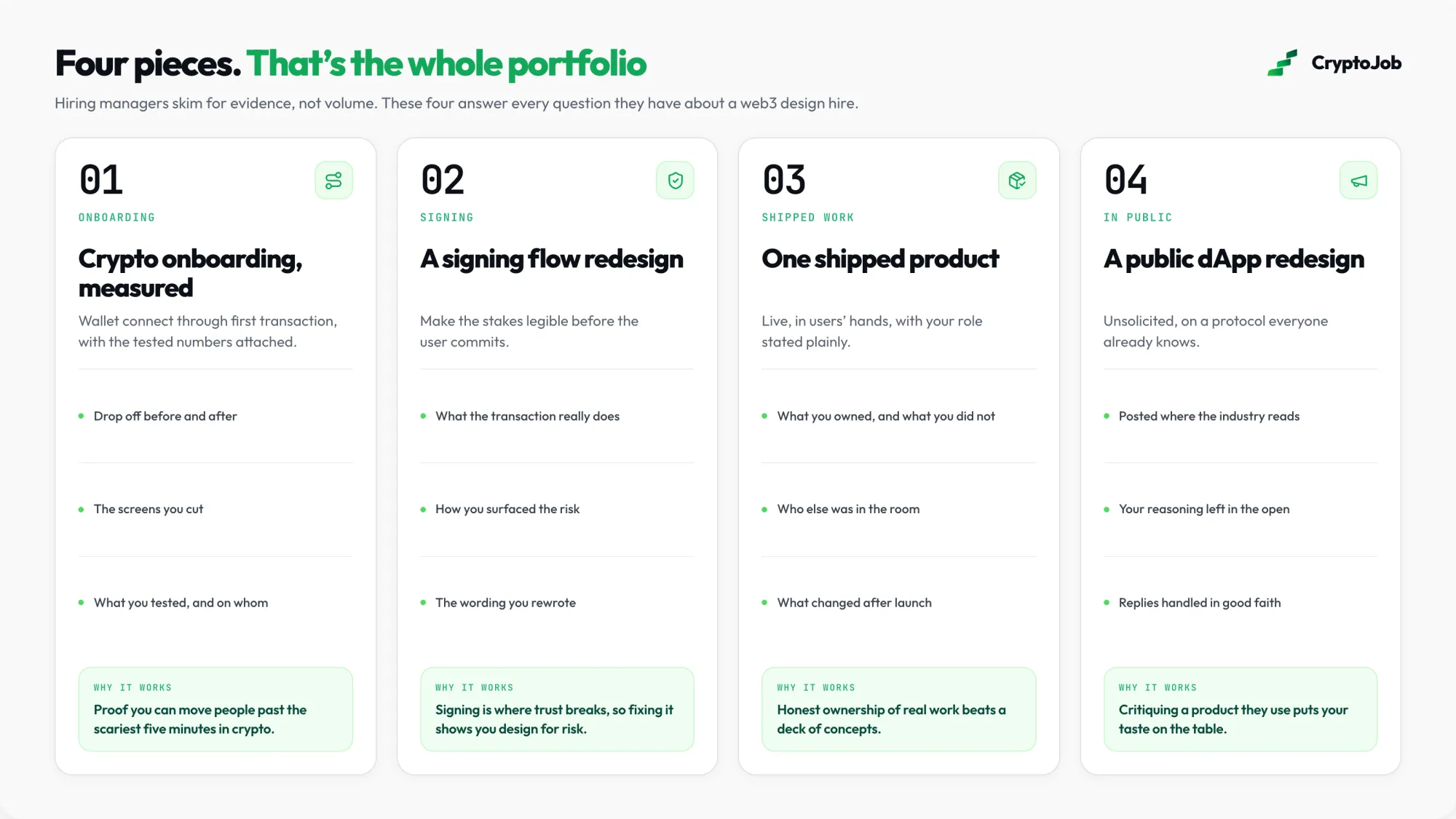
Case studies of crypto specific problems, not dribbble shots. The strongest portfolios in 2026 walk through an onboarding redesign, a signing flow that makes the stakes legible, one shipped product with your role stated plainly and a public redesign of a real dApp.
Show process over polish. Hiring managers at wallets consistently ask how you validated decisions, so include user testing notes and the tradeoffs you weighed, with metrics where you have them.
One unsolicited redesign of a well known product is the classic breakthrough piece. Pick a flow everyone agrees is painful, such as seed phrase backup or bridging, then publish your thinking where hiring managers scroll. Our piece on web3 portfolio projects shows how builders of every kind apply the same principle.
What crypto knowledge do designers actually need?
Enough to design honestly for the failure states. You should understand what a transaction, a network fee, an approval and a signature request actually do, because the core UX problem is helping users act confidently around irreversible operations.
You do not need to code contracts. Listings like Phantom's ask for a crypto native perspective gained through work or community participation, which is a bar anyone can clear in a focused month of real usage.
Use the products daily and keep notes. A designer who can articulate why bridging feels frightening or where a DEX loses beginners walks into interviews with material no bootcamp provides. Design remains one of the best paths in for people without engineering backgrounds, alongside the others in our guide to web3 jobs without coding.
How do the main design paths compare?
| Path | Typical 2026 pay | Demand level | Best proof of skill |
|---|---|---|---|
| Product design at wallets and exchanges | $110K to $238K | Strong and steady | Onboarding or signing flow case study |
| Brand and marketing design | $90K to $175K | Moderate | Systemized brand work at scale |
| Startup and protocol UI or UX | $75K to $115K plus tokens | Bursty | Shipped dApp interfaces |
| Freelance and contract | $60 to $150 per hour | Network dependent | Public redesigns and referrals |
How do you break in from web2 design?
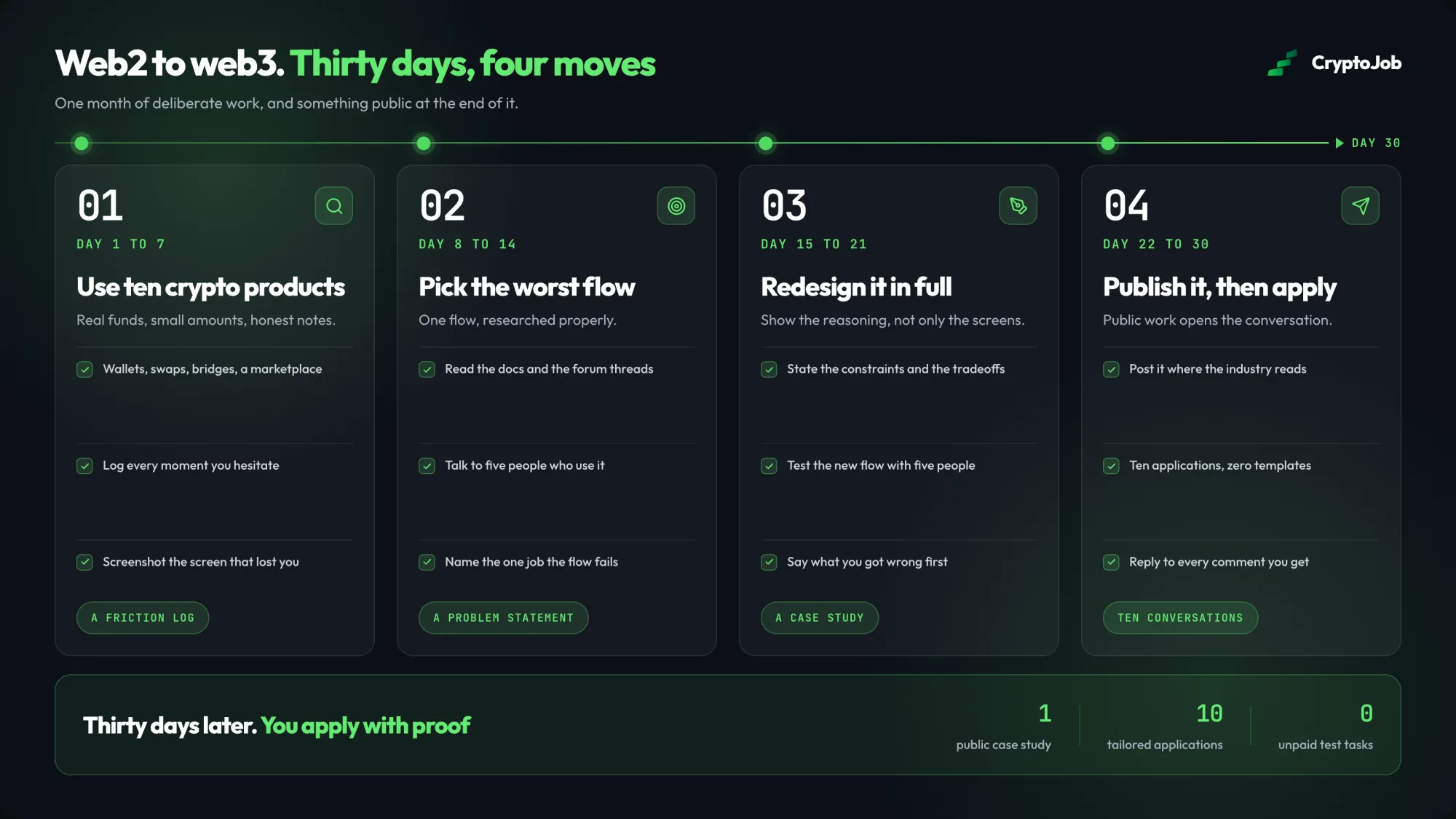
Your craft transfers completely, so the gap is domain fluency and proof. Spend thirty days using ten crypto products deliberately, journal the friction, then turn the worst experience into a full case study with proposed fixes.
Give the piece a real title and a summary paragraph so it reads like a case study rather than a complaint thread, because the framing itself demonstrates product maturity.
Ship it publicly and tag thoughtfully. Design leads at wallets and exchanges are active on X, respond to substantive UX critique and have hired directly from viral teardown posts more than once in this industry.
Then apply narrow rather than wide. Ten tailored applications referencing each product's real flows outperform a hundred generic ones, and a published case study means you never owe anyone an unpaid test task.
How do web3 design interviews actually run?
Expect four or five stages: a recruiter screen, a portfolio deep dive where you present one case study for thirty to forty minutes, a practical exercise and a team panel. Senior loops add a leadership or values conversation.
The portfolio review carries the most weight, and interviewers push on decisions rather than visuals. Why this flow, what did testing show, what did you trade away and what happened after launch are the questions that separate hires from callbacks.
Practical exercises increasingly use live product critique instead of take home mockups. You will open the company's own app and walk through what you would change, so rehearse exactly that on your target list before the loop begins.
What tools and skills belong on a web3 design resume?
Figma is assumed, prototyping in it at high fidelity is expected and motion basics help for wallet moments like confirmations and errors. Familiarity with design systems matters at exchanges, where dozens of surfaces share components.
Add the crypto literacy line explicitly. Naming the wallets you use daily, the chains you have transacted on and one protocol whose UX you have studied tells screeners you will not need a semester of onboarding.
One more differentiator worth naming: accessibility and localization. Crypto products chase global users across dozens of languages and ability levels, yet few design teams have anyone who owns that lens, so a case study touching either topic reads as senior thinking regardless of your years.
AI tooling is the newest expectation. Listings in 2026 increasingly ask designers to accelerate production with AI assistants while owning taste and judgment, so a sentence on your workflow there reads as current rather than optional.
Is web3 design a good bet for 2026?
Yes for product designers who like hard problems. The speculative art era ended, the financial software era is here and companies pay premium rates because every usability gain directly moves revenue and retention.
The market rewards specificity, so pick a surface such as wallets or payments and go deep. When your case study is ready, browse web3 jobs and start with the teams whose products you already critiqued.
FAQ
Do web3 designer jobs require coding skills?
No. Figma mastery and interaction design are the requirements, though understanding how contracts and transactions behave makes your designs far more credible.
Are web3 design roles remote?
Mostly yes. Wallets and infrastructure firms hire globally remote, while some exchanges prefer hubs, and contract work is remote by default.
How is AI affecting web3 design jobs?
Production design and asset creation are compressing, while product thinking and flow design remain human led. Listings increasingly expect designers to use AI tools to move faster rather than compete against them.
What is the fastest way to get a first web3 design client?
Publish one strong unsolicited redesign of a known crypto product and share it where that team is active. It functions as both portfolio and application, and small protocols regularly hire the author directly.