

TLDR
- Web3 freelance jobs typically pay $50 to $150 per hour for developers and $25 to $75 for non-technical roles
- Smart contract audits and Solidity work pay the most, often $100+ per hour
- Most clients pay in stablecoins like USDC
- Land 2 or 3 repeat clients before quitting your day job
Web3 freelance jobs let you earn crypto industry income without betting your whole career on a volatile market. Projects hire freelancers for smart contract development, audits, content, design and community work, usually paying in stablecoins at rates from $25 to $150+ per hour depending on the role. You can start with a few hours a week and scale up as your client base grows.
This guide covers what these roles pay, which ones are easiest to break into and where to actually find them. If you want to skip ahead, you can browse web3 jobs on CoinTerminal right now, including contract and part-time listings.
Freelancing first is the smart play in web3. Full-time roles come and go with market cycles, but a freelancer with three clients has three income streams instead of one.
What counts as a web3 freelance job?
Any paid work for a crypto or blockchain project that isn't a salaried position. That includes one-off gigs like a landing page or an audit, retainers like 20 hours a month of community management and fixed-term contracts like a 3-month protocol integration.
The clients range from two-person NFT teams to DAOs, exchanges and well-funded L2s. DAOs in particular lean on contractors because many were never structured to employ people traditionally.
How much can you earn from web3 freelance jobs?
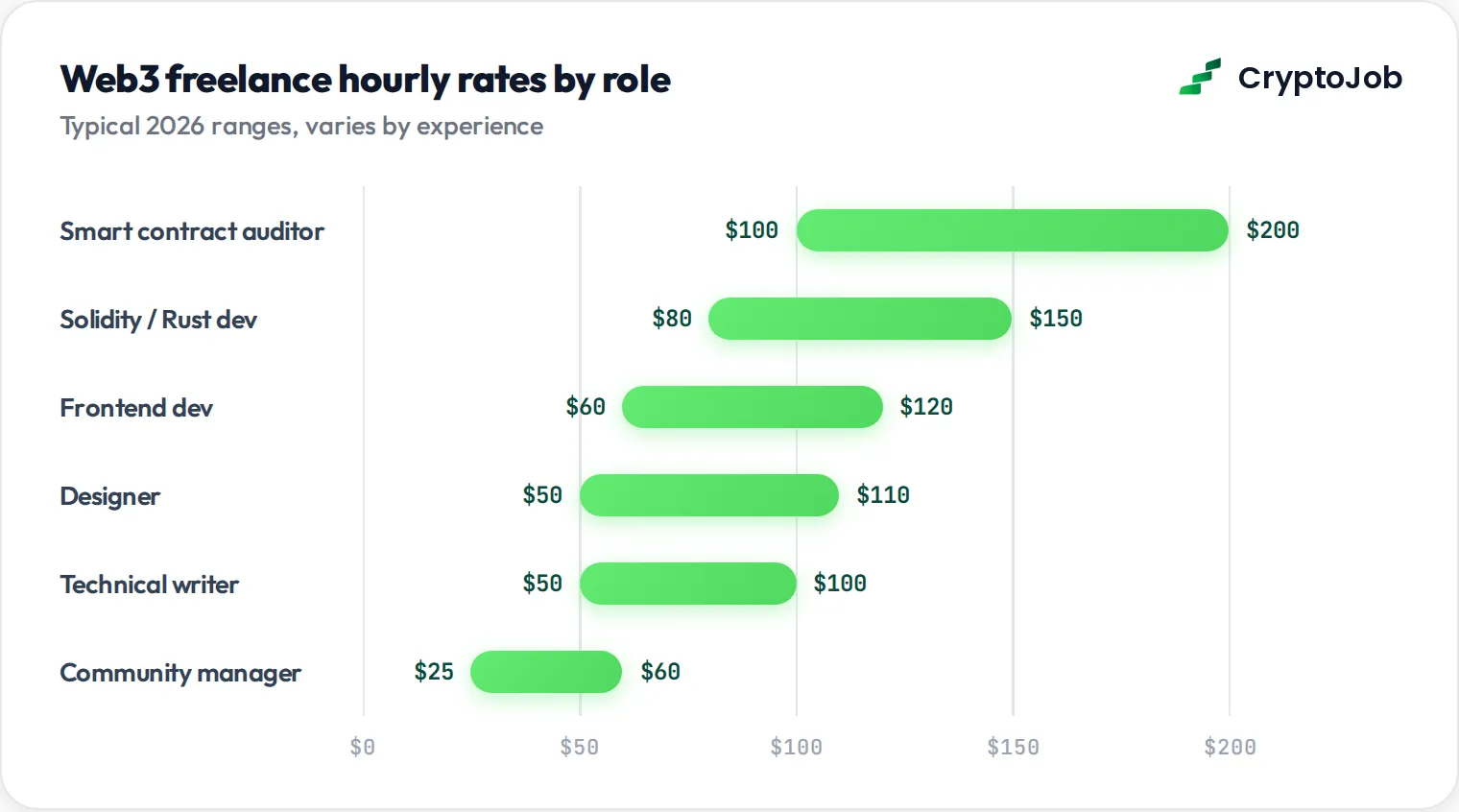
Rates vary a lot by skill, experience and how well-funded the client is, but these ranges reflect what freelancers commonly charge in 2026:
- Smart contract auditor: $100 to $200+ per hour or $5,000 to $50,000+ per audit depending on codebase size
- Solidity or Rust developer: $80 to $150 per hour
- Frontend developer (web3 dApps): $60 to $120 per hour
- Technical writer: $50 to $100 per hour or $0.15 to $0.50 per word
- Product or brand designer: $50 to $110 per hour
- Community or social manager: $25 to $60 per hour
Treat these as starting points, not guarantees. A freelancer with a public track record, shipped contracts on mainnet or a strong Twitter presence can charge well above these ranges, while beginners often start below them to win their first few reviews.
One realistic scenario: 15 billable hours a week at $75 per hour is roughly $4,500 a month. That's a serious side income before you've gone anywhere near full-time.
Which crypto freelance roles are easiest to break into?
Not everyone needs to write Solidity. These crypto freelance paths have the lowest barriers to a first paid gig:
Content and technical writing. Projects constantly need docs, blog posts, threads and tutorials. If you can explain how a bridge or a restaking protocol works in plain English, you're hireable. Publish 3 or 4 sample pieces first so clients can see your work.
Community management. Discord and Telegram moderation, ambassador programs and social scheduling. Pay is lower but the entry bar is basically "be active in crypto communities already."
Design. Landing pages, dashboards and brand kits. A portfolio of 2 or 3 mock web3 projects is usually enough to start pitching.
QA and testing. Testnet participation, bug reporting and user testing for dApps. Some protocols pay bounties for this even before you have a client relationship.
The pattern across all of them: do a small amount of the work for free in public, then point at it when you pitch.
How do you become a freelance blockchain developer?
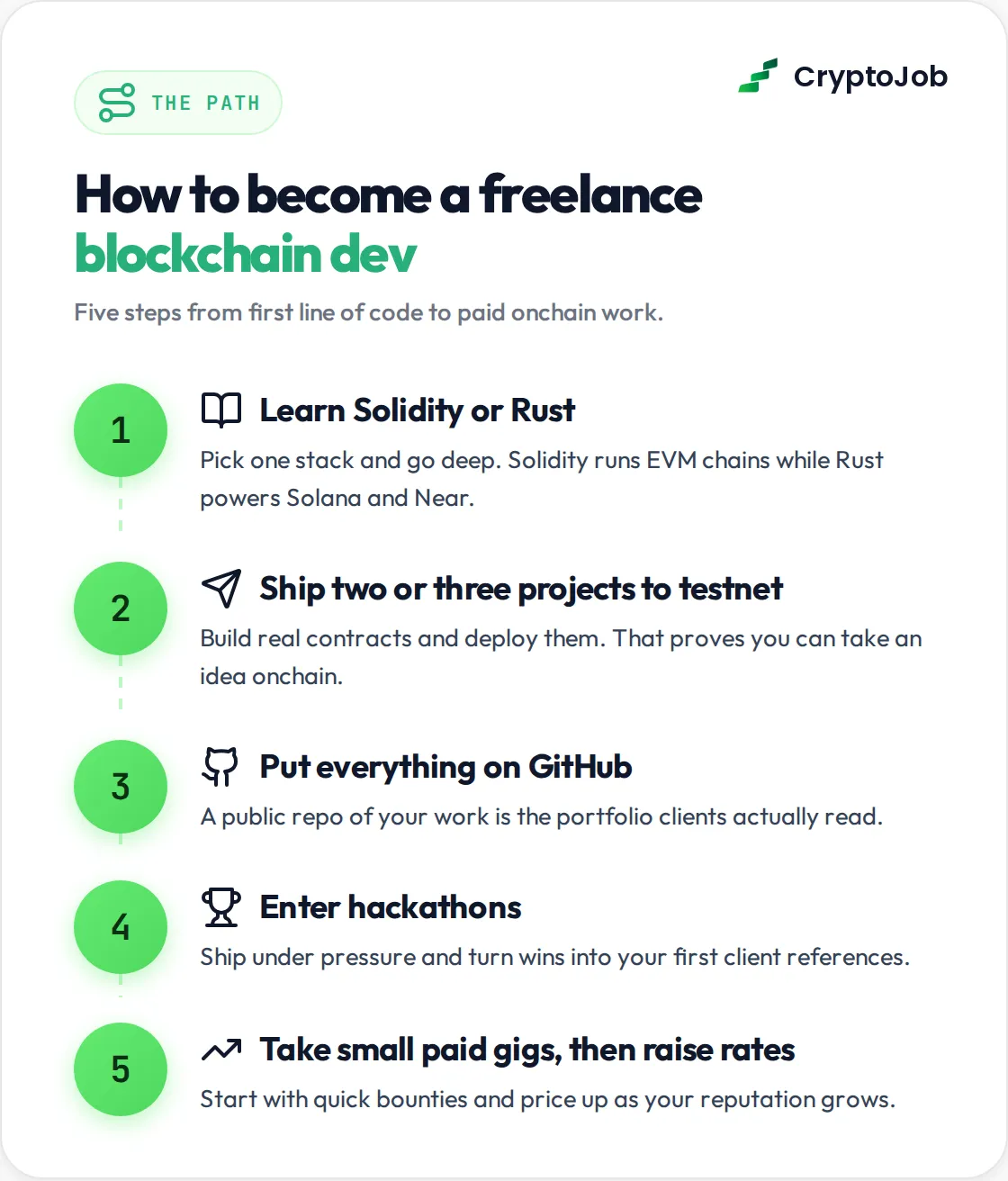
Developer roles pay the most, and demand for a good freelance blockchain developer consistently outstrips supply. Here's the path that works if you already code:
- Learn Solidity or Rust. Solidity covers Ethereum and every EVM chain. Rust opens Solana. Free resources like CryptoZombies, Cyfrin Updraft and the Solana docs are enough to start.
- Ship 2 or 3 real projects. A token, a staking contract, a small dApp with a frontend. Deploy to testnet at minimum, mainnet if you can.
- Put everything on GitHub. In web3, your repo is your CV. Clean code and readable READMEs matter more than certificates.
- Enter hackathons. ETHGlobal and similar events are the fastest route to your first client, because sponsors are literally there to find builders.
- Take small paid gigs. Bug fixes, contract reviews and integrations. Underprice slightly for your first 2 or 3 jobs to collect testimonials, then raise rates.
Most developers who follow this path land their first paid work within 3 to 6 months. It varies with how much time you put in and whether you're visible in communities where clients hang out.
Should you freelance, contract or wait for a full-time role?
Each setup trades money, stability and freedom differently:
|
|
Freelance (multiple clients) |
Fixed-term contract |
Full-time |
|
Typical pay |
Highest hourly rate |
High hourly, often 20-40% above salary equivalent |
Salary plus possible tokens |
|
Income stability |
Low at first, improves with retainers |
Stable for the contract length |
Highest, until it isn't |
|
Token upside |
Rare |
Sometimes negotiable |
Common |
|
Time to land |
Fastest, days to weeks |
Weeks |
Often 1 to 3 months of interviews |
|
Risk if market turns |
Spread across clients |
One client, fixed end date |
One employer |
|
Best for |
Building income and reputation |
Testing a team before committing |
Long-term conviction in one project |
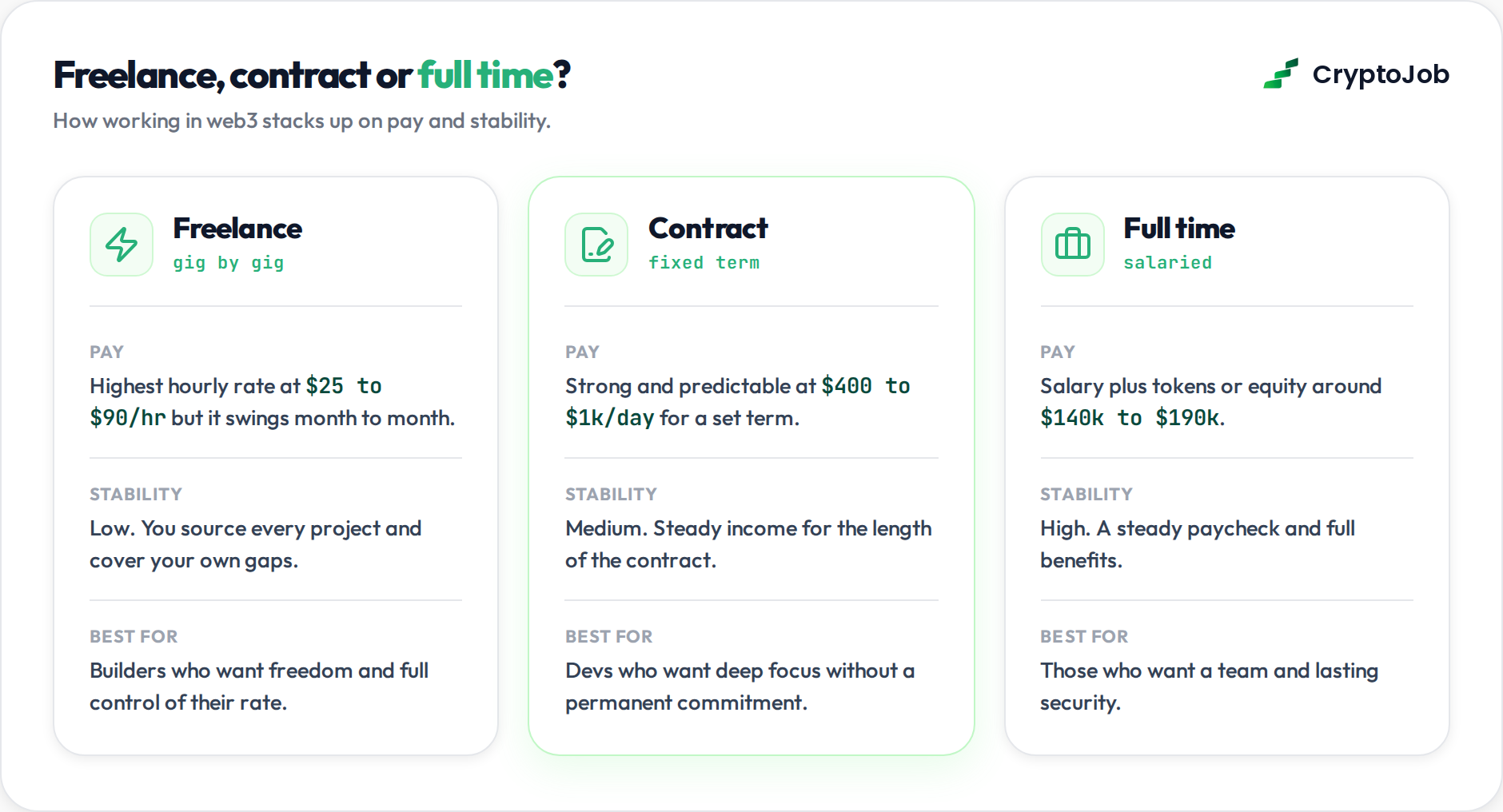
The freelance-to-contract-to-full-time pipeline is real in web3. Plenty of teams use a paid contract as an extended trial, and hiring a freelancer they already trust is far cheaper for them than a cold hire.
Where do you find web3 freelance jobs?
Job boards. Dedicated crypto boards list contract and freelance roles alongside full-time ones. Filter by contract type on CoinTerminal's careers page and set alerts for your skill.
Discord and Telegram. Most projects post gigs in their own community channels before they hit any job board. Join the communities of protocols you'd actually want to work with.
Twitter/X. Search phrases like "looking for a Solidity dev" or "hiring technical writer." Founders post openings there daily, and replying fast with a relevant portfolio link wins gigs.
Hackathons and bounty platforms. ETHGlobal, Gitcoin and audit contest platforms like Code4rena and Sherlock. Audit contests in particular let developers earn real money with zero client relationship, since payouts go to whoever finds valid bugs.
Direct outreach. Find a project with bad docs, a broken frontend or a dead blog. Send a short message naming the problem and offering a fixed-price fix. Cold pitching with a specific fix converts far better than "hire me for anything."
How do web3 freelancers get paid?
Most clients pay in stablecoins, usually USDC or USDT, sent to your wallet. Some offer part payment in their own token, which you should treat as a bonus rather than income you can budget on.
Protect yourself on every gig. For new clients, ask for 30 to 50% upfront or use milestone payments. Never start large unpaid "test tasks" and be suspicious of anyone who asks you to send funds anywhere for any reason.
On taxes: crypto payments are still taxable income in almost every country, valued at the price when you receive them. Keep a record of every payment date and amount, and talk to an accountant familiar with crypto once your income becomes meaningful.
When should you go full-time?
There's no universal number, but these signals suggest you're ready:
- Your freelance income has matched or beaten your salary for 3+ consecutive months
- You have at least 2 or 3 clients, so losing one doesn't zero your income
- You're turning down work because you're out of hours
- You have 3 to 6 months of expenses saved, in something that isn't a volatile token
Some freelancers never go independent full-time and instead convert a contract into a salaried role at a project they've grown to trust. That's a win too. The whole point of starting freelance is that you get to choose from a position of income rather than desperation.
Either way, the first step is the same: get one paying client. Browse web3 jobs on CoinTerminal, filter for contract and freelance roles and send your first pitch this week.
FAQ
Do I need to code to get web3 freelance work?
No. Writing, design, community management, marketing and QA make up a large share of freelance demand. Developers earn the highest rates, but non-technical freelancers regularly build full-time-equivalent incomes.
How long does it take to land a first web3 freelance gig?
Anywhere from a week to a few months, depending on your existing skills and visibility. People with a portfolio and an active presence in crypto communities move fastest. Small, cheap first gigs shorten the timeline a lot.
Is it safe to get paid in crypto?
It's safe if you take precautions: get partial payment upfront, invoice in stablecoins rather than volatile tokens and never send funds to a client for any reason. Requests to pay for "onboarding" or "equipment" are always scams.
Can freelancing lead to a full-time web3 job?
Yes, and it's one of the most common hiring routes in the industry. Teams frequently convert reliable contractors into full-time hires because the trust is already built.
How many hours a week do I need to start?
Many freelancers start with 5 to 10 hours a week alongside a day job. A single retainer client at that volume is enough to build reviews and raise your rates over time.