

TLDR
- Yes, is web3 a good career in 2026? For most skilled candidates, yes.
- US web3 developers average around $105k to $110k, seniors reach $200k+.
- Security, compliance and AI-blockchain skills are the hottest hires.
- Roughly 70 to 75% of roles are remote.
- Downside: volatility and heavy competition for junior roles.
Short answer: yes, web3 is a good career in 2026 if you bring real skills and can handle a market that still moves in cycles. Demand for blockchain engineers, security auditors and compliance specialists keeps outpacing supply, US developer salaries average around $105k to $110k and roughly 70 to 75% of roles are fully remote.
The catch is that "good" depends on your risk tolerance. Pay is strong and hiring has largely decoupled from token prices, but junior roles are crowded and some startups still fail fast.
This guide breaks down demand, salaries, stability and how to actually get hired. If you want to see what's live right now, browse web3 jobs on CoinTerminal while you read.
Is web3 a good career in terms of job demand?
Demand is real and growing. Blockchain-related job postings grew somewhere between 30% and 45% during 2025 depending on which tracker you look at and estimates put active global openings in the range of 8,000 to 12,000 at any given time. Major employers like Binance, Coinbase and Kraken hire continuously across engineering, compliance and operations.
Two things changed in 2025 and carried into 2026. First, hiring stopped tracking token prices. Companies now treat engineers as long-term infrastructure rather than bull-market expenses, so teams keep hiring even when altcoins bleed. Second, regulatory clarity in the US and EU let companies plan multi-year headcount instead of quarter to quarter.
The demand is not evenly spread though. The hottest hires in 2026 are:
- Smart contract and protocol engineers (Solidity, Rust, Move)
- Security auditors, driven by billions lost to exploits in 2025 alone
- Legal and compliance specialists, now among the hardest roles to fill
- AI x blockchain engineers building agents and on-chain inference
- Non-technical operators in BD, community, product and tokenomics
The flip side: competition for entry-level engineering roles is intense, with popular postings attracting hundreds of applicants. Getting in is very doable, but you need proof of work, not just a CV.
How much do web3 jobs pay in 2026?
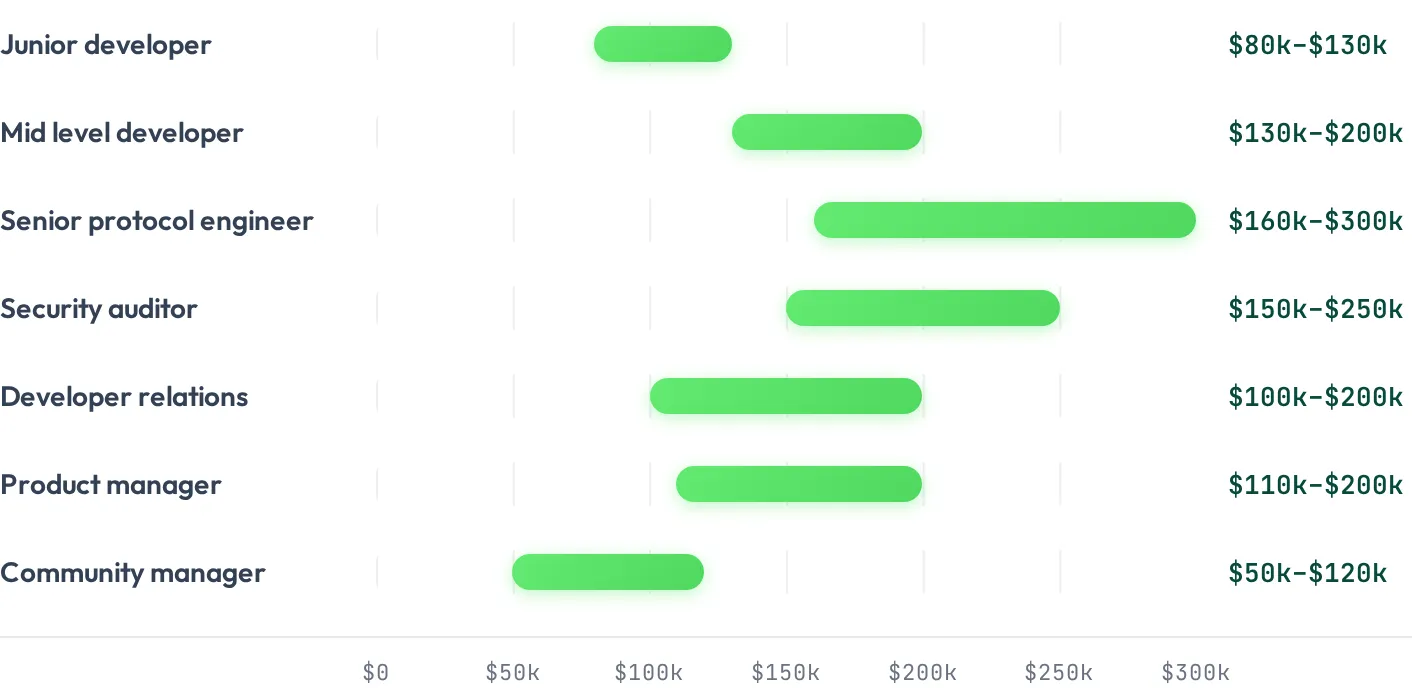
Web3 pays well, and often 10% to 30% above equivalent web2 roles at the same seniority. Exact figures vary by source, region and role, so treat these as realistic ranges rather than gospel.
For US-based web3 developers, ZipRecruiter puts the average around $110k, with most salaries falling between $84k and $135k. Global averages sit lower, around $80k to $84k, because remote hiring pulls in every market.
Here's how base salaries break down by role in 2026:
|
Role |
Typical base (US/global remote) |
Notes |
|
Junior smart contract dev |
$80k to $130k |
Solidity basics, dApp integration |
|
Mid-level blockchain dev |
$130k to $200k |
Production experience, gas optimization |
|
Senior protocol engineer |
$160k to $300k |
Consensus, L2s, ZK tech |
|
Security auditor (mid to senior) |
$150k to $250k+ |
Severe talent shortage |
|
Solidity developer (median) |
~$150k |
$100k to $250k range overall |
|
DevRel / developer advocate |
$100k to $200k |
Content plus code |
|
Web3 product manager |
$110k to $200k |
Tokenomics knowledge expected |
|
Community / DAO roles |
$50k to $120k |
Wide range, often token upside |
Then there's token compensation. Senior developers at established protocols commonly get $150k to $250k base plus token grants worth $80k to $200k vesting over four years. Total comp can run 30% to 100% above base, but token value is never guaranteed. Treat grants as upside, not salary.
One welcome shift: the era of "we'll pay you mostly in tokens" is basically over. Candidates in 2026 expect a solid fiat or stablecoin base, and companies that don't offer one lose talent fast.
What do non-technical web3 roles pay?
Non-technical hiring is actually growing faster than technical hiring in 2026 as the industry professionalizes. Marketing leads, BD managers, compliance officers and community architects are all in demand. Pay varies more here. Community roles often start around $50k to $80k, while senior BD, legal and product roles at funded companies compete with engineering salaries.
Is a web3 career worth it compared to web2?
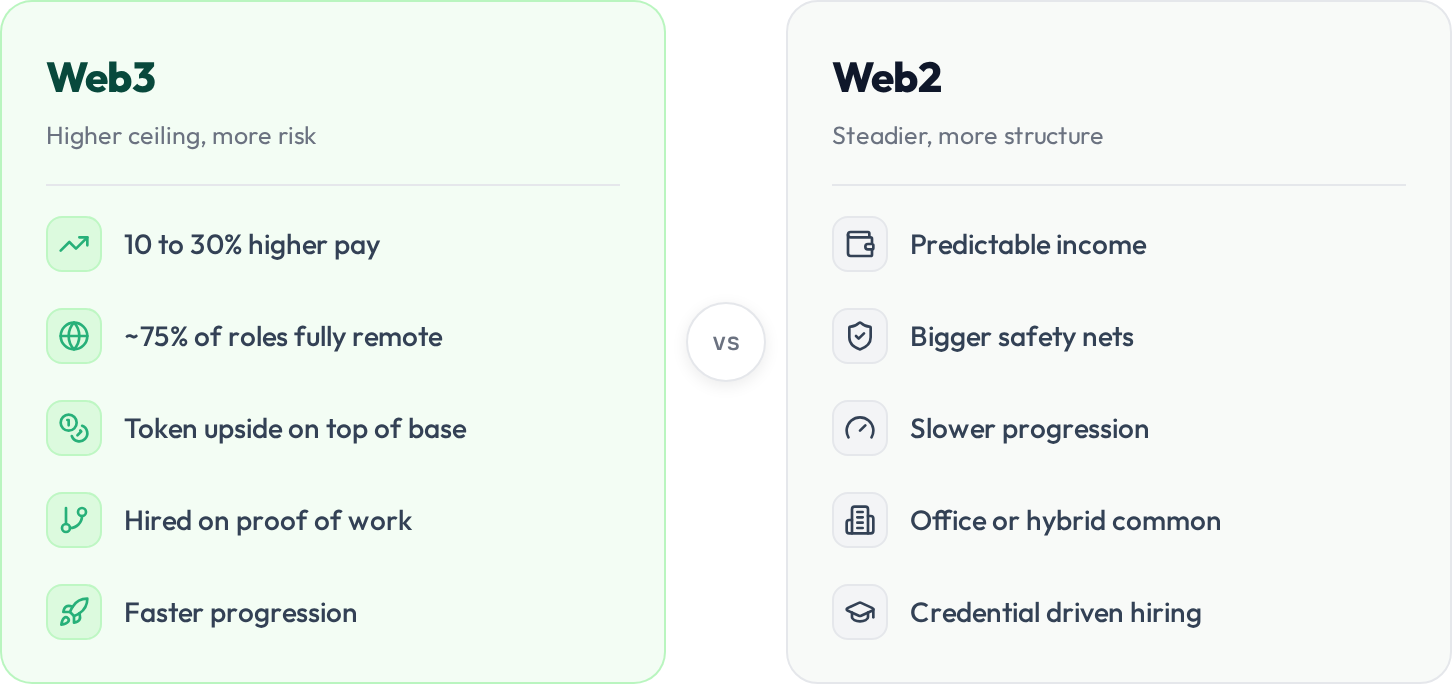
For most people with in-demand skills, yes. Here's the honest trade-off.
What you gain: higher pay at the same seniority, remote-first work as the default rather than a perk, faster career progression because teams are small, token upside if your project succeeds and hiring based on what you've shipped rather than your degree.
What you give up: predictability. Startups fail, treasuries shrink in bear markets and layoffs happen faster than in big tech. You also inherit crypto's reputation problem, which matters if you ever move back to traditional finance or big tech, though this stigma has faded a lot as institutions have entered.
The worth-it calculation looks best if you're early or mid-career, comfortable with some volatility and willing to keep learning. Skills in web3 age quickly, so the people who thrive treat continuous learning as part of the job.
If you have a mortgage and zero appetite for risk, target the most stable end of the spectrum: exchanges, infrastructure companies and well-funded protocols with real revenue, not pre-token startups.
How stable are web3 jobs in 2026?
More stable than they've ever been, but still less stable than a job at Google. Three reasons stability has genuinely improved:
Companies now hire against revenue and multi-year roadmaps instead of token launches. Regulatory frameworks in the US and EU removed a huge source of existential risk. And hiring has decoupled from token prices, so a red month on the charts no longer means a round of layoffs.
Stability still varies wildly by employer type. A rough ranking from most to least stable: established exchanges and custodians, infrastructure and tooling companies, revenue-generating protocols, VC-funded startups, then early-stage DAOs paying in tokens.
Practical rule: before accepting an offer, ask about runway, revenue and how much of your comp is fiat. Serious companies answer these questions without flinching.
What does the future of web3 jobs look like?
The future of web3 jobs points toward specialization. Generalist "crypto enthusiast" roles are disappearing while deep skill areas keep expanding:
- Zero-knowledge engineering has moved from niche to a top-five hiring requirement as ZK rollups hit production.
- AI x blockchain roles barely existed two cycles ago. Now teams hire engineers to build autonomous agents, AI-driven DAOs and on-chain inference.
- Compliance and institutional BD keep growing as banks and asset managers plug into crypto rails.
- Tokenomics and governance are becoming full-time professions rather than side tasks.
Language demand gives a useful signal: Solidity appears in roughly 40% of developer postings and Rust in about 25%, with Move rising fast on Sui and Aptos. If you're choosing what to learn in 2026, that's the map.
Will AI replace web3 developers? Unlikely. AI speeds up code generation, but security auditing, protocol architecture and incentive design still need humans and mistakes in this industry cost real money.
How do you actually break into web3 in 2026?
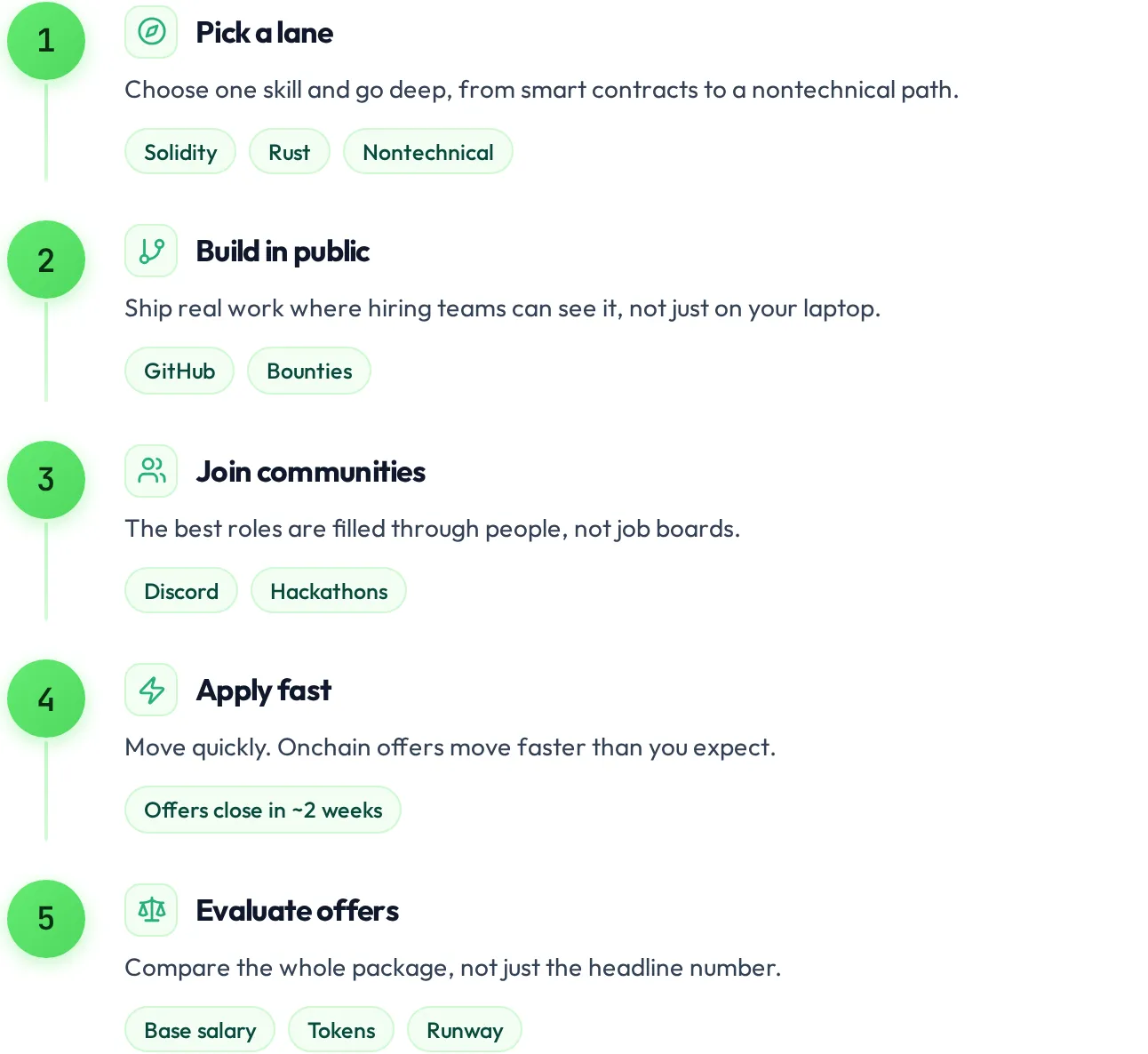
Web3 hiring rewards proof over credentials. A working plan:
- Pick a lane. Solidity plus security, Rust plus Solana or a non-technical path like BD or community.
- Build in public. Ship small dApps, contribute to open source, complete bounties on platforms like Gitcoin or Dework. Your GitHub beats your resume.
- Join communities. Discord servers, hackathons and governance forums are where referrals happen.
- Apply fast and often. Good candidates get multiple offers and are off the market within two weeks, so speed cuts both ways.
- Evaluate offers properly. Weigh base salary, token vesting, runway and benefits as separate line items.
So, is web3 a good career? The verdict
Is web3 a good career in 2026? Yes, with a caveat. The pay beats web2, remote work is standard, demand for specialized skills outstrips supply and the industry has matured past the point where one bear market wipes out hiring. The caveat is that you're trading some stability for that upside, and junior competition is fierce.
If you have or can build skills in smart contracts, security, compliance or AI-blockchain integration, 2026 is one of the best entry windows the industry has offered. Ready to test the market? Browse web3 jobs on CoinTerminal and see what companies are paying this week.
FAQ
Can I get a web3 job with no experience?
Yes, but you need proof of work instead. Build small projects, contribute to open source and complete bounties. Web3 companies hire on demonstrated skill far more than degrees or years of experience.
Do web3 jobs pay in crypto?
Most companies now pay base salary in fiat or stablecoins, with token grants on top that vest over 2 to 4 years. Fully token-based pay still exists at early DAOs but is no longer the norm.
Are non-technical web3 jobs in demand?
Yes. Compliance, BD, marketing, product and community roles are growing faster than technical roles in 2026 as the industry professionalizes. Legal and compliance specialists are among the hardest hires right now.
Is web3 a stable industry to work in?
More stable than in past cycles. Hiring has decoupled from token prices and regulation is clearer, but startups still carry more risk than big tech. Exchanges and infrastructure companies offer the most stability.
How long does it take to become job-ready in web3?
It varies. Developers with an existing programming background often become job-ready in 6 to 12 months of focused learning and building. Non-technical candidates can transition faster if their existing skills map to open roles.