

TLDR
- DAO jobs typically pay $40k to $200k+ a year depending on role, usually in USDC plus tokens
- Start with bounties worth $50 to $5,000 to build an on-chain track record
- Developers and governance leads earn the most, community roles are the easiest entry point
- You don't need a degree. Your contributions are your resume
DAO jobs are paid roles inside decentralized autonomous organizations and yes, they pay real money. Full-time contributors at established DAOs like Uniswap, Aave or Arbitrum can earn anywhere from $40k for community roles to $200k+ for senior engineering, mostly paid in stablecoins with token incentives on top. The catch is that DAOs don't hire like companies. You usually earn your way in through small contributions first.
This guide covers what DAO jobs actually look like, what they pay, how the payments work and the exact path to landing one. If you want to see live openings right now, you can browse web3 jobs on CoinTerminal while you read.
Let's get into it.
What Are DAO Jobs and Who Actually Hires?
A DAO is an internet-native organization governed by token holders instead of a CEO. There's no HR department. Work gets funded through governance proposals, grants programs and working groups that manage their own budgets from the DAO treasury.
DAO jobs fall into a few broad buckets:
- Engineering: smart contract developers, frontend devs, security reviewers
- Governance and operations: proposal writers, delegates, treasury managers, working group leads
- Community and content: community managers, moderators, writers, meme makers
- Growth: business development, partnerships, marketing
Who's hiring depends on treasury size. Large DAOs like Arbitrum, Optimism, Aave, ENS and Sky (formerly MakerDAO) fund dozens of full-time contributors through grants and service provider agreements. Mid-size protocol DAOs might fund 5 to 15 people. Smaller community DAOs mostly pay per task through bounties.
One thing worth understanding early: many "DAO jobs" are technically contracts with a service provider or working group that the DAO funds, not employment with the DAO itself. That structure affects how you get paid and how you handle taxes, which we'll cover below.
How Do You Work for a DAO With No Experience?
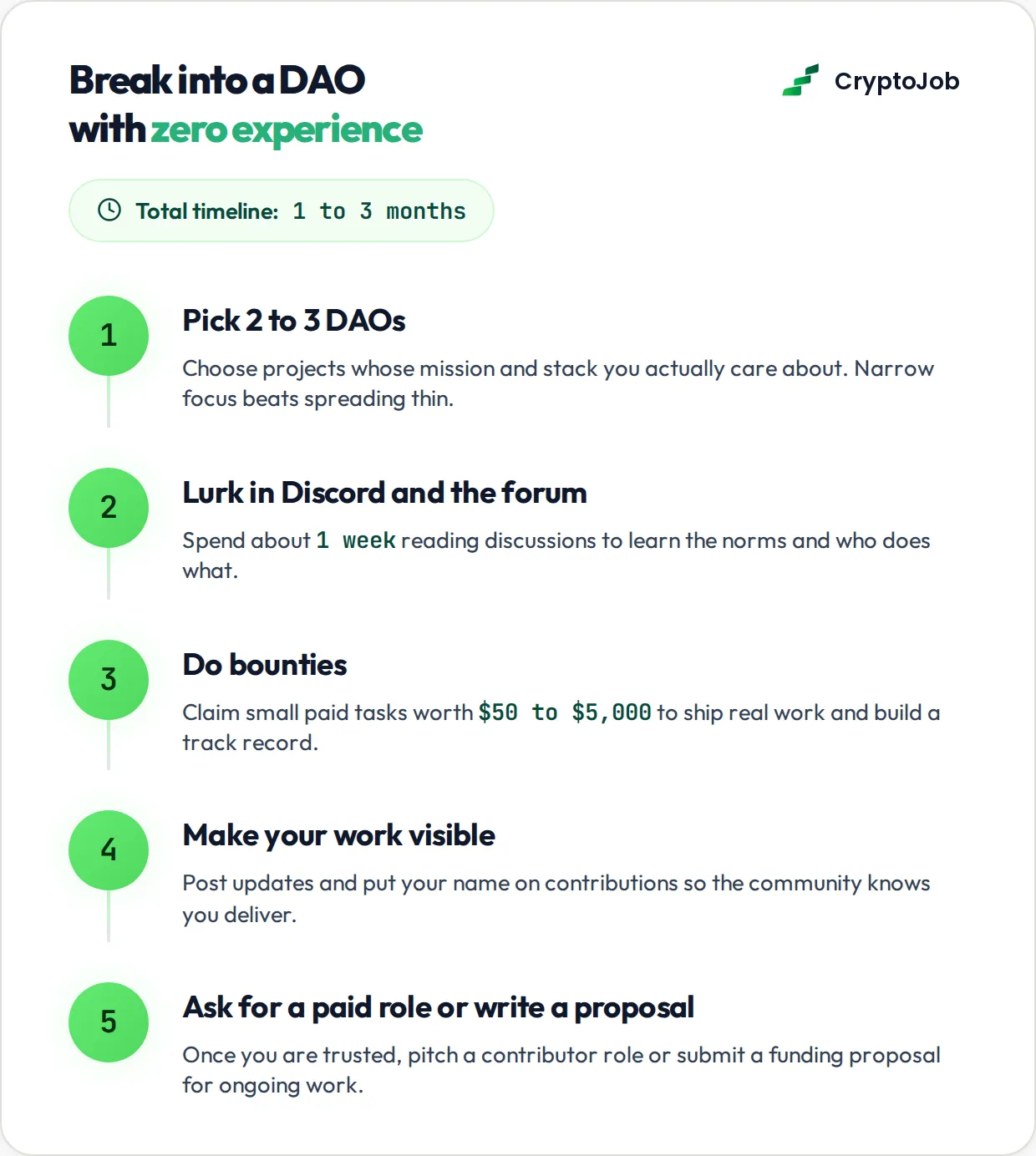
You don't apply. You show up. That's the biggest mindset shift coming from traditional job hunting, and it's also why DAO work is more accessible than it looks.
Here's the path that works for most people:
1. Pick 2 or 3 DAOs and actually use their product. Don't spray applications at 50 Discords. Choose DAOs whose protocol you genuinely use or whose mission you care about. Depth beats breadth here.
2. Join the Discord and forum, then lurk for a week. Read the governance forum (usually on Discourse or Snapshot). Learn what the DAO is debating, what's stuck and who the active contributors are.
3. Do small unpaid or bounty work. Answer questions in the support channel. Fix a typo in the docs via GitHub. Summarize a governance call. Claim a bounty on Dework or Layer3. These tasks pay anywhere from $50 to $5,000 depending on complexity.
4. Make your work visible. Post what you did in the forum. Tag the working group lead. DAOs run on reputation, and reputation only compounds if people can see your output.
5. Ask for a paid role or write a proposal. After 4 to 8 weeks of consistent contribution, most active contributors get pulled into paid work. If nobody offers, write a small proposal yourself: scope, deliverables, timeline and a budget. Start small, like $2k to $5k for a defined project.
This whole ramp typically takes 1 to 3 months of part-time effort. Faster if you're a developer, since code contributions get noticed immediately.
What Skills Do DAOs Actually Pay For?
Solidity and smart contract security top the list, no surprise. But non-technical demand is real and often less competitive.
Governance is the sleeper skill. Someone who can read a 4,000 word proposal, summarize the tradeoffs and write clearly is valuable to every DAO with an active forum. Delegate platforms and governance facilitation roles have become legitimate career paths at DAOs like Arbitrum and Optimism.
Community management, technical writing, data analytics (Dune dashboards are a proven foot in the door) and treasury operations round out the most fundable skill sets.
How Much Do DAO Jobs Pay?
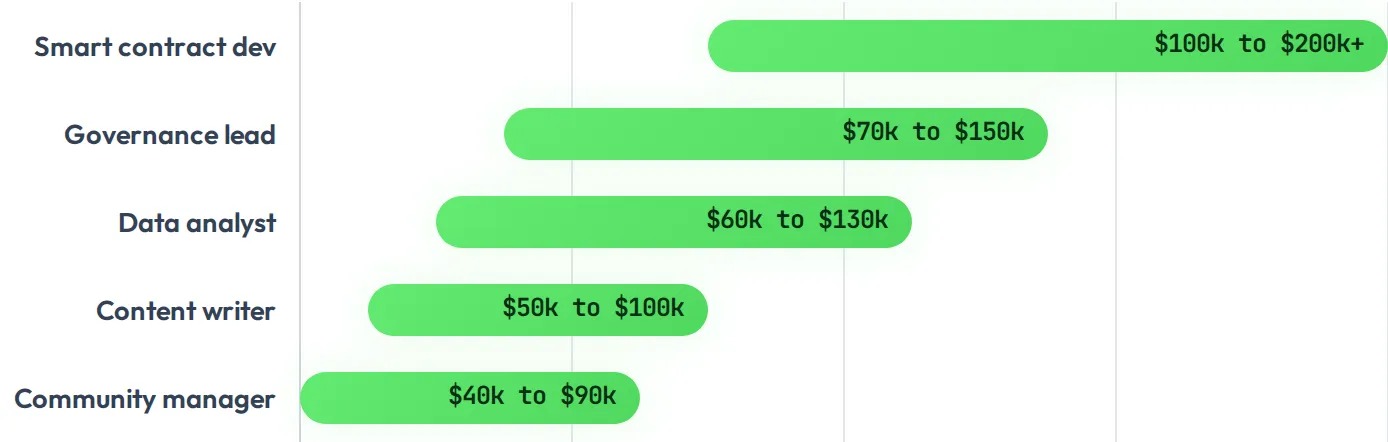
Pay varies a lot by DAO treasury size, role and whether you're full-time or per-task. These are realistic ranges based on what established DAOs have historically funded, not guarantees:
|
Role |
Typical annual range (full-time) |
Notes |
|
Smart contract developer |
$100k to $200k+ |
Often plus token vesting |
|
Governance / ops lead |
$70k to $150k |
Higher at large treasuries |
|
Community manager |
$40k to $90k |
Most common entry role |
|
Content / technical writer |
$50k to $100k |
Often starts per-piece |
|
Data analyst |
$60k to $130k |
Dune skills in demand |
|
Bounty work (any skill) |
$50 to $5,000 per task |
No commitment required |
|
Grants |
$5k to $100k+ per project |
Scoped deliverables |
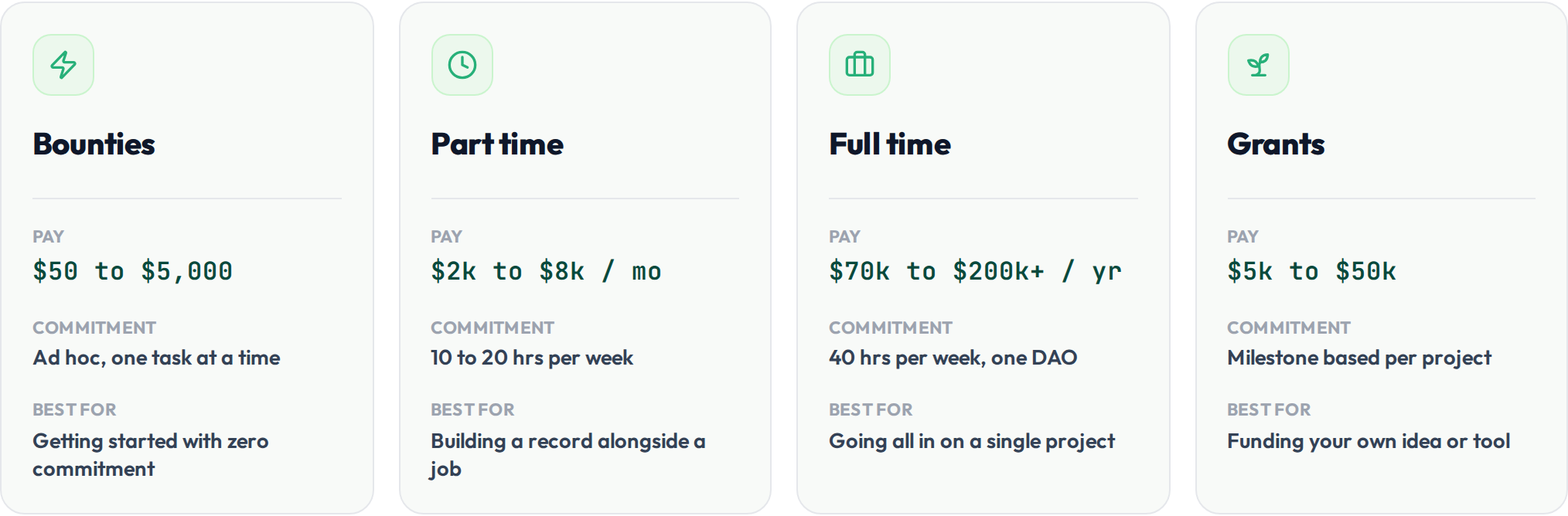
A few things skew these numbers. Large DAOs with nine-figure treasuries pay at or above market rates to compete with crypto companies. Small DAOs pay below market but often add larger token allocations. And token compensation can massively outperform or underperform the cash equivalent depending on the market.
Compensation is also unusually transparent. Most funding proposals are public on governance forums, so you can literally look up what contributors at a specific DAO earn before you pitch yourself. Use that.
How Do the Different Ways of Earning Compare?
|
Earning model |
Pay |
Commitment |
Best for |
|
Bounties |
$50 to $5,000 per task |
None, one-off |
Getting started, testing a DAO |
|
Part-time contributor |
$1k to $5k per month |
10 to 20 hrs/week |
Building reputation with income |
|
Full-time contributor |
$40k to $200k+ per year |
Full-time |
Committed career path |
|
Grants |
$5k to $100k+ per project |
Project-based |
Builders with a specific idea |
Most successful DAO careers stack these. People start with bounties, move to a part-time stream and either go full-time at one DAO or run 2 or 3 part-time roles across different DAOs.
How Do You Get Paid by a DAO?
This is where DAO work differs most from a normal job, so it's worth understanding before your first payment lands.
What you're paid in. The standard is stablecoins, usually USDC, sometimes split with the DAO's governance token. A common structure is something like 70% USDC and 30% tokens, often with vesting on the token portion. Always clarify the split and whether tokens vest before you agree to anything.
How the money moves. Payments come from the DAO treasury, typically a multisig wallet (Safe is the standard). Depending on the DAO, you'll be paid through recurring multisig payouts, streaming tools like Superfluid or Sablier that pay you by the second or peer-based systems like Coordinape where contributors allocate a budget among themselves.
The practical checklist:
- Set up a dedicated wallet for income, separate from your personal degen wallet
- Confirm the payment schedule and chain (mainnet, Arbitrum, Optimism etc)
- Record the USD value of every payment on the day you receive it
- Set aside 25% to 35% for taxes, since nothing is withheld for you
On taxes: in most jurisdictions, including the US, crypto payments for work are taxed as ordinary income at the fair market value when received and you're typically treated as self-employed. Token price movements after receipt are a separate capital gains event. This varies by country, so talk to a crypto-literate accountant once you're earning consistently.
Where Do You Find DAO Jobs?
Formal listings exist, but they're only half the picture. Use both channels:
Job boards and platforms. Start with the CoinTerminal careers board for web3 and DAO roles. Bounty and task platforms like Dework and Layer3 list paid work you can claim today without an interview.
Direct channels. Governance forums are underrated job boards. Grant program pages (Arbitrum, Optimism, Uniswap and ENS all run them) are effectively open job applications where you define the role. Discord #contribute channels surface work that never gets posted publicly.
The best opportunities usually go to people already in the room. Treat job boards as your map and the Discord as the actual door.
What Do DAO Careers Look Like Long Term?
DAO careers rarely follow a ladder. They follow reputation.
A typical progression: bounty hunter, then paid part-time contributor, then working group member, then working group lead or grants council member, then delegate or multi-DAO advisor. Each step comes from visible output, not from a promotion cycle.
Two long-term realities to plan around. First, income is less stable than employment. Funding proposals renew every 3 to 12 months and can get voted down, so experienced contributors diversify across 2 or 3 income streams. Second, your reputation is portable. Because your work history is public and on-chain, switching DAOs is far easier than switching companies and strong contributors get recruited constantly.
The people who last in DAO work treat it like a freelance business with equity upside, not like a job with a boss.
Ready to Get Started?
The playbook is simple even if the execution takes effort. Pick a few DAOs you care about, contribute something small this week, make it visible and let paid work follow the reputation. Within 1 to 3 months of consistent effort, most people land their first paid task and full-time DAO jobs follow from there.
Start by checking what's open today. Browse web3 jobs on CoinTerminal and shortlist 2 or 3 DAOs to dig into this week.
FAQ
Do DAO jobs pay in crypto or fiat?
Almost always crypto. USDC is the default, often combined with the DAO's governance token, sometimes with vesting. A few large DAOs work through legal entities that can pay fiat, but that's the exception.
Can you work for a DAO full-time?
Yes. Established DAOs fund full-time contributors through working groups, service providers and grants, with pay from roughly $40k to $200k+ depending on the role. Most full-timers earned the position through part-time contributions first.
Do you need a degree or interview to get a DAO job?
Usually neither. DAOs hire on visible contribution. Bounties, forum posts, GitHub commits and Dune dashboards function as your resume. Some larger working groups do run informal interviews for full-time roles.
How long does it take to get your first paid DAO work?
Bounties can pay you this week. A recurring paid role typically takes 1 to 3 months of consistent, visible contribution to one or two DAOs.
Are DAO jobs legal and how are they taxed?
Working for a DAO is legal in most countries, but you're generally treated as a self-employed contractor. Payments are taxed as ordinary income at their USD value when received and rules vary by country, so get advice from a crypto-literate accountant.