

TLDR
- A smart contract auditor reviews blockchain code for exploits before launch
- Full-time pay: roughly $60K to $100K junior, $200K+ senior. Sources vary widely
- Top contest auditors on Code4rena and Sherlock clear $200K+ per year
- Immunefi has paid $110M+ in bug bounties. Biggest single payout: $10M
- Realistic timeline from developer to first paid audit: 6 to 12 months
If you want one of the highest-paying technical jobs in crypto, becoming a smart contract auditor is probably it. Auditors review the code behind DeFi protocols, bridges and token contracts to catch vulnerabilities before attackers do. Full-time roles typically pay somewhere between $60K and $150K for junior to mid-level work, with senior auditors at top firms earning $200K or more. Independent auditors and bug bounty hunters can out-earn both.
This guide covers what the job actually involves, what it pays at each level and a realistic path in, even without a security background. If you'd rather skim live openings first, browse web3 jobs on CoinTerminal and come back.
One warning up front: this field pays well because it's hard. A missed bug can cost a protocol millions, so the bar is high and the interviews are brutal. The good news is that hiring is unusually meritocratic. Public proof of skill beats a resume every time.
What does a smart contract auditor actually do?
An auditor's core job is reading code with hostile intent. You take a protocol's smart contracts, usually written in Solidity or Rust and hunt for ways they can be drained, bricked or manipulated.
A typical engagement runs one to four weeks. You map the architecture, trace how value moves through the system, then attack each assumption: access controls, math, oracle inputs, external calls, upgrade paths. Findings go into a report ranked by severity, from informational nitpicks to critical bugs that could drain the treasury.
The classics you'll hunt include reentrancy, oracle manipulation, broken access control, flawed accounting and business logic errors. Tools like Slither, Foundry fuzzing and Echidna help, but the highest-value bugs are logic flaws that only a human who deeply understands the protocol will catch.
How much do smart contract auditors make?
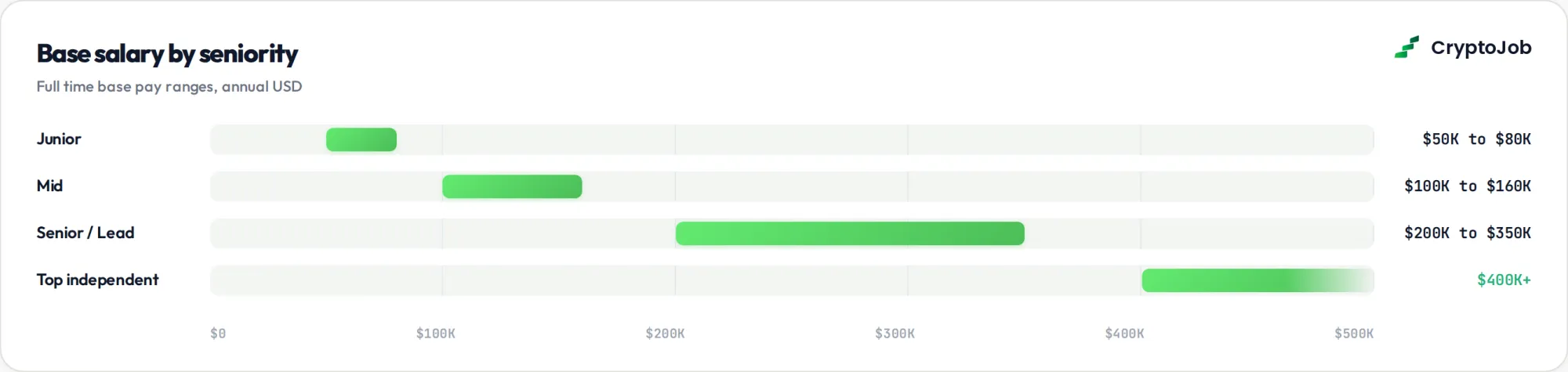
Honest answer: reported figures are all over the place, so treat every number as a range. Aggregators like ZipRecruiter and Glassdoor show US averages between roughly $40K and $75K, but those samples skew toward junior generalist roles and tiny sample sizes. Specialist salary trackers and actual web3 job postings tell a different story, with dedicated crypto job boards listing the role at $179K to $210K.
A more useful picture by seniority, based on data compiled from Cyfrin, Glassdoor and crypto job boards as of early 2026: juniors at full-time firms mostly land between $50K and $80K, mid-level auditors roughly $100K to $160K and lead or principal auditors $200K to $350K in base pay. Equity or token allocations can push senior total comp past $400K. It varies a lot by firm, region and whether you're hired locally or remotely at US rates.
Full-time salary is only one of four ways auditors get paid. Here's how the models compare:
|
Model |
Typical earnings |
Stability |
Best for |
|
Full-time at an audit firm |
$60K to $350K+ by level |
High |
Learning fast with mentorship |
|
Audit contests (Code4rena, Sherlock, Cantina) |
$0 to $200K+ per year, top-50 performers earn the most |
Low |
Building a public track record |
|
Bug bounties (Immunefi, HackenProof) |
Lumpy. $1K findings to seven-figure criticals |
Very low |
Experienced hunters |
|
Independent solo audits |
Often $10K to $50K+ per engagement |
Medium |
Auditors with reputation and clients |
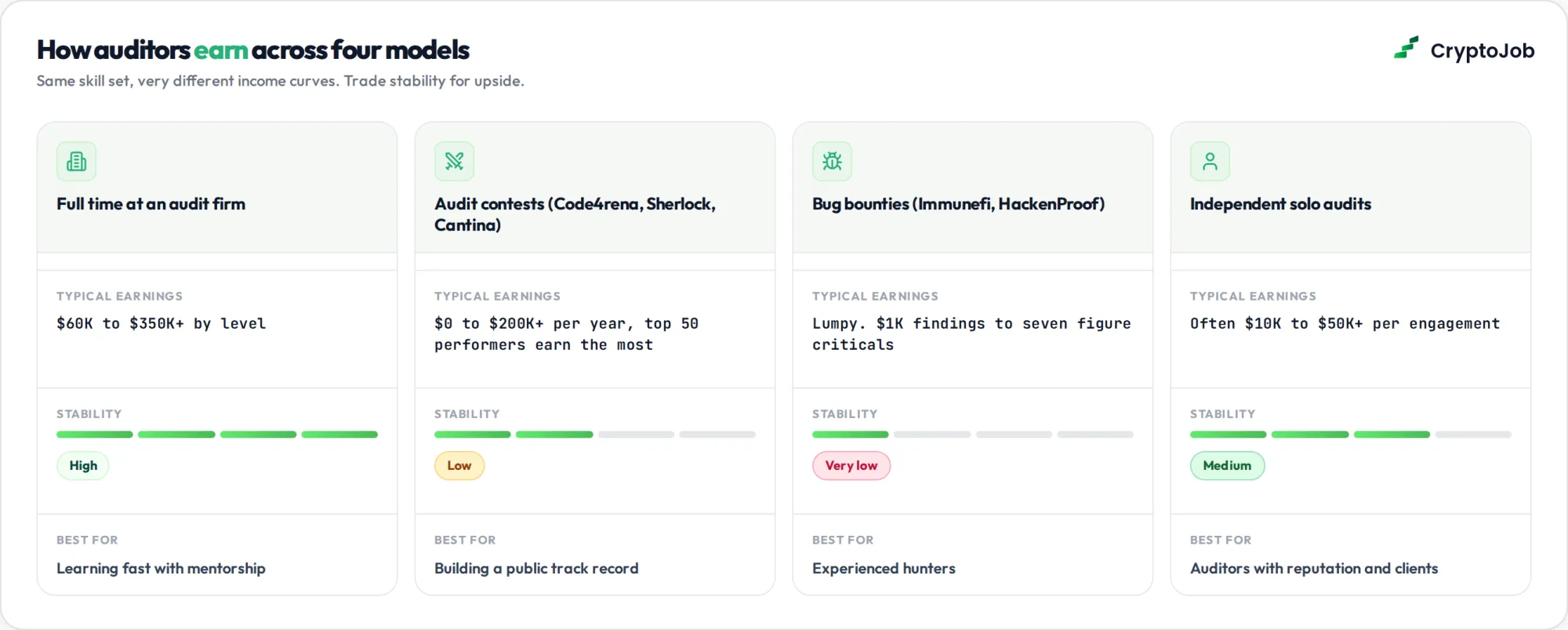
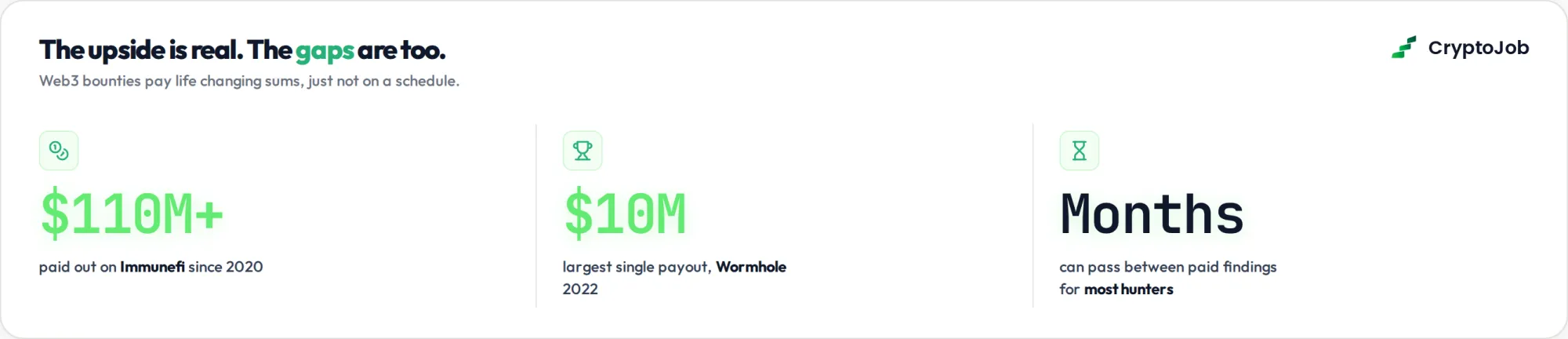
Bug bounties deserve their own caveat. Immunefi has paid out more than $110 million to security researchers since 2020, and the largest single payout on record is $10 million for a critical Wormhole vulnerability found in 2022. Those headline numbers are real but rare. Most hunters earn little or nothing for long stretches, which is why most people start with a salary or contests and treat bounties as upside.
What affects blockchain auditor salary the most?
Experience matters, but demonstrated skill matters more. A junior who finds a critical bug in a contest with a $500K prize pool can out-earn a senior who missed it, and contest payouts are identical whether you submit from Lagos or San Francisco.
Beyond seniority, the biggest salary levers are niche skills. Zero-knowledge circuit auditing (Circom, Noir, Halo2), formal verification with tools like Certora and non-EVM chains like Solana and Sui all command premiums because so few auditors can do them. A top-100 spot on the Immunefi leaderboard or a publicly credited critical finding is the strongest signal of all.
Location matters less than in normal tech because remote is the default. Remote auditors in lower-cost countries regularly negotiate close to US or EU rates at senior levels.
How do you become a smart contract auditor with no audit experience?
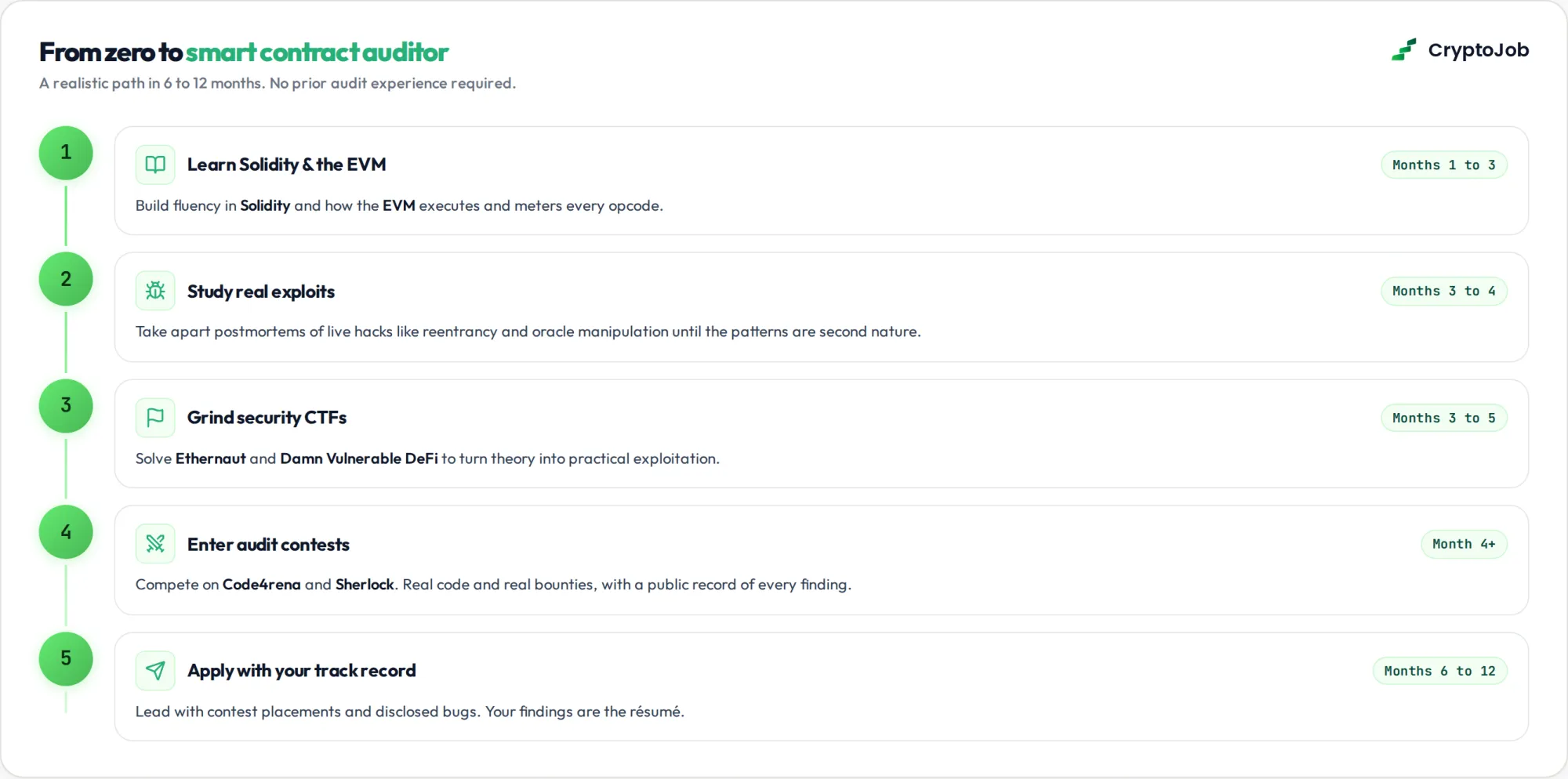
You don't need a security job first, but you do need to be a competent developer. Most working auditors were Solidity or backend engineers who cross-trained. Here's the path that actually works.
Step 1: Learn Solidity and the EVM deeply (2 to 3 months). Not tutorial-level. You need to understand storage layout, delegatecall, gas mechanics and proxy patterns, because bugs live in those details. Cyfrin Updraft and the Secureum bootcamp materials are free and widely respected.
Step 2: Study past exploits (1 to 2 months). Read post-mortems of real hacks and reproduce them locally in Foundry. Rekt.news and Solodit, a searchable database of past audit findings, are the standard resources. Pattern recognition is the whole job.
Step 3: Grind CTFs (ongoing). Ethernaut and Damn Vulnerable DeFi are the entry points. They teach you to think in exploits rather than features.
Step 4: Enter audit contests (month 4 onward). Code4rena, Sherlock and CodeHawks let anyone compete on real codebases for real money. Your first contests will be humbling. That's normal. Every valid finding becomes a public, verifiable line on your profile.
Step 5: Convert the track record (month 6 to 12). A handful of solid contest findings is enough to apply for junior roles at audit firms, or to start fellowship programs like Spearbit's or guest auditor spots. Firms recruit directly from contest leaderboards.
Total realistic timeline for a working developer: 6 to 12 months of consistent effort before first paid audit work. Faster is possible, but rare.
Where do you find web3 security jobs?
Auditing roles cluster in a few places, and most never hit LinkedIn.
Dedicated crypto job boards are the first stop. You can see current web3 security openings on CoinTerminal, filtered for audit and security roles. Audit firms like Trail of Bits, OpenZeppelin, Cyfrin, Spearbit, Zellic and Sherlock also post directly on their own sites and many hire on rolling applications rather than fixed openings.
The contest platforms double as recruiting pipelines. Strong Code4rena or Sherlock performance gets you inbound messages from firms, and protocols increasingly hire in-house security engineers straight off leaderboards. Security-focused Twitter and the Discord servers of the contest platforms are where a surprising number of offers actually start.
Protocols themselves are the fourth channel. Major DeFi teams like Aave, Uniswap and Lido employ internal security engineers and those roles often pay at or above audit firm rates with better hours.
Is smart contract auditing still worth getting into?
Yes, with eyes open. Billions are still lost to exploits every year, protocols keep launching and the supply of genuinely skilled auditors remains small. Demand for niche skills like ZK and Solana auditing is growing faster than supply.
The counterweight is that entry-level competition has intensified. Contests that once had dozens of participants now have hundreds, and AI tooling is automating the shallow findings. The people who thrive are the ones who go deep on protocol logic, not the ones scanning for textbook reentrancy.
If you're a solid developer willing to spend six months to a year building real skill in public, the risk-reward here is still among the best in software. Start with a CTF tonight, enter a contest next month and browse web3 jobs on CoinTerminal to see exactly what firms are asking for right now.
FAQ
How long does it take to become a smart contract auditor?
For a developer who already knows how to code, 6 to 12 months of focused study and contest participation is realistic before first paid work. Complete beginners should add 6 months or more to learn programming fundamentals first.
Do I need a degree or certification to get hired?
No. This field hires on demonstrated skill: contest rankings, public findings and audit reports. Certifications carry little weight compared to a Code4rena profile with valid high-severity findings.
Can smart contract auditors work remotely?
Almost all of them do. Audit firms are remote-first, contests are open globally with identical payouts everywhere and bug bounties have no location requirement at all.
What programming languages should I learn first?
Solidity is the priority since most audited value sits on EVM chains. Rust is the strongest second language, opening Solana, Sui and other non-EVM ecosystems where auditor supply is thinner and rates are higher.
Is bug bounty hunting a reliable income?
No. Payouts are lumpy and most hunters go months without a paid finding. Treat bounties as high-variance upside on top of a salary or contest income, not as a primary plan.